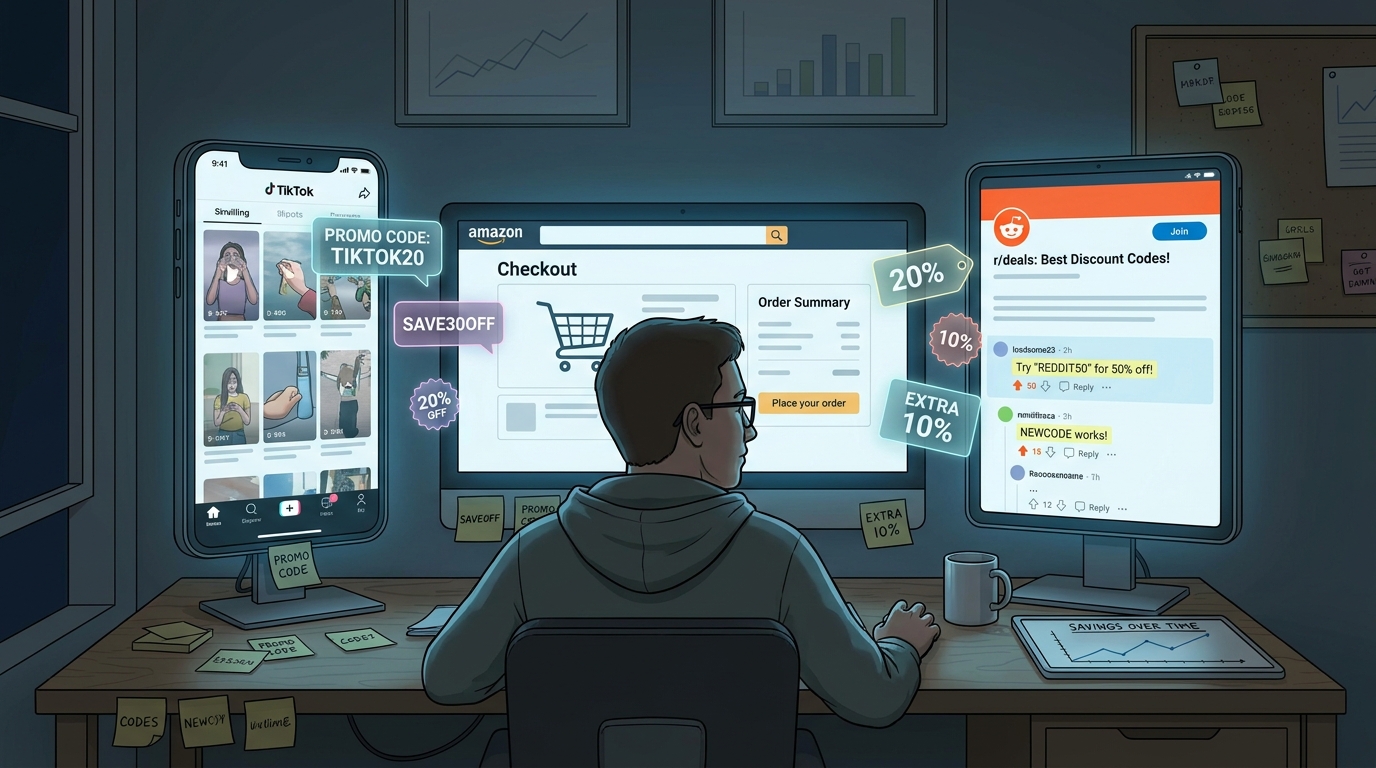
You are not imagining it. Amazon deals really do feel like a private club now. One minute a TikTok creator flashes a 40 percent off kitchen gadget, and the next minute you are staring at the same listing at full price, wondering what secret handshake you missed. That frustration is real, and it has gotten worse lately because Amazon quietly pulled back the old public promo code paths that regular shoppers used to watch. The result is a messy new system where the best discounts often show up first in creator-only channels, small Facebook groups, niche subreddits, and newsletters with about 200 readers. The good news is you do not need to become an influencer to follow those trails. You just need a better map. Here is how the creator code system works now, where those hidden Amazon influencer promo code hacks tend to appear, and how to build your own private feed without wasting hours or falling for scammy fake code tools.
⚡ In a Hurry? Key Takeaways
- The old public Amazon promo code page is no longer the best place to find deals. Many of the strongest discounts now appear first through creators and small deal communities.
- You can build your own private promo feed by following the right TikTok, Instagram, Facebook, Reddit, and newsletter sources, then checking them fast before codes expire.
- Never use “Amazon promo code generator” sites or apps. Real creator codes come from actual posts, links, and communities, not magic code tools.
Why Amazon deals suddenly feel harder to find
For years, deal hunters had a simple habit. Refresh the obvious places. Check Today’s Deals. Scan Amazon Coupons. Maybe peek at an affiliate promo page. Done.
That system is breaking down.
In the last few weeks, Amazon has pushed more discounting into private creator channels and off-Amazon sharing. That means many codes now show up in places regular shoppers rarely check. A creator posts a short TikTok. A tiny Instagram Story drops a code. A Reddit deal thread shares a limited-use coupon. A Facebook group passes it around. By the time it reaches the average shopper, it is dead.
That is why it feels like some people are shopping at a different Amazon than you are. In practice, they sort of are. They are seeing a different stream of discounts.
What the “Creator Code Cross-Over” hack actually means
This is not hacking in the shady sense. No passwords. No scripts. No weird browser tricks.
The real trick is cross-over. You stop waiting for Amazon to show you deals on its own public pages, and instead tap into the same creator channels where those promo codes are being handed out first.
Think of it like this. Influencers are often the early warning system. You do not need to be them. You just need to watch where they post.
The basic idea
Build a personal deal feed from the places creators already use:
- TikTok accounts that regularly post Amazon finds
- Instagram Stories and broadcast channels
- Facebook groups focused on Amazon bargains
- Small Reddit deal communities
- Email newsletters from niche deal curators
Once you follow the right mix, you start seeing codes before they hit mainstream deal sites, if they ever do.
Where hidden creator promo codes usually show up first
1. TikTok captions, comments, and creator link pages
TikTok is still one of the fastest places for Amazon promo codes to spread. But many shoppers miss the real code because they only watch the video.
Look in three places:
- The caption
- The top comments, especially pinned comments
- The creator’s bio link page, where they may list current Amazon deals
Sometimes the code is not shown in the video at all. The creator uses the video to bait interest, then drops the code in the caption or links to a storefront roundup.
If this sounds familiar, you may also want to read The ‘Influencer Cart Clone’ Hack: How To Hijack TikTok’s Secret Amazon Promo Codes Before They Vanish, which explains why these discounts disappear so fast and how to catch them before the price jumps back up.
2. Instagram Stories and broadcast channels
Instagram is sneaky here because Stories vanish and many deals never make it to the main grid. Creators will often post “extra 30% code in Story” because it feels more exclusive and creates urgency.
Watch for:
- Story slides with screenshots of the Amazon listing
- “DM me for code” or “code in broadcast channel” prompts
- Link stickers that go to Amazon product pages with coupon context
Broadcast channels are especially useful because they act like mini alert feeds. If a creator uses one heavily, join it.
3. Small Facebook groups
Yes, Facebook still matters for deals. A lot.
Many coupon-heavy Amazon communities have moved into private or semi-private groups because codes last longer when they are not blasted all over the public web. These groups may be run by creators, affiliate admins, or obsessive bargain hunters who repost good finds fast.
The useful groups are usually specific, not broad. Think “Amazon home deals,” “Amazon coupon finds,” or “daily clearance and promo code alerts,” not giant catch-all shopping groups full of junk.
4. Reddit deal subs and niche threads
Reddit can be gold if you avoid the noisy parts. Big subreddits are useful, but smaller deal communities often surface Amazon codes earlier because members are more active and less focused on karma farming.
Pay attention to threads where users confirm whether a code still works. That live feedback matters more than the original post.
If five people say “worked at checkout” in the last hour, that is a much better signal than a screenshot floating around on social media.
5. Tiny newsletters
This is the most overlooked source. Some of the best Amazon deal curators send short, plain-looking emails that never go viral. They are not pretty. They are not polished. They are useful.
Why? Because email lists can move codes to loyal readers without instantly burning through limited redemptions.
If you find a creator or deal curator who consistently posts real savings, subscribe. You can always make a separate “deals” email folder to keep it tidy.
How to build your own private promo code feed
This is the part that makes the whole thing practical.
Step 1. Pick 10 to 15 reliable sources, not 100 random ones
Too many people make this harder than it needs to be. They follow every loud deal account they can find, then drown in junk.
Start small:
- 3 to 5 TikTok creators who focus on Amazon finds
- 2 to 3 Instagram accounts with active Stories or broadcast channels
- 2 Facebook groups with tight moderation
- 2 Reddit communities with recent code confirmations
- 2 to 3 newsletters
Your goal is not maximum volume. It is signal.
Step 2. Look for proof, not hype
The best sources usually show one or more of these:
- The before-and-after price
- A screenshot of the code applying
- The exact coupon stack, such as on-page coupon plus promo code
- Comments from buyers saying it worked
If an account constantly posts “RUN!!!” and “OMG 90% OFF” with no proof, skip it.
Step 3. Turn on alerts selectively
You do not need notifications for everything. That gets annoying fast.
Turn alerts on only for your most reliable sources. Usually that means one or two TikTok creators, one Instagram broadcast channel, and maybe one Facebook group where moderators post clean deal alerts.
That alone can save you from missing limited-use codes.
Step 4. Check fast, but verify before buying
Creator codes often expire quickly or have redemption caps. So yes, speed matters. But do not panic buy.
Before checkout, verify:
- The seller looks legitimate
- The item has decent reviews
- The final checkout price matches the claimed deal
- The code is applying to the exact variation you want
A code on the blue version of a gadget may not work on the black one. Amazon loves that kind of tiny gotcha.
How creators are getting these codes in the first place
This part helps explain why these deals feel scattered.
Creators can receive discount opportunities through several paths:
- Amazon creator programs and campaign tools
- Seller outreach through affiliate networks
- Third-party code distribution platforms
- Direct brand partnerships
Some codes are broad and reusable. Others are single-use. Some are capped at a certain number of redemptions. Some only work during a narrow window. That is why two people can click the same creator post and get two different results depending on timing.
So no, it is not always user error. Sometimes the code is simply gone.
How to spot the best code posts quickly
Good signs
- Specific discount math, like “clip 20% coupon, then use code SAVE30”
- Actual checkout screenshots
- Time stamps or comments showing recent success
- A creator with a track record of posting working Amazon deals
Bad signs
- No product link, no seller name, no proof
- Claims that sound impossible, like “free MacBook with secret code”
- Links to “generator” tools or off-brand coupon apps
- Requests for your Amazon login
That last one should end the conversation immediately. Real deal sharing never requires your Amazon password.
The scam wave to avoid right now
Whenever Amazon changes how promo codes are distributed, scammy sites show up fast. They know shoppers are confused. They know people feel left out. That is when the fake “promo code generator” garbage starts spreading.
Here is the simple rule.
If a site claims it can generate secret Amazon codes out of thin air, it is almost certainly nonsense, a data grab, or malware bait.
Legit Amazon influencer promo code hacks are not generators. They are discovery methods. You are finding real creator-posted codes sooner, not inventing magical ones.
Never do these things
- Download a browser extension from a random coupon site
- Enter your Amazon login into a third-party tool
- Pay for access to a “private code vault” with no proof
- Trust a code image with no source link or comments
How to make this sustainable without turning it into a part-time job
This is the part most people care about. You want savings, not homework.
Use a light system:
- Create a private bookmark folder called “Amazon deal sources”
- Follow only your best sources
- Check them once in the morning and once in the evening
- Save especially good creators to a favorites list
- Use our live deal coverage to filter the chaos
That last part matters. The value is not just finding codes. It is sorting them. A good deal feed should help you answer three questions fast:
- Is the code still working?
- Is the product worth buying?
- Is this actually a strong discount or just fake retail-price theater?
When these hidden deals are most likely to appear
You will often see heavier code activity during:
- Prime-adjacent sales windows
- Month-end inventory pushes
- Seasonal shopping periods
- Product launches for cheap gadgets, home items, and beauty products
But some of the best creator codes show up on random Tuesdays. That is another reason the old “just check Today’s Deals” habit no longer cuts it.
At a Glance: Comparison
| Feature/Aspect | Details | Verdict |
|---|---|---|
| Old public Amazon deal hunting | Relied on Today’s Deals, Coupons, and public promo pages. Easy to check, but now often misses creator-only discounts. | Still useful, but no longer enough on its own. |
| Creator channel deal tracking | Uses TikTok, Instagram Stories, Facebook groups, Reddit threads, and newsletters to catch codes earlier. | Best way to find hidden promo codes before they disappear. |
| Promo code generator sites | Promise secret Amazon codes with little or no proof, often asking for clicks, downloads, or account details. | Avoid completely. High scam risk, low value. |
Conclusion
The big shift is simple. Amazon’s old public promo path is fading, and more of the real action is happening in private creator streams and off-Amazon sharing. That sounds annoying because it is. But it also means regular shoppers can still catch those deals if they stop waiting for one official page to do all the work. Build a tight feed from the right TikTok accounts, Instagram Stories, Facebook groups, Reddit deal subs, and small newsletters. Check quickly. Verify carefully. Ignore fake code generators. And when the whole thing feels scattered, lean on us to surface and sort the best working codes in real time. You do not need to become an influencer. You just need to follow the same breadcrumbs they do.