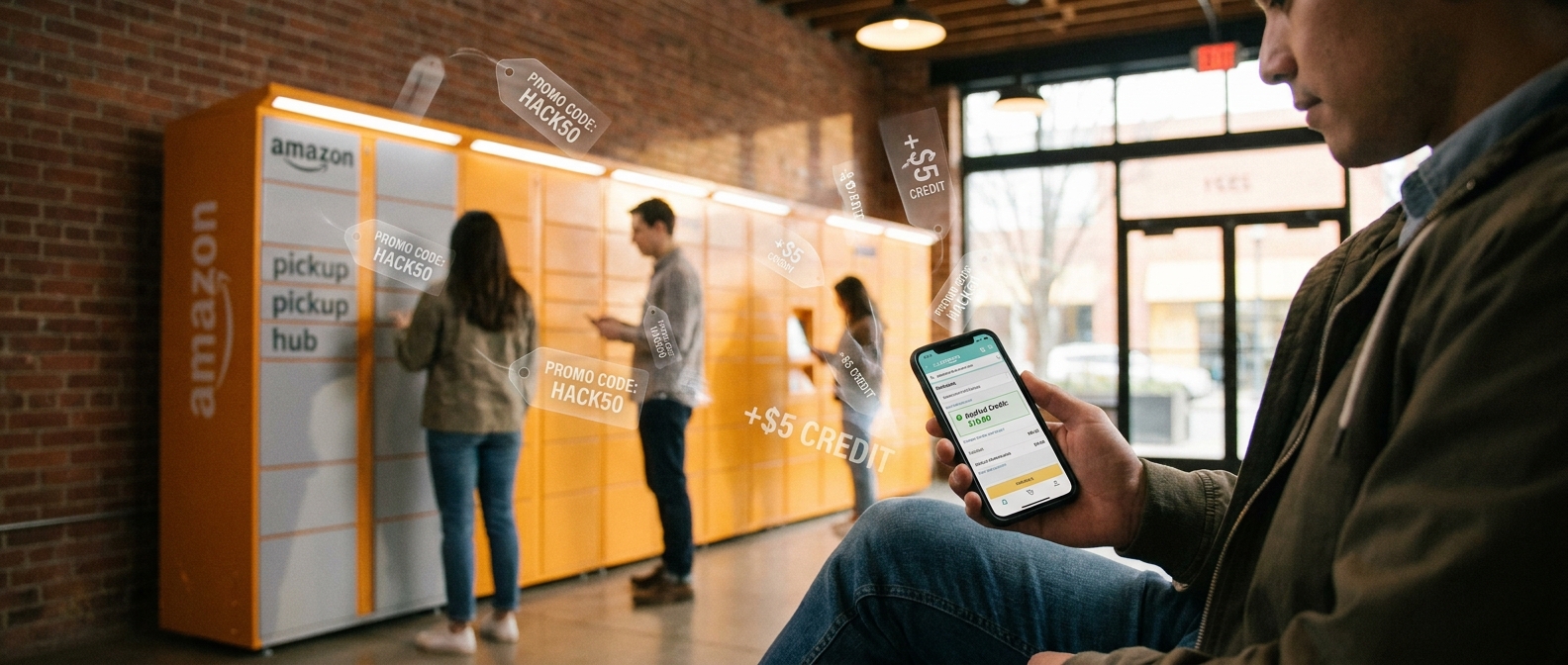
You are not imagining it. Most “Amazon promo code” lists are junk. You click through a dozen expired offers, copy random strings into checkout, and end up saving exactly nothing. That is why this Amazon locker promo code credit hack has people paying attention. It is not really a code at all. It is a checkout incentive that Amazon sometimes shows when you choose an Amazon Locker, Counter, or other pickup point instead of home delivery.
The useful part is that these offers can be real, repeatable, and surprisingly easy to miss. They often appear as a small banner, a checkbox prompt, or a note during shipping selection. If you know where to look, read the terms, and time your orders well, you can stack up a small credit and use it on something you already planned to buy. That is the difference between a gimmick and a system. Done carefully, this can act a lot like a quiet little checkout bonus that trims $5 to $10 off future Amazon purchases.
⚡ In a Hurry? Key Takeaways
- Amazon sometimes offers real credits when you choose a Locker, Counter, or pickup point instead of home delivery.
- Check the shipping step, promo banners, and account messages, then save those credits for planned purchases instead of impulse buys.
- Always read the terms. Minimum spend, item exclusions, and short expiry dates decide whether the credit is actually worth it.
What this “pickup point payoff” really is
Let’s clear up the name first. Calling it an amazon locker promo code credit hack makes it sound shady. It is not. You are not breaking anything. You are simply spotting a legitimate Amazon promotion tied to a delivery choice.
Amazon has been testing these incentives in different countries and regions for a while. The pitch is simple. If you help Amazon avoid a doorstep delivery by sending your order to a pickup location, Amazon may reward you with a checkout credit, promo credit, or a discount on a later order.
Sometimes it is $5 off a future order. Sometimes it is a smaller amount, like a few dollars or local-currency equivalent. Sometimes it only works for first-time pickup users. Other times it rotates back for existing customers.
Where these credits usually show up
This is the part most people miss. They expect a giant homepage banner. Usually, that is not where the magic happens.
1. During checkout at the shipping step
This is the most common place. When you pick a Locker or Counter instead of home delivery, Amazon may show a note saying you will receive a promotional credit after delivery, or that a discount applies if you switch delivery methods.
2. On a location-specific promo page
Some offers live on country or account-specific landing pages. These are often hard to find unless Amazon emails you directly or surfaces a small ad inside the app.
3. In app banners and account messages
Check your Amazon app homepage, your messages center, and promotional emails. If Amazon is testing pickup behavior in your area, that is often where the nudge appears.
4. At the point you add or change a pickup location
Sometimes the offer appears only when you add a new Locker or pickup point to your address book, or when you switch from a home address to a collection point for an eligible item.
The terms that matter most
This is where people lose the value. They see “Get $10 credit” and stop reading. Don’t do that.
Order minimums
A promo may require a qualifying order amount, like $25 or $50 before tax. If you spend under that number, no credit.
Eligible products
Not every item can go to a Locker. Oversized items, age-restricted products, some third-party seller items, and certain hazmat products are often excluded. The future credit you earn may also be limited to items sold by Amazon, not every marketplace listing.
Expiry windows
This is the big one. Many of these credits expire fast. Think 7, 14, or 30 days. If you do not have a plan for using the credit, it can vanish before you notice.
One per account or one per household
Some pickup promos are strictly limited. If you got one last month, trying to repeat it immediately may not work.
Auto-applied versus manual redemption
Some credits show up automatically at checkout on the next eligible order. Others sit quietly in your account and only apply when the right item mix appears. Watch the final checkout screen carefully.
How to do the “credit farming” sequence without getting sloppy
“Credit farming” sounds dramatic, but the smart version is just being organized. You are not buying random stuff to trigger random offers. You are using a sequence.
Step 1: Wait for a real pickup incentive
Do not force this. Start only when Amazon actually presents an offer tied to pickup delivery.
Step 2: Use it on a low-risk order you already need
Good candidates are toiletries, household basics, vitamins, cables, printer paper, and pantry items that fit Locker rules. Avoid oversized products and niche third-party items on your test run.
Step 3: Screenshot the terms
Take one screenshot before placing the order. Capture the credit amount, the minimum spend, and the expiry date. This saves arguments later if the credit does not post.
Step 4: Track when the credit lands
Some credits are issued when the order ships. Others only appear after pickup is completed. That timing matters.
Step 5: Spend the credit on a planned purchase
This is where people waste the deal. Do not burn a $5 credit on a novelty gadget you did not need. Keep a small Amazon list ready for things you will buy anyway.
Step 6: Check again on your next order
Promos rotate. Once you use one, keep watching the shipping step on future checkouts. Another pickup prompt may appear weeks later.
Best way to use the credit so it actually saves money
A $5 credit is only a win if it reduces spending you were going to do anyway. The best targets are practical purchases with stable pricing.
Good uses include:
- Household refills
- School or office supplies
- Phone chargers and cables
- Baby products
- Pet supplies
- Basic health and personal care items
Avoid using pickup credits on impulse items with inflated list prices. A “free” discount can disappear fast if the item itself was a bad buy.
If you want to push savings further, pair this with other legitimate methods, like card-linked shopping portals. That is where The ‘Bank Portal Loop’ Hack: How To Turn Boring Reward Malls Into Secret Amazon Promo‑Code Level Prices fits nicely. A portal rebate plus a pickup credit can beat a lot of fake coupon-code nonsense.
Common mistakes that kill the deal
Choosing an ineligible item
If the item cannot be delivered to a Locker or pickup point, the offer may disappear without much warning.
Forgetting the expiration date
This is the most common fail. People earn the credit, then remember it after it is dead.
Assuming every pickup order gets a credit
It does not. These are promos, not permanent account perks.
Using the credit on excluded categories
Some credits do not work on gift cards, digital goods, subscriptions, or certain seller types.
Treating social media screenshots as universal truth
One person’s offer in one country does not mean your account will get the same deal. Amazon tests these things constantly.
How to spot whether your account is a good candidate
You may be more likely to see these offers if you rarely use pickup locations, live near several eligible collection points, or shop in a market where Amazon is trying to reduce delivery costs.
That said, nobody outside Amazon knows the exact formula. The safe rule is simple. Check each time you place a normal order. If the offer appears, great. If not, move on.
Is this safe and legit?
Yes, if you are only using official Amazon prompts and checkout options. This is not a code generator trick. It is not a browser exploit. It is not a gift card loophole.
What you should not do is create account farms, open duplicate accounts to trigger “new user” promos, or buy stuff solely to return it after the credit posts. That is the kind of behavior that can get offers blocked.
At a Glance: Comparison
| Feature/Aspect | Details | Verdict |
|---|---|---|
| How the credit appears | Usually during checkout, in app banners, emails, or pickup-location prompts. | Real, but easy to miss. |
| Best use case | Apply earned credits to practical future purchases you already planned to make. | Worth it if you stay organized. |
| Biggest risk | Missing exclusions, minimum spend rules, or expiry windows. | Read the terms every time. |
Conclusion
The best thing about this pickup-point trick is that it is not fantasy. It is not another expired list of promo codes copied across ten coupon blogs. Amazon really does test and rotate country-specific rewards for choosing Lockers, Counters, and other pickup options, and a lot of shoppers either never notice them or waste them on random buys. If you watch where these promos show up, pay attention to the minimum spend, item limits, and expiration dates, and use a simple earn-then-spend plan, this can work like a quiet little reusable secret code. In a time when every extra dollar matters, shaving $5 to $10 off real purchases with a method you can repeat this week is a genuinely useful edge.