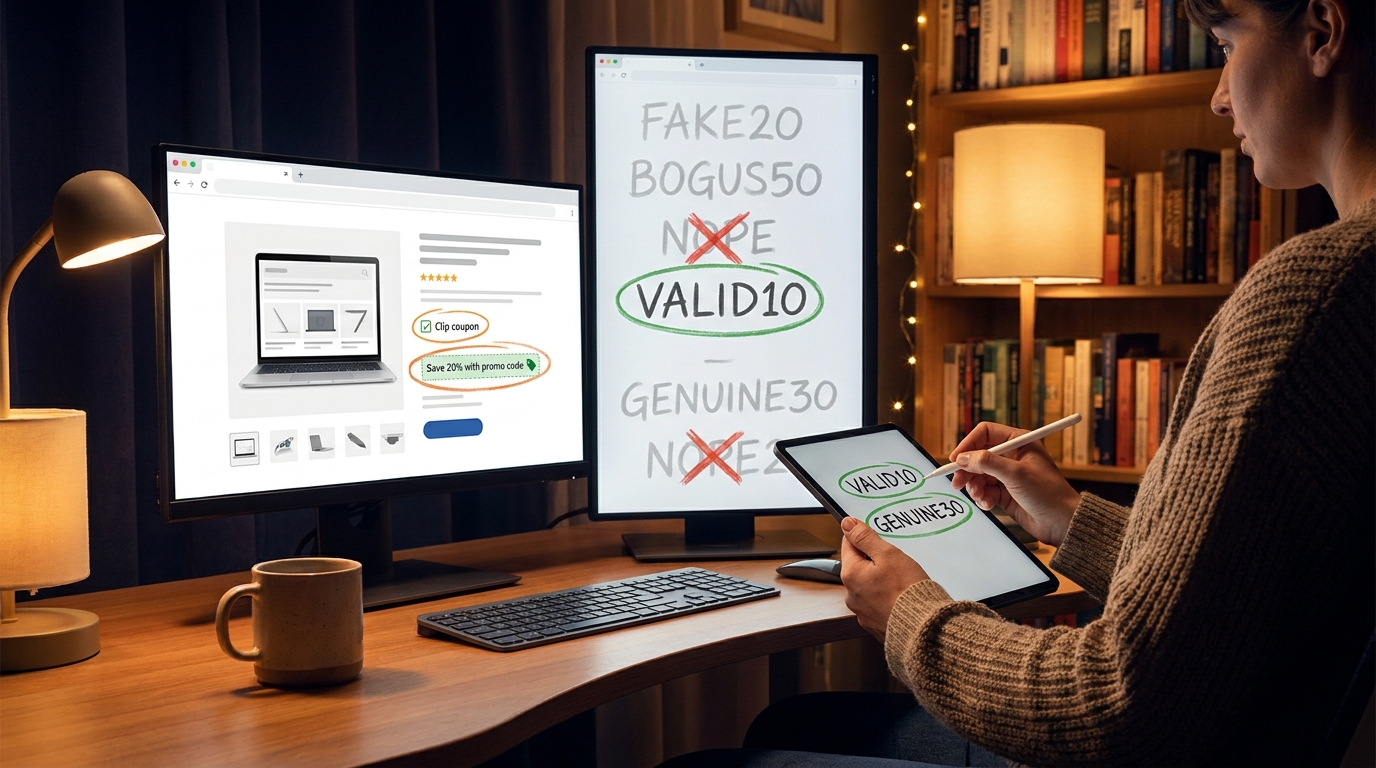
You are not crazy if Amazon promo codes feel worse than ever lately. One minute you see “50% off” on TikTok or Reddit. The next minute you are staring at checkout with an error message, a region lock, or a code that was dead three days ago. That is the real problem. Most people are not failing to save money. They are being buried under fake code noise. The good news is that there is a much faster way to sort the junk from the real deals. Think of it as a 30-second trusted-code filter. Instead of chasing mystery “sitewide” Amazon codes, you check whether the deal lives on an actual product page, has a clickable coupon, matches the seller terms, and has been tested in the last 24 hours. That simple habit changes everything. It turns random coupon hunting into a short, repeatable system that helps you find real working Amazon promo codes without wasting your evening.
⚡ In a Hurry? Key Takeaways
- The fastest way to find real working Amazon promo codes is to ignore “storewide” claims and verify deals on product pages, coupon checkboxes, and recently tested deal feeds.
- Use a 30-second filter. Check seller, click coupon box, confirm code terms, and make sure the deal was tested within the last 24 hours.
- Avoid promo generator sites and recycled social posts. They waste time and can push fake or expired offers.
Why So Many Amazon Promo Codes Fail
Amazon is not one store in the way most people think. It is a giant marketplace made up of lots of sellers, each with their own rules, budgets, regions, and promo limits. That is why a code can look real and still fail for you.
Sometimes the code is tied to one seller only. Sometimes it works only on one color or size. Sometimes the coupon budget is already gone. And sometimes the post you found was never real in the first place.
This is exactly why broad claims like “20% off everything on Amazon” should make you stop and squint. They are usually the first sign you are looking at recycled nonsense.
The Hidden Trusted-Code Filter
If you want to know how to find real working Amazon promo codes, start with this filter before you test anything.
1. Check whether the deal exists on the actual product page
A real Amazon discount usually leaves fingerprints. You may see a coupon checkbox under the price, a “redeem” style promotion, or a listed percentage off with code instructions. If the social post claims a huge discount but the product page shows nothing at all, be careful.
2. Look for seller-specific terms
This part matters a lot. Many good codes are not for all of Amazon. They are for one brand or one storefront. If you skip that detail, the code fails and it looks fake, even when it is technically real. That is why this related guide, The Hidden ‘Single‑Seller Stack’ Hack: How One Storefront Filter Turns Brand‑Only Promos Into Real Amazon Checkout Codes, is worth reading. It explains why brand-only promos often trip people up.
3. See if there is a clickable coupon to stack
Some of the best Amazon savings do not come from a code alone. They come from a code plus the little coupon box on the listing. This is where fake “50% off” posts miss the point. The real value is often a smaller but real stack, like 10% off with code plus 15% off with a page coupon.
4. Confirm it was tested recently
Timing is everything. Amazon promo budgets can disappear fast. A code that worked this morning may be dead by dinner. That is why a human-tested feed from the last 24 hours is far more useful than a random blog post that has been sitting around for a week.
5. Ignore promo generator sites completely
There is no magic Amazon code machine spinning out secret discounts for everyone. Those sites are usually bait. Best case, they waste your time. Worst case, they push sketchy redirects, spam, or fake urgency.
What the 30-Second Check Looks Like in Real Life
Here is the coffee-table version. You see a post claiming 40% off a kitchen gadget.
Before you get excited, do this:
- Open the actual Amazon product page.
- Check whether the item is sold by the same seller mentioned in the deal.
- Look for a coupon checkbox under the price.
- Read the promo instructions for item limits, Prime-only rules, or region limits.
- Use only a source that says the code was tested recently.
If two or three of those signs are missing, move on. That is the whole hack. You are not trying every code anymore. You are filtering first.
Where the Real Deals Usually Hide
The funny part is that legit savings are often less flashy than fake ones. Real Amazon promos tend to show up in a few boring but dependable places.
Product pages
This is still the best place to start. If a deal is real, the page often shows some proof. Maybe a checkbox coupon. Maybe a promo note. Maybe a discounted variation.
Amazon’s live coupon sections
These do not always have the biggest percentages, but they are real and easy to verify. They are much better than chasing mystery codes from social posts with no backup.
Verified, human-tested deal feeds
This is where Best Amazon Coupons becomes useful. Instead of pushing fantasy sitewide offers, the better approach is a trusted-code filter that favors recent testing, seller match, product-page proof, and stackable discounts when available.
What Makes Best Amazon Coupons Different
The biggest difference is simple. It treats Amazon deals like they actually work in the real world, not like some coupon fairy tale.
That means the focus is not on huge fake percentages that look good in a headline. The focus is on offers that a human can test, verify, and explain clearly. Was the code working in the last 24 hours? Is it tied to a certain seller? Is there a coupon box to clip too? Those are the details that save money.
That also saves your patience. And honestly, that may be worth as much as the discount.
Red Flags That Mean “Close the Tab”
Here are the warning signs I would tell a neighbor to watch for:
- Claims of storewide Amazon discounts with no seller or product details.
- Sites promising “generated” codes.
- Coupon pages with no recent test date.
- Social posts that show a percentage but no exact listing link.
- Codes copied word-for-word across ten different blogs.
Those are usually dead ends.
How to Save Time When Codes Burn Out Fast
On busy shopping days, promo budgets vanish quickly. That means speed matters, but smart speed matters more.
Start with items that show both a code and a page coupon
Those are often the strongest real deals.
Test newest listings first
If a deal was verified today, it has a better shot than one floating around from earlier in the week.
Do not keep hammering failed codes
If the seller does not match or the product page gives no sign of a promo, move on. You are not one refresh away from a miracle.
At a Glance: Comparison
| Feature/Aspect | Details | Verdict |
|---|---|---|
| Random social or coupon posts | Often recycled, vague, expired, or missing seller and product-page proof | Low trust |
| Product-page plus coupon checkbox | Shows visible discount signs and may allow stacking with a promo code | Best starting point |
| Human-tested deal feeds like Best Amazon Coupons | Focuses on recently working offers, seller match, and realistic deal terms | Most efficient option |
Conclusion
The trick is not finding more Amazon promo codes. It is filtering out the fake ones faster. Right now there is a surge of sketchy “Amazon promo generator” sites and recycled storewide codes on social media and even some coupon blogs. Meanwhile, the real working deals are usually sitting in quieter places, on product pages, in live coupon sections, and inside a handful of verified deal feeds. A clear, human-tested filter system from Best Amazon Coupons helps people stop chasing fantasy 20% sitewide codes and start focusing on the small group of legit, stackable offers that are actually working in the last 24 hours. That saves real time, real money, and a surprising amount of aggravation, especially on days when promo budgets burn out in hours.