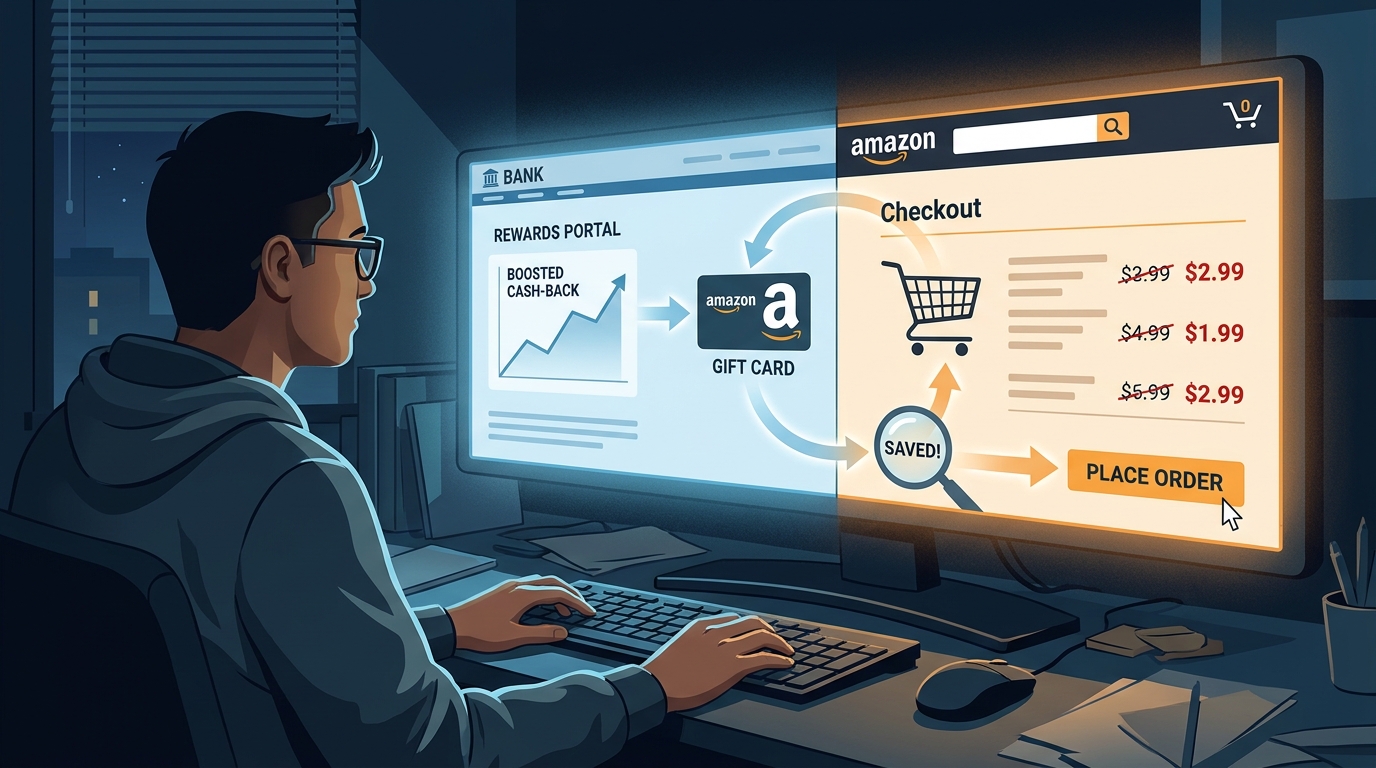
You know that feeling. You finally find an Amazon item you need, clip the little coupon, try Honey or another browser add-on, search Reddit for a working code, and still end up paying basically full price. Meanwhile, your bank or card rewards portal is sitting there like wallpaper, offering weird promos most people ignore. That is where the real trick often starts. The so-called amazon bank rewards portal hack is not a shady loophole. It is just a smarter route. Instead of hoping Amazon shows you a big public discount, you buy discounted Amazon gift cards or trigger boosted cash back through your bank, card issuer, or shopping portal first, then use that value at normal checkout. The item page never shows a magical promo code, but your final cost can drop like one was applied. It is boring on the surface. That is exactly why so many shoppers miss it.
⚡ In a Hurry? Key Takeaways
- The amazon bank rewards portal hack works by buying Amazon value through a bank, card, or cash-back portal first, then spending that balance on Amazon like a private discount.
- Check for short-window promos on Amazon gift cards, portal boosts, and card-linked offers before you shop. The order matters.
- Stay safe by using only official bank portals, major cash-back sites, and terms that clearly allow gift card purchases.
What the “bank portal loop” actually is
Let’s make this simple.
You start outside Amazon. Not on the product page. Not in a coupon extension. You check whether your bank rewards mall, your credit card offers page, or a cash-back shopping portal is paying extra on either Amazon itself or on stores that sell Amazon gift cards.
Then you buy Amazon spending power at a discount, or earn boosted rewards while doing it. After that, you load the gift card to your Amazon balance and shop as usual.
That is the loop.
The reason it feels like a secret promo code is because the savings happen before checkout, not during checkout.
Why this works better than chasing public Amazon promo codes
Public Amazon codes are usually limited, item-specific, account-specific, or dead by the time most people see them. Portal offers are different. They are often tied to your bank login, your rewards program, or a partner store promotion. That means fewer people are piling in at once.
Also, these promos move fast. A bank may offer 5 percent back at Amazon for three days. A card issuer may give a statement credit for a qualifying purchase. A rewards mall might quietly sell gift cards at a discount or with bonus points. Those are not always headline deals, but stacked together they can beat the obvious coupon blogs.
If you liked the idea of stacking hidden savings, you would probably also like The ‘Gift Card Double-Dip’ Hack: How Stacking Quiet Card Bonuses With Amazon Deals Becomes a Secret Promo Code. It covers the same basic mindset. Get the discount before Amazon ever totals your cart.
Where to look first
1. Your bank’s rewards mall or shopping portal
Many banks have a “shop with us” section buried inside online banking. It may be called rewards, shopping deals, earn more, bonus mall, or offers. Look for Amazon, gift cards, department stores, office supply stores, grocery chains, and big-box retailers.
You are looking for things like:
- Extra cash back at Amazon
- Bonus points per dollar at a store that sells Amazon gift cards
- Discounted gift cards in the rewards catalog
- Limited-time spend offers, like spend $100 and get $10 back
2. Credit card “offers” pages
American Express, Chase, Citi, Bank of America, Capital One, and others often run merchant-specific offers. Sometimes it is direct Amazon spending. Sometimes it is through places like Best Buy, Staples, Walgreens, Kroger, or other sellers that may carry Amazon gift cards.
The key point is this. A deal does not have to say “Amazon” to help you save on Amazon.
3. Cash-back portals
Rakuten, TopCashback, BeFrugal, and airline shopping portals sometimes run temporary rates that beat your bank’s offer. The winning move is to compare before buying. Some portals track on gift cards, some do not. Some track only on physical cards, some only on e-gift cards, and some exclude them entirely.
Read the terms. It is not exciting, but it is where the money is.
How to do the loop step by step
Step 1: Find the best route
Before buying anything, compare these three paths:
- Direct bonus at Amazon
- Bonus at a retailer that sells Amazon gift cards
- Discounted gift cards inside a bank or rewards catalog
Example. Let’s say your bank portal offers 8 percent cash back at an office supply store, and that store sells Amazon gift cards. That may beat a direct 3 percent offer at Amazon.
Step 2: Check the exclusions
This part saves headaches later. Look for wording such as:
- Gift cards excluded
- Only valid on in-store purchases
- Only valid on first purchase
- Maximum reward cap
- Offer valid only after activation
If gift cards are excluded, do not assume the portal will pay anyway. Sometimes people get lucky. Luck is not a plan.
Step 3: Buy only what you can use soon
Do not turn this into a garage full of digital coupons. Buy Amazon balance in amounts you are likely to use in the near term. A modest $50, $100, or $200 test is smarter than loading up just because the rate looks exciting.
Step 4: Load to your Amazon account
Once you have the gift card code, redeem it to your Amazon balance. Now your next purchase is effectively subsidized by the portal or rewards bonus you triggered earlier.
Step 5: Stack with normal Amazon deals
This is where the trick gets fun. You can still use:
- Lightning deals
- Subscribe & Save
- On-page coupons
- Warehouse deals
- Price drops
The portal loop does not replace those. It sits underneath them.
The three versions of this hack that work best
Version 1: Direct Amazon boost
Your bank or card gives extra rewards at Amazon this week only. Easy. Click through the portal or activate the offer, buy your item, and get the bonus.
This is the simplest route, but often not the best-paying one.
Version 2: Gift card route
You earn bonus rewards at another merchant, buy Amazon gift cards there, then use them on Amazon.
This is usually the sweet spot when terms allow it.
Version 3: Discounted rewards redemption
Some rewards programs let you redeem points for gift cards at a temporary discount. If a $100 Amazon gift card costs fewer points than usual, your points stretch further.
This is not cash back in the classic sense, but it still lowers your real cost.
What can go wrong
Most problems come from speed and assumptions.
Portal tracking fails
Ad blockers, private browsing, cookie blockers, or jumping between tabs can break tracking. If you are using a portal, start clean. Click through once. Finish the purchase in that session.
Gift card exclusions kill the deal
Some merchants clearly exclude gift cards. Others are vague. If the wording is muddy, assume nothing.
People forget the cap
An offer may say 10 percent back, but only on the first $50 or $100. Anything above that earns nothing extra.
You buy too much balance
Amazon balance is useful, but it is still prepaid money tied to one ecosystem. Keep it practical.
How to spot the best windows
The strongest promos tend to show up around:
- Holiday weekends
- Prime Day season
- Back-to-school shopping
- Quarter-end rewards pushes from banks
- Month-end portal competitions
That said, random Tuesday offers happen all the time. This is why the pattern matters more than any single deal. Once you know where to check, you stop relying on luck.
A simple example with real math
Say you want to buy a $200 item on Amazon.
- Your bank portal offers 6 percent back at a store that sells Amazon gift cards.
- Your credit card also earns 2 percent on that purchase.
- You buy a $200 Amazon gift card there.
You earn $12 from the portal and $4 from the card. That is $16 back on $200 spent. Your Amazon item still rings up at $200, but your effective cost is $184.
If the product also has a clipped coupon or drops in price, your real savings get even better.
Is this global, or only a US trick?
The exact portals vary by country, but the pattern is widely usable.
In many regions, banks run shopping portals, cards run merchant offers, and supermarket or electronics chains sell Amazon gift cards. The names differ. The logic does not.
If Amazon gift cards are available in your market and your bank has shopping promotions, you can test the loop locally.
Who should use this, and who should skip it
Good fit for:
- People who already shop on Amazon regularly
- Households trying to cut costs without changing what they buy
- Readers willing to spend five extra minutes comparing offers
Probably skip it if:
- You carry credit card debt and chase rewards impulsively
- You tend to overbuy just because something feels discounted
- You dislike managing gift card balances
My practical rule of thumb
If the loop saves less than 3 percent and takes more than a few minutes, I usually would not bother.
But when you see 5 percent, 10 percent, or even those occasional 15 to 20 percent style promos on gift cards or partner offers, that is where this gets interesting. Suddenly a very average Amazon price starts acting like a private sale.
At a Glance: Comparison
| Feature/Aspect | Details | Verdict |
|---|---|---|
| Direct Amazon portal bonus | Fastest option, usually easy to track, but often lower than indirect gift card routes | Best for simplicity |
| Retailer gift card route | Can produce the biggest savings if gift cards qualify for rewards and caps are generous | Best for max value |
| Discounted rewards redemptions | Useful when points buy more Amazon value than normal, but deals can be rare | Best for points users |
Conclusion
The nice thing about this trick is that it does not depend on a viral coupon code surviving long enough for you to use it. Right now, deal subreddits and coupon blogs are obsessed with whatever public Amazon code is floating around, but almost none of them walk through how banks, card issuers, and cash-back portals are running their own mini Prime Days behind the scenes. Those extra 5 to 20 percent back on gift cards, or bonus cash back at Amazon this week only promos, are live today and changing daily. Most shoppers either miss them or use them once and forget the pattern. If you remember nothing else, remember this. Check the portal first, compare the route, then send that value back into your normal Amazon checkout. Done right, the amazon bank rewards portal hack makes ordinary prices act like secret promo-code prices, and that is a pretty useful move when July budgets are tight.