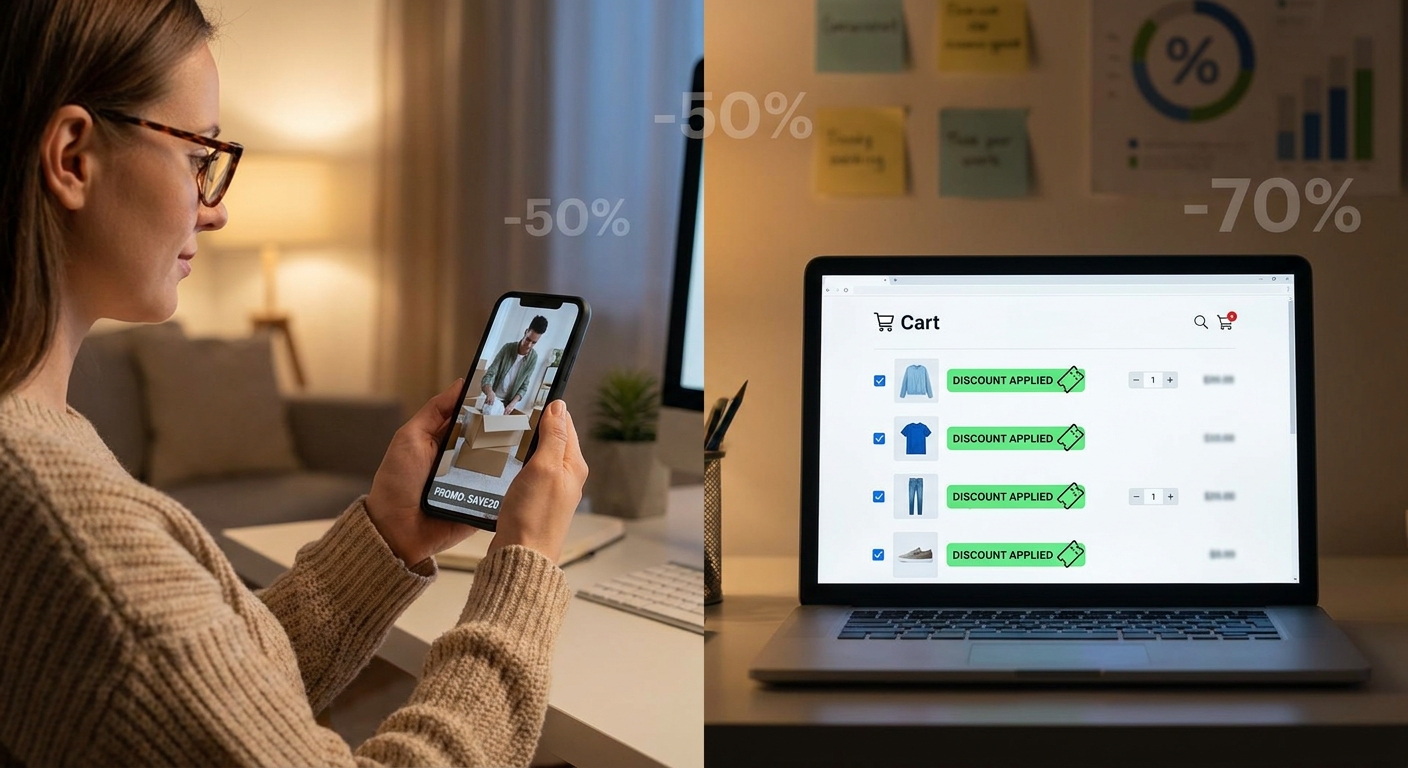
You are not crazy. You see a TikTok creator show a $49 gadget dropping to $17 on Amazon, you tap the link 10 minutes later, and suddenly the coupon is gone, the code says invalid, or the price has jumped back up. It feels rigged because, in a way, it sort of is. Many of these deals are real, but they are built for speed. Creators often post low-visibility promo codes in captions, Stories, Lives, storefront pages, or bio links, then swap them out once stock starts moving. That leaves regular shoppers staring at expired discounts and wondering what they missed. The good news is you do not need to camp on TikTok all day to keep up. The smart move is what I call the Amazon influencer promo code hack: cloning the creator’s cart setup fast, checking the exact seller and coupon stack, and skipping the junky code-generator sites that waste your time.
⚡ In a Hurry? Key Takeaways
- The best Amazon influencer promo code hack is not finding “secret” codes. It is catching live creator links and copying the exact product, seller, coupon, and checkout combo before it changes.
- Save creator storefronts, turn on post alerts, and always screenshot the item page, coupon box, and promo code details before you try to check out.
- Avoid “Amazon code generator” sites and random coupon blogs recycling dead codes. They are usually late, misleading, or trying to farm clicks.
Why these creator Amazon deals disappear so fast
Short answer. They are often meant to.
Influencers are working with a mix of public coupons, seller promo codes, affiliate links, and short-run discounts that may only apply to one variation of a product or one third-party seller. Sometimes the code is limited by quantity. Sometimes it is limited by time. Sometimes the creator quietly edits the caption when the deal dies and replaces it with a new one.
That is why the deal you saw at lunch is gone by your coffee break.
This is also why normal coupon sites struggle to keep up. By the time a deal gets copied, indexed, reposted, and wrapped in a giant “secret savings” headline, the code is often already toast. If you have been burned by that loop before, you might also like The ‘Newsletter Bait-and-Switch’ Hack: How Off-Amazon Email Deals Turn Into Real Secret Promo-Code Savings, which covers another place where the real deals often show up before the public finds them.
What the “Influencer Cart Clone” hack actually means
It sounds sneaky, but it is really just smart shopping.
Instead of hunting for a code in isolation, you copy the creator’s full setup as closely as possible. That means:
- The exact Amazon listing
- The exact seller on that listing
- The exact product size, color, or bundle
- Any clickable on-page coupon
- Any promo code shown in the caption, comments, Story, or bio link
- The timing, because some deals end almost immediately
Most failures happen because shoppers only copy the code, not the whole cart recipe.
How to do the Amazon influencer promo code hack step by step
1. Start with the creator’s freshest post, not a repost account
Deal aggregator accounts are useful, but they are usually slower than the original creator. Go to the creator’s own TikTok, Instagram, or Amazon storefront first. Look for the most recent version of the deal.
If the creator posted “link in bio,” tap that before doing a search yourself. A plain Amazon search may show a similar product from a different seller, which can break the deal.
2. Check whether the discount is a stack
Many of the wildest deals are not one code. They are a stack.
For example:
- Sale price on the product page
- Clickable coupon box like “Save 20%”
- Promo code at checkout like “LAMP40”
Miss one step and the math falls apart.
3. Match the seller exactly
This is the part most people skip.
On Amazon, one product page can have multiple sellers. The code may only work for one of them. If the creator’s screenshot shows “Sold by BrightHome Deals” and your cart switches to another seller, your code may fail even though the product looks identical.
Always check the “Sold by” line before checkout.
4. Match the variation exactly
That 50% off code may work only on the beige two-pack, not the black single unit. Amazon is full of tiny variation traps like that.
If the creator says “click the gray one” or “choose the 3-pack,” believe them. It sounds silly, but it matters.
5. Screenshot everything before you test the code
Take quick screenshots of:
- The product page price
- The selected variation
- The seller name
- The clipped coupon
- The promo code from the post or Story
Why? Because creator posts get edited. Links get swapped. Coupons vanish. A screenshot gives you a record of what you were trying to copy.
6. Add to cart immediately, then test at checkout
Some discounts only show up in the final checkout screen. So do not assume the deal failed if you do not see the full discount in the cart yet.
Add the item fast. Then go to checkout and paste the code there.
7. If it fails, test the likely break points
Do not waste 20 minutes randomly retrying. Check these in order:
- Did the seller change?
- Did you miss the coupon checkbox?
- Did you pick the wrong color, size, or pack count?
- Did the code have a typo?
- Did the creator remove or update the code in comments?
- Did the deal simply hit its limit?
Where creators usually hide the good codes
If you want to beat the crowd, know where to look first.
TikTok captions
Often the fastest place for a code drop. The downside is that captions are easy to edit once the deal cools off.
TikTok comments
Creators will sometimes pin the code, then update the pinned comment when stock gets low.
Instagram Stories
Stories are perfect for flash deals because they vanish quickly. If you catch one, move fast.
Instagram bio links
A Linktree or storefront page may carry the active version of the product after an old Reel keeps getting views.
Amazon storefront pages
Some creators maintain idea lists or sections with currently active finds. It is not foolproof, but it can be cleaner than scrolling social posts.
Live shopping sessions
These can have the best discounts and the shortest shelf life. If a creator says “this works right now,” take that literally.
How to track deals without living on TikTok
You do not need to become a full-time discount detective.
Turn on alerts for a handful of reliable creators
Do not follow 200 deal accounts. Pick 5 to 10 who post products you actually buy and whose deals tend to check out cleanly.
Use a notes app or bookmark folder
Keep a short list of creators, storefronts, and categories you care about. Kitchen gadgets. Beauty. Pet supplies. Tech accessories. That way you can check quickly instead of starting from scratch every time.
Shop in batches
If you know certain creators post in the evening or during lunch, do a five-minute scan then. You are not trying to monitor the whole internet. You are trying to catch a few good windows.
Build a watch list on Amazon
Add likely products to your cart or save-for-later list. When a creator posts a live code, you can test faster because you are not searching from zero.
How to spot fake “secret code” sites before they waste your time
This matters because fake urgency is everywhere.
Be suspicious if a site:
- Promises a “generator” for Amazon promo codes
- Shows no timestamp or last-checked date
- Lists dozens of generic codes with no product links
- Uses the same code across unrelated products
- Forces you through pop-ups before showing anything useful
Real creator-driven deals are usually tied to a specific listing and a specific moment. Fake sites are broad, vague, and weirdly dramatic.
What usually works best in real life
Here is the boring truth. The best deals usually come from speed, accuracy, and a little pattern recognition. Not magic.
If a creator regularly posts Amazon home deals, and you know they often stack a page coupon with a checkout code from a specific seller, you can move much faster next time. After a while, you start spotting the signs.
You also start ignoring the noise. That alone saves money because it stops impulse buys built on fake scarcity.
When to skip the deal entirely
Sometimes the smartest hack is walking away.
Skip it if:
- The product has weak reviews or a suspicious review pattern
- The seller looks brand new or hard to verify
- The discount only works after a maze of redirects
- You cannot recreate the price the creator showed, even after matching the setup
- You were only interested because the percentage off looked huge
A 70% discount on junk is still a bad buy.
At a Glance: Comparison
| Feature/Aspect | Details | Verdict |
|---|---|---|
| Live creator deal posts | Usually the fastest source for active Amazon coupons, promo codes, and seller-specific discounts, but they can change within minutes. | Best option if you can act quickly and copy the cart exactly. |
| Coupon websites and repost blogs | Often show expired, incomplete, or wrong seller codes because they lag behind social posts. | Useful for ideas, not for time-sensitive checkout success. |
| Cart cloning method | Focuses on matching the exact listing, seller, coupon, variation, and checkout code from the creator’s setup. | Most reliable way to make real influencer deals work before they disappear. |
Conclusion
The real trick behind this Amazon influencer promo code hack is simple. Stop chasing random codes and start copying the full deal setup while it is still live. Right now, the hottest Amazon promo code “hacks” are happening in short-form content, where creators quietly paste single-use or low-visibility codes into captions, Stories, Lives, and bio links, then delete or swap them as soon as items start selling out. Great for engagement. Brutal for everybody else. A focused “Influencer Cart Clone” approach helps you track those drops in the short window they actually work, rebuild the creator’s cart with active coupons, and avoid the fake generator sites pushing dead codes as clickbait. You do not need perfect timing every day. You just need a better method, a little speed, and the habit of checking the exact seller, variation, and coupon stack before the deal slips away.