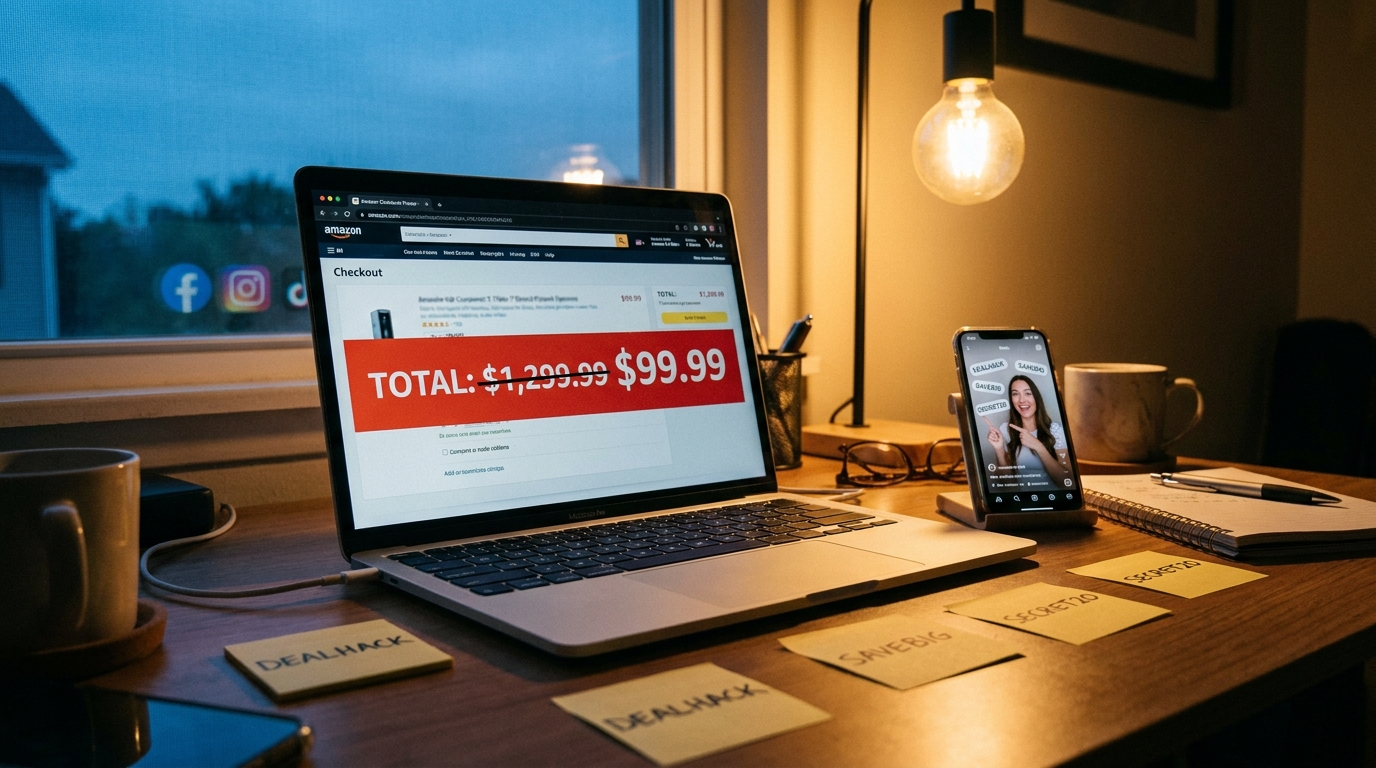
You are not crazy if Amazon deal hunting feels broken now. You click a coupon blog, test three codes, and every single one is expired. Meanwhile, somebody on TikTok just bought the same gadget for half price because a creator dropped a code in a reel caption 20 minutes ago. That is the real shift. The best Amazon promo codes are not always sitting on page one of Google anymore. They are hiding in Instagram stories, TikTok comments, Facebook reels, and creator bio links, then disappearing fast. If you have been searching for amazon secret promo code hacks from instagram and tiktok, the trick is not finding one magic account. It is building a simple system. Once you know which creators post real codes, how to spot the fakes, and how to test each code once instead of ten times, your normal social scrolling can turn into a reliable savings feed instead of a time sink.
⚡ In a Hurry? Key Takeaways
- The fastest working Amazon codes now often show up on Instagram, TikTok, and Facebook creator posts before they reach coupon sites.
- Follow a small group of high-signal creators, save their codes into one note, then verify them once before you buy.
- Stick to creators who show the product, the discount math, and a direct Amazon path. Avoid sketchy links and code lists with no proof.
Why social feeds are beating old coupon pages
Static coupon pages have a simple problem. They age badly. A code that worked this morning can be dead by lunch. Many roundup sites keep recycling the same offers because they want search traffic, not because the codes are still alive.
Creators work differently. They post when a code is fresh. They show the item in a reel or story, drop the promo code in the caption or comments, and move on. That speed is exactly why shoppers are seeing better deals there.
It is not really secret in the spy-movie sense. It is just buried in fast-moving social content. If you do not catch it quickly, you miss it.
What these “hidden social stream” deals usually look like
Most of these Amazon deals show up in one of five places:
- Instagram reel captions
- Instagram story text or sticker links
- TikTok captions
- TikTok comment replies from the creator
- Link-in-bio pages that hold the code and product link together
The discount itself can come from a mix of offers. Sometimes it is a clickable on-page coupon plus a promo code. Sometimes it is a creator code only. Sometimes it is a short lightning-style drop with limited uses.
That is why people brag about 50 percent to 70 percent off at checkout while everyone else sees full price on the product page.
How to spot high-signal creator accounts
1. Look for proof, not hype
A good deal creator usually shows the actual item, the normal price, the final checkout price, or at least the promo steps. A weak one just says “run!” and gives you nothing useful.
2. Check comment quality
If real followers are saying “worked for me” and naming the color or version they bought, that is a good sign. If the comments are vague or filled with bots, move on.
3. Favor niche creators
The best codes often come from people in specific lanes. Think home finds, baby gear, beauty tools, kitchen gadgets, or tech accessories. Niche creators tend to post cleaner, more relevant deals than giant generic coupon accounts.
4. Watch posting patterns
Reliable accounts post often and update quickly when a code dies. That matters. A creator who says “dead now” is more useful than one who leaves old posts up all week.
5. Avoid mystery redirects
If a bio link bounces you through strange sites before landing somewhere random, skip it. A safer path is a clear link hub, an Amazon storefront, or a direct item link with the code written plainly.
Build your own clean code list in 10 minutes a day
This is the part most people skip. They keep every code in their head, then retest the same bad ones later. Do this instead.
Start one simple note
Use Apple Notes, Google Keep, Notion, or even a plain text file. Give each line the same format:
Product name | Creator handle | Code | Date seen | Status tested
Example:
Milk frother | @kitchenfindsdaily | FROTH40 | Sept 13 | Worked at 9:20 AM
Save only likely winners
Do not copy every code you see. Save the ones that have three things:
- A visible product match
- A code shown clearly
- Some proof in comments or video
Test once, then mark it
If the code works, mark it worked. If it fails, mark it dead and move on. This keeps you from wasting time entering the same bad code later.
Match social finds with a trusted coupon source
This is where a hybrid approach helps. Social is fast, but messy. A tracking site can help you organize what is worth testing. If you want a deeper system for turning creator-only offers into something more usable, this guide from Best Amazon Coupons is worth a read: The “Creator Code Cross‑Over” Hack: How To Turn Influencer‑Only Amazon Deals Into Your Own Private Promo Code Feed.
How to plug that stream into Best Amazon Coupons
Think of social as the discovery layer and Best Amazon Coupons as the filter.
Here is a practical routine:
- Scan your saved Instagram and TikTok creators once in the morning and once in the evening.
- Pull out only the codes tied to products you actually want.
- Add those codes to your running note.
- Check Best Amazon Coupons for matching listings, active coupon stacks, or overlap with current promos.
- Test at checkout one time. If it works, buy. If not, archive it and move on.
This matters because many social deals rely on a stack. For example, a creator code might take 30 percent off, but the full bargain only appears after you also click the on-page Amazon coupon box. A good tracker helps you catch that second step.
Common mistakes that waste the most time
Testing random codes on random products
Amazon promo codes are often product-specific, seller-specific, color-specific, or limited to one variation. A code for the black version may fail on the blue one. That does not always mean the code is fake.
Following giant “deal spam” accounts
If an account posts 80 products a day with no context, the hit rate is usually poor. You want fewer, better posts.
Ignoring the timestamp
A code from six hours ago can be ancient in social-deal terms. Freshness matters more than follower count.
Forgetting the stack
Always check whether the creator mentioned an on-page coupon, Subscribe and Save, or a specific seller box. Missing one step can make a real code look dead.
Safety rules for social-only Amazon deal hunting
You do not need to be paranoid, but you should be careful.
- Do not give a creator your Amazon password. Ever.
- Stick to Amazon checkout for payment.
- Be cautious with shortened links if the destination is unclear.
- Read seller ratings on unfamiliar brands.
- Take a screenshot of the post and code before checkout in case the creator deletes it.
The good news is that many of these deals are perfectly legitimate. The bad news is that social also makes it easy for junk offers to spread fast. A little caution saves a lot of hassle.
How to know if a creator code is actually worth chasing
Ask three quick questions:
- Is this something I was going to buy anyway?
- Can I see how the discount is supposed to apply?
- Is the final price good compared with normal sale prices, not just the fake list price?
If the answer is yes, it is worth a checkout test. If not, it is probably just entertainment with a promo code attached.
At a Glance: Comparison
| Feature/Aspect | Details | Verdict |
|---|---|---|
| Old coupon blogs | Easy to search, but often slow to update and packed with expired Amazon promo codes. | Useful for background checking, weak for fast drops. |
| Instagram and TikTok creator posts | Fresh codes, fast posting, more proof, but deals can vanish in hours and take some filtering. | Best place to find live social-only deals. |
| Personal code tracker plus Best Amazon Coupons | Lets you organize creator finds, avoid retesting dead codes, and check for stackable savings. | Best overall system for repeatable savings. |
Conclusion
The big change is simple. Amazon deal hunting has moved from slow, searchable coupon pages to quick social drops that live in reels, captions, comments, and bio links for a few hours at a time. That is why so many shoppers miss the best codes or waste half the night testing old ones. If you start following a short list of trustworthy creators, save only the strongest codes into one clean note, and cross-check them through Best Amazon Coupons, you can turn random scrolling into a smart savings routine. That is the real win here. Less guesswork, fewer expired “hacks,” and more trackable discounts that actually work when you reach checkout.