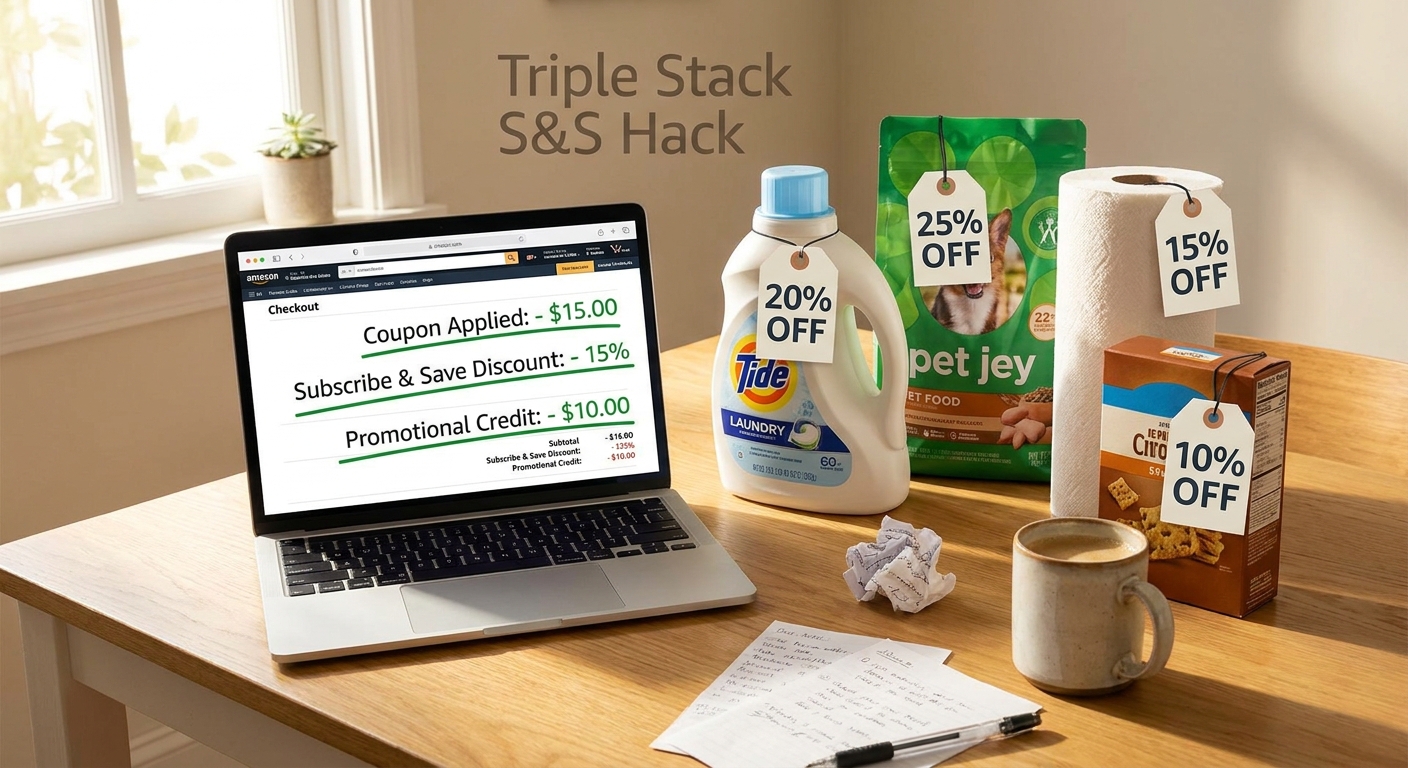
You are not imagining it. The price of boring stuff like detergent, paper towels, pet food, diapers, coffee pods and protein snacks keeps creeping up, while the little Subscribe & Save badge acts like it is doing you a huge favor. For a lot of shoppers, it is not. The good news is that Amazon sometimes lets three different discounts land on the same item at once: a clipped coupon, a first-delivery Subscribe & Save boost, and a separate promo or credit. That is the real trick behind how to stack amazon coupon and subscribe and save discounts without doing anything shady. You are simply building the order in the right sequence and checking for the signs that the stack will hold through checkout. Done right, one routine reorder can turn into a quiet 35 to 60 percent win on things you already needed to buy.
⚡ In a Hurry? Key Takeaways
- The best household deals often come from stacking a clipped coupon, Subscribe & Save, and a seller promo or Amazon credit on the same item.
- Build the cart in order. Clip the coupon first, choose Subscribe & Save second, then verify any extra promo on the product page and again at checkout.
- Watch for red flags like coupon text disappearing, sold-by changes, or checkout totals that “recalculate” at the last step. That usually means the stack broke.
Why this works better than chasing random gadget deals
Most people think the biggest Amazon savings are on flashy electronics. Right now, that is often not true.
A lot of the strongest discounts are buried in everyday essentials. Household brands and third-party sellers are pushing inventory with overlapping promos. Amazon’s own system does not always advertise that clearly. It just quietly allows the discounts to mix if the item is set up the right way.
That means your boring reorder can beat a so-called “deal” on a gadget you did not need in the first place.
What “triple stack” actually means
Here is the simple version. A triple stack usually looks like this:
- Discount 1: A clickable coupon on the product page, often 5 percent to 25 percent off.
- Discount 2: A Subscribe & Save discount, sometimes boosted for the first delivery.
- Discount 3: A separate promo, such as “save an extra 10%,” “buy 2 get credit,” or a limited-time brand promotion.
If all three survive checkout, your effective discount can get surprisingly big. Not fantasy big. Real big.
The copy-and-paste checklist for building a working triple-stack cart
1. Start on the product page, not the cart
This matters more than it should. Amazon often hides promo details better on the cart page than on the product page.
Check for these boxes:
- A visible coupon with a checkbox or “Apply” button
- A Subscribe & Save option, especially one mentioning first delivery savings
- A promo line such as “Extra savings,” “Limited time deal,” or “Purchase 2 items and receive…”
2. Clip the coupon first
Always do this first. If you skip it and jump straight into Subscribe & Save, you can forget to come back, and sometimes the page refresh loses the coupon state.
Once clipped, take a quick screenshot. It sounds fussy, but it helps if the discount vanishes later.
3. Switch to Subscribe & Save
Select the Subscribe & Save option after clipping the coupon. Watch the price area carefully. You want to see the updated percentage or delivery savings reflected on the page.
If it is your first time buying that item through Subscribe & Save, there may be an extra boost. That is where some of the biggest household savings show up.
4. Double-check who is selling the item
This is a sneaky one. A stack can break if the item changes from one seller to another, even when the product page looks almost identical.
Make sure the coupon, promo, and Subscribe & Save option all belong to the same listing. Look at:
- Sold by
- Ships from
- Pack size or variation
5. Add to your Subscribe & Save list
Do not rush to checkout yet. Add the item with the Subscribe & Save setting active.
If the promo requires multiple items, add the second eligible item now. Sometimes it can be the exact same product. Sometimes it must be a specific variation from the brand page. Read the fine print.
6. Go to checkout and inspect every line
This is the truth-telling step.
You are looking for all the discounts to appear somewhere before you place the order. They may not show in one neat block. Amazon often spreads them across:
- Item-level coupon savings
- Subscribe & Save discount lines
- Promotional credits or order summary reductions
If one piece is missing, stop. Back out and recheck the listing.
The red flags that usually mean the stack will fail
There are a few warning signs that save a lot of frustration.
The coupon vanishes after you select Subscribe & Save
This often means the coupon only applies to the one-time purchase option. If the coupon text disappears or grays out, the stack probably will not hold.
The seller changes when you pick a different size or scent
This happens all the time with detergents, vitamins, snacks and pet supplies. Same brand. Same page. Different backend listing. The promo may only apply to one version.
The item says “extra savings” but no actual amount appears at checkout
That usually means there is a hidden quantity requirement, a brand restriction, or an expiration that just hit.
The total drops in cart, then rises again on the final review page
That is the classic fake-out. Do not assume the earlier total is locked in. The review page is the one that counts.
A simple example of how the math can work
Let’s say a household item is listed at $24.99.
- Clip a 20% coupon
- Use a 15% first Subscribe & Save discount
- Add a separate 10% promo or small credit
You are not always getting a perfect straight 45% off because Amazon may calculate some discounts in sequence, not all at once. But your effective final price can still land in the 35% to 60% savings range depending on how the promo is structured.
That is serious money on items you buy repeatedly.
Best categories for triple-stack hunting
You will usually have better luck in repeat-purchase categories than in trendy electronics.
- Laundry detergent and fabric care
- Diapers and baby wipes
- Pet food and treats
- Protein bars and snack packs
- Coffee pods and drink mixes
- Paper goods and cleaning supplies
- Vitamins and personal care basics
If you liked the idea of catching hidden deal leftovers after major sale events, you might also like The ‘Prime Day Leftover Stacks’ Hack: How To Turn Yesterday’s Deals Into Today’s Secret Amazon Promo Code Prices. It pairs nicely with this strategy because both rely on Amazon’s promo system being a little messy in the shopper’s favor.
How to screenshot and share a live working stack
If you find a real stack, it helps other shoppers if you capture it clearly before the setup changes.
Take three screenshots
- Screenshot 1: Product page with clipped coupon visible
- Screenshot 2: Subscribe & Save option selected with the savings shown
- Screenshot 3: Checkout or review page showing the promo lines and final total
Include the key details
When you share it with the Best Amazon Coupons community, add:
- The exact product name
- Size, scent, flavor, or variation
- Sold by and shipped from details
- How many you added
- The final effective discount you got
That makes it far easier for someone else to copy your exact setup before the promo disappears.
Small rules that make this safer and smarter
Do not subscribe and forget
Set a reminder to review or cancel future deliveries if you only wanted the first order savings. There is nothing wrong with using Subscribe & Save for the discount, but you should stay in control of the schedule.
Compare with local store pricing
A triple stack is only a good deal if the base price is reasonable. Sometimes an item starts higher on Amazon, which shrinks the real win.
Check unit price, not just the percent off
A 40% discount on a weirdly inflated bundle can still be worse than a warehouse club or grocery sale. Look at cost per ounce, count, or load.
Move quickly when you find a live stack
These setups can disappear without warning. Coupons get pulled. Sellers change. Promo text updates. If it works and you needed the item anyway, it is usually best not to overthink it.
At a Glance: Comparison
| Feature/Aspect | Details | Verdict |
|---|---|---|
| Single Subscribe & Save discount | Usually simple, but often only 5% to 15% off and easy to overestimate. | Fine for convenience, not usually the best savings. |
| Coupon + Subscribe & Save | A solid middle ground. Works often on household essentials if the coupon applies to subscription orders. | Worth checking every time. |
| Triple stack | Coupon, first-delivery Subscribe & Save boost, plus an extra promo or credit on the same ASIN. | Best value when all terms align and the checkout math holds. |
Conclusion
The best Amazon savings right now are often hiding in plain sight inside the stuff you buy on autopilot. Not the flashy gadgets. Not the headline-grabbing lightning deal. Everyday essentials. Sellers are quietly running overlapping household promos using coupons, first-delivery Subscribe & Save boosts and limited-time credits, and Amazon’s own promo engine often lets all three interact on the same ASIN if you build the cart in the right order. For anyone feeling grocery and household inflation every week, getting a real 35 to 60 percent effective discount on necessities is a much bigger win than chasing random codes for things you did not plan to buy. Use the checklist, watch for the red flags, and screenshot live working stacks when you find them so the Best Amazon Coupons community can copy them before the setup quietly disappears.