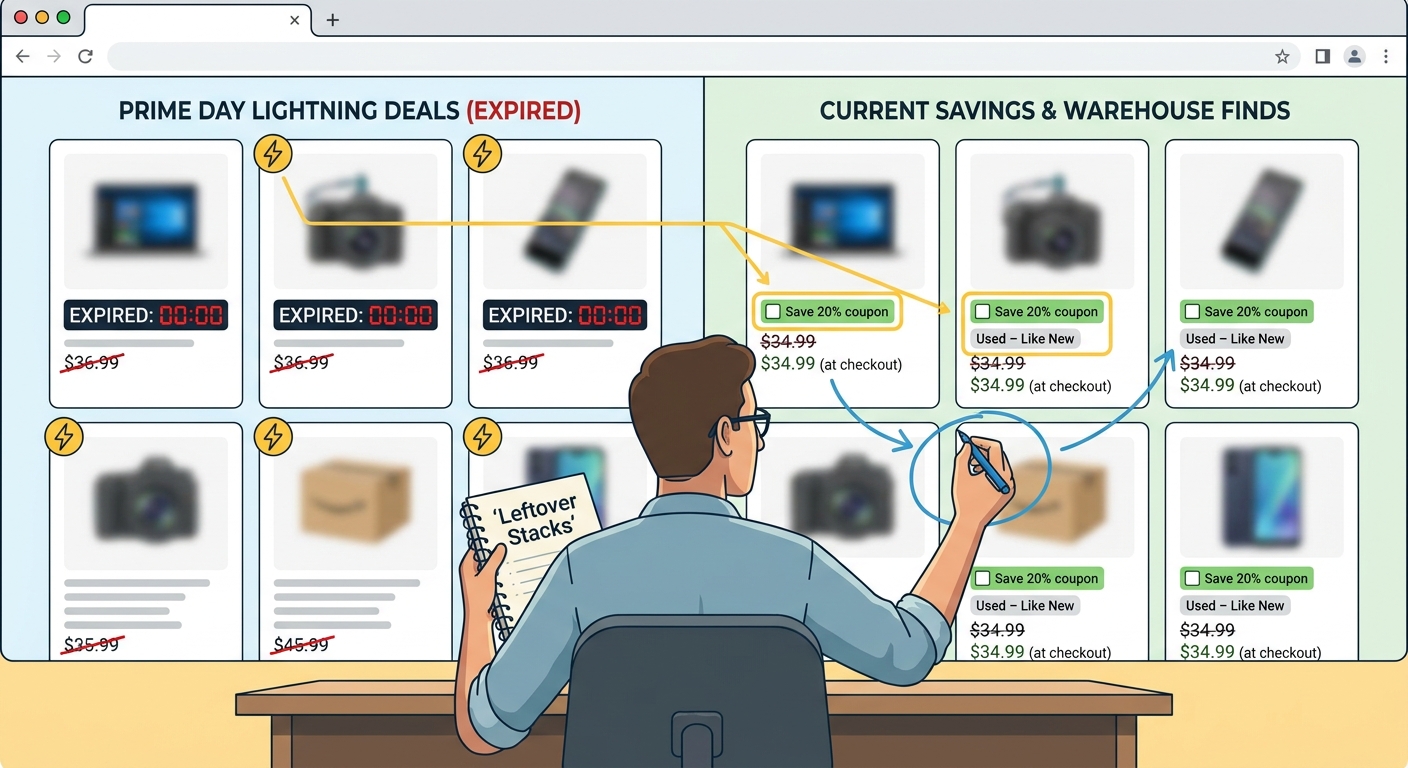
You did the whole Prime Day thing. You compared prices, watched countdown timers, maybe even lost sleep refreshing deal pages. And now that the sale is over, it feels like the good stuff is gone and all that is left is “regular price” and sketchy coupon codes that fail at checkout. That frustration is real. The annoying part is that many shoppers quit looking at exactly the wrong time. Right after a big Amazon event, sellers often still have extra inventory to move. Instead of shouting about it on the homepage, they quietly add clipped coupons, reset pricing on less popular colors or sizes, and let Amazon Warehouse listings sit next to the main product page. That creates a short, weird window where yesterday’s deal hunters are tired, but today’s patient shoppers can still find real savings. If you want an amazon prime day leftover deals hack that actually works, this is the moment to use it.
⚡ In a Hurry? Key Takeaways
- The best post-Prime Day deals often come from leftover stock, clipped coupons, and Warehouse listings, not the main Prime Day page.
- Check product variations, the “Other sellers” box, and Amazon Resale or Warehouse options before you assume the deal is dead.
- Ignore fake strike-through prices and compare the final checkout total, because that is the only number that matters.
Why the best leftovers show up after the sale ends
Prime Day trains people to think like sprinters. Fast click. Fast checkout. Fast panic. But the day after a giant sale, the market gets sloppy.
Some sellers sold out. Others did not. The ones sitting on too much inventory still need it gone, especially if they stocked up expecting more Prime Day traffic. So they start making quieter moves.
That can mean:
- Adding a clickable coupon on the listing page
- Dropping price on one color or storage size
- Letting a third-party seller undercut the main listing
- Moving returned or open-box units into Amazon Warehouse or Resale
This is the basic amazon prime day leftover deals hack. You stop shopping the event page and start shopping the product page like a detective.
Start with products that were featured during Prime Day
Do not start from scratch. Begin with items you already watched during the sale. Maybe it was earbuds, an air fryer, a robot vacuum, or printer ink. Search those exact products again now.
Why? Because products that had heavy traffic during Prime Day are more likely to have leftover inventory and follow-up discounts. Sellers know shoppers are still interested. They just stop advertising it loudly.
Check these spots on the product page
Amazon hides useful discounts in plain sight. Slow down and scan the full page.
- Coupon box. Look for a small checkbox offering 5 percent, 10 percent, or a dollar amount off.
- Other sellers on Amazon. Sometimes the cheapest version is not the default seller.
- Style or color options. Black may be full price while blue is still discounted.
- Subscribe & Save. On basics like vitamins, detergent, razors, and pet food, this can beat the visible sale price.
If you have been wasting time with old code lists, it also helps to read The ‘Deprecation Escape Hatch’ Hack: How To Turn Amazon’s Vanishing Promo Codes Page Into One Last Round Of Secret Discounts. It explains why random copied promo codes so often fail and where the real discount signals are moving now.
The leftover stacks trick
The real win is not one discount. It is stacking two or three small ones that other shoppers miss.
What a “leftover stack” looks like
Here is a common example:
- Item price is reset lower than it was the day before
- There is a clipped coupon on the page
- An Amazon Warehouse or Resale option is available for less
- A card-linked or Subscribe & Save discount still applies
You may not be able to combine every one of these at the same time on every item. But even two layers can turn a “normal” looking listing back into a sale.
For example, a coffee maker that appears to have bounced back to $89 might also have a hidden 15 percent coupon. Then you notice the stainless steel version is $79 instead of $89. Then a “Used Like New” Warehouse option shows up under buying choices at $67. That is where the real savings are living.
Do not trust the strike-through price
This matters a lot. Amazon and third-party sellers love a dramatic crossed-out number. It makes you feel like you are getting a huge deal. Sometimes you are. Sometimes you are absolutely not.
How to sanity-check a deal fast
- Compare the final checkout price, not just the listing price.
- Check whether the coupon only appears after you click it.
- Look at recent pricing on your browser history, wishlist, or cart if you tracked it before.
- Compare similar models, because brands often inflate “was” prices on weaker versions.
A fake 40 percent discount is still more expensive than a plain-looking item with a real clipped coupon.
Use Amazon Warehouse and Resale like a grown-up, not a gambler
Post-sale periods are especially good for open-box shopping. People return impulse buys after Prime Day. That feeds Amazon Warehouse and Resale inventory.
This is one of the easiest ways to turn a decent leftover discount into a great one.
What to buy used or open-box
- Kitchen appliances
- Monitors
- Headphones
- Smart home devices
- Office gear
What to be more careful with
- Personal care items
- Storage drives without a clear return policy check
- Gifts where box condition matters
Read the condition notes. “Like New” and “Very Good” can be great. “Acceptable” is where you should slow down and ask if saving a few bucks is worth the hassle.
The 24 to 48 hour rule
This post-event window does not stay open long. Most of the weird pricing settles down within a day or two after the sale. That is why this hack works now, not next week.
If an item was on your Prime Day maybe-list, check it again today and tomorrow. After that, many of the best leftovers are gone, or the stock gets cleaned up by other shoppers who know the pattern.
Best categories for leftover deals
Not every category behaves the same way. Some are much better for this trick.
Usually strong
- Small electronics
- Home and kitchen
- Smart home gear
- Supplements and household basics
- Accessories like chargers, cables, cases, and stands
More hit or miss
- Big-name Apple gear
- Game consoles
- Brand-new flagship products
Mainstream, high-demand gear can still get a discount, but the sloppy leftover pricing usually happens more often on accessories, mid-range gadgets, and products with lots of variations.
A simple post-Prime Day checklist
Use this before you buy anything.
- Search the exact item you wanted during Prime Day.
- Check all colors, sizes, and versions.
- Clip any on-page coupon.
- Open “Other sellers” and compare shipped-by-Amazon options.
- Check for Amazon Warehouse or Resale.
- Compare final total at checkout.
- Skip it if the “deal” only looks good because of a silly strike-through price.
That is the whole system. Nothing fancy. Just better habits than the average frantic shopper.
At a Glance: Comparison
| Feature/Aspect | Details | Verdict |
|---|---|---|
| On-page coupons | Often appear quietly after Prime Day on product pages and can cut 5 to 20 percent off. | One of the best leftover deal signals. |
| Amazon Warehouse or Resale | Returned or open-box stock can drop below Prime Day pricing, especially for electronics and home gear. | Great value if condition notes and returns look good. |
| Strike-through “regular” pricing | Can make discounts look bigger than they really are if the crossed-out number was inflated. | Treat with skepticism. Check the final total. |
Conclusion
If you thought Prime Day ending meant the bargains were over, that is exactly the assumption that creates this little shopping edge. Right after a major Amazon sale, lots of people stop looking. Sellers do not. They keep clearing leftover stock with small coupons, quiet price resets, and Warehouse listings that can beat the headline deal from yesterday. If you spend the next day or two checking product pages carefully, mixing clipped discounts with open-box options, and ignoring fake strike-through drama, you can still come out ahead. The weird post-event window is short, but it is real. Use it while it is still open.