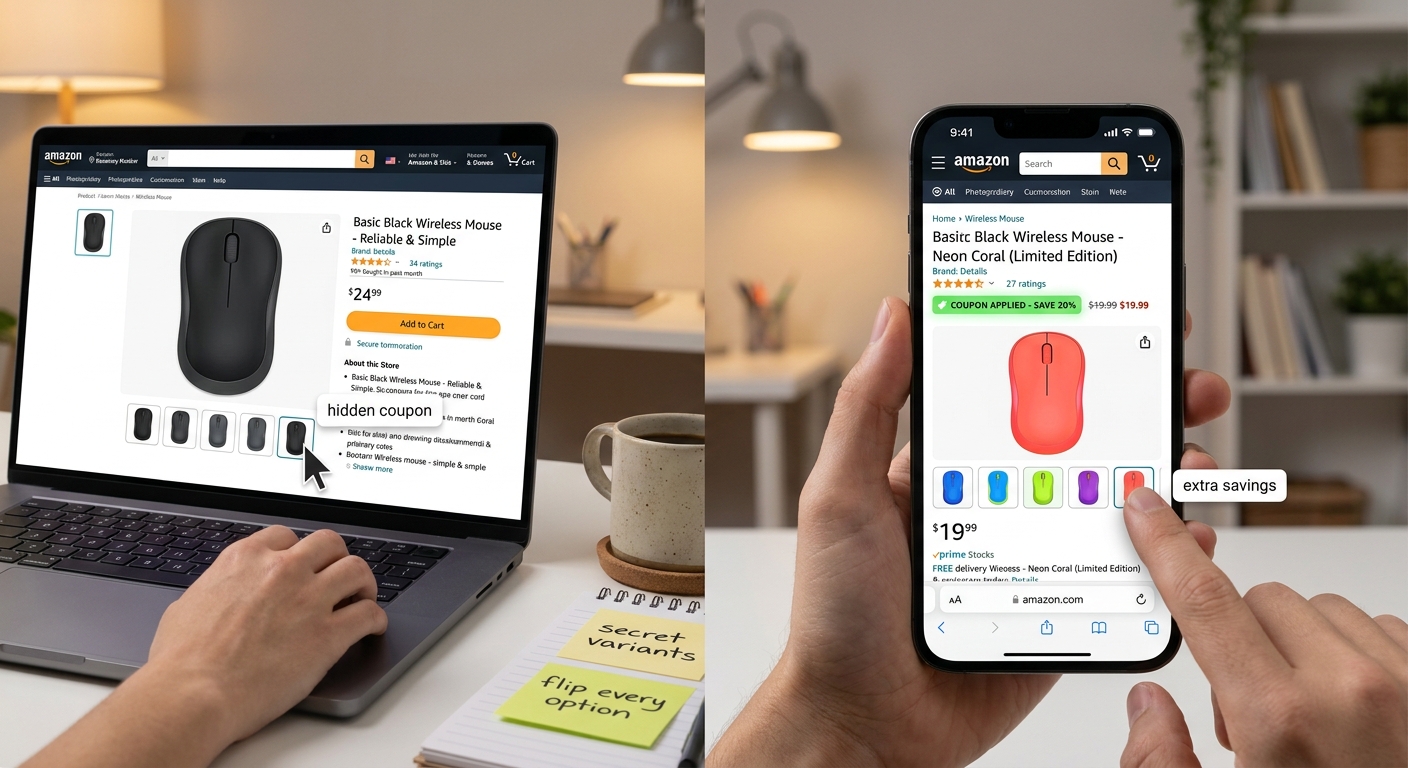
You are not imagining it. Amazon really can make a product look cheap on the main listing, then quietly bump the price the second you choose the color, size, or pack version you actually need. It is one of the most annoying parts of shopping online because the deal feels real right up until the final click. A blue shirt is one price. Your size in black is suddenly five dollars more. A storage bin in white has a coupon. The gray one does not. Most people shrug, assume the deal is gone, and move on.
But there is a simple trick here. Sellers often attach discounts to specific variants, not the whole listing. That means one color or size can hide a digital coupon, a lower base price, or an overstock markdown that acts a lot like a secret promo code at checkout. If you know where to look, you can check a listing in about 30 seconds and spot the real bargain before you buy.
⚡ In a Hurry? Key Takeaways
- The hidden amazon variant coupon hack is simply checking every size, color, or style on a listing because discounts often apply to only one version.
- Use a 30-second routine: tap each variant, watch the base price, look for a coupon checkbox, then compare the final cart price before buying.
- This is safe and normal shopping behavior. You are not using shady tools, just catching the pricing logic sellers hope you will ignore.
What the “Variant Flip” hack really is
This is less of a hack in the sneaky sense and more of a smart shopping habit.
Amazon listings often bundle several product versions onto one page. Different colors, sizes, counts, materials, and styles all sit under the same listing. To you, it looks like one product with options. To the seller, each option can have its own price, stock level, coupon, and discount strategy.
That is why the cheapest version on the page is often not the one most people want. It might be an odd color the seller is trying to clear out. It might be a less popular size. It might even be the only variant carrying a clickable coupon.
The “variant flip” move is simple. Instead of trusting the first price you see, you flip through the variants and compare what actually happens.
Why Amazon prices jump when you change color or size
There are a few common reasons.
1. Different variants have different stock pressure
If a seller has too many red towels and not enough gray ones, the red version may get a price cut or coupon to move inventory faster.
2. Coupons can be attached to only one variant
This is the big one. A listing may show a green “Save 20%” coupon, but once you click another color, that coupon can disappear. Same product family. Different discount behavior.
3. The displayed headline price can be the lowest variant, not the one you selected
This is how a lot of shoppers get fooled. The listing page may advertise “starting at” the cheapest version, even if the common version costs more.
4. Some variants are discounted because they are less popular
That is not always a bad thing. If color is not important to you, this is where the savings live.
The 30-second routine that finds the real deal
If you remember only one thing from this article, make it this.
Step 1: Open the listing and ignore the first price
Treat the first price as bait until proven otherwise. Do not get emotionally attached yet.
Step 2: Tap through every variant
Click each size, color, style, pack count, or material option. Watch for three things:
- The base price changing
- A coupon appearing or disappearing
- Any “limited time deal” or sale badge moving with the variant
Step 3: Check for a coupon box on each version
This matters more than most people realize. The coupon is often variant-specific. A seller may offer 10% off only on the blue model, or five dollars off only on the two-pack.
Step 4: Add the best candidate to your cart
Do not stop at the product page. The real answer shows up in the cart, where coupon math and any checkout discount become clearer.
Step 5: Compare one or two close alternatives
If the black version is $2 more but much better reviewed, maybe that is worth it. But at least now you know the tradeoff.
What to look for on the listing page
When using the hidden amazon variant coupon hack, your eyes should go straight to these spots:
The coupon checkbox
If you see “Apply 5% coupon” or “Save $10 with coupon,” click variants and see if it stays. Often, it will not.
The tiny price text under each variant button
Sometimes Amazon shows mini pricing under color tiles or size buttons. That can give away the cheapest option fast.
The final price after discount
A lower sticker price is nice, but a slightly higher sticker price with a coupon can still win.
The delivery date
A cheaper variant is not always the better pick if it ships three weeks later and you need it now.
A simple real-world example
Let’s say you are buying a water bottle.
The listing says $19.99. Great. Then you click the 32-ounce version in black, and now it is $24.99. Annoying.
But if you click the navy version, it is $21.99 with a 15% coupon. Then you click green, and it is $18.99 with no coupon. In the cart, navy drops to about $18.69 after the coupon, making it the true winner.
That is the whole game. Not magic. Just checking the variants instead of assuming the first or most popular option is the best value.
When this works best
This trick is especially useful on products with lots of choices.
- Clothing and shoes
- Home storage items
- Bedding and towels
- Phone accessories
- Kitchen gadgets
- Supplements with different counts or flavors
- Furniture in multiple finishes
The more variants a listing has, the more likely one of them is priced differently for inventory reasons.
How this connects to checkout discounts
Some discounts only make sense once you combine them with what is already happening on the page.
For example, one variant may carry a digital coupon, while another version might qualify for a short-lived sale. If you are already watching flash discounts too, it helps to know how those stack with listing-level deals. That is where The ‘Lightning Code Stack’ Hack: How 1-Hour Flash Coupons Turn Into Real Amazon Promo‑Level Savings fits nicely. It is a good next step once you get comfortable checking variants first.
Common mistakes shoppers make
They only check the color they want
Even if you really want black, check the others. You need a price baseline.
They forget to compare the cart total
Some coupons do not fully show their value until cart or checkout.
They assume the cheapest variant is low quality
Sometimes it is just overstock. Same item. Less popular finish.
They waste time on every listing
Do this on products you are actually ready to buy. It is a quick savings habit, not a full-time job.
Is this actually a “secret promo code”?
Not literally. There is no hidden box, no browser trick, and no weird script.
But for everyday shoppers, the effect feels similar. You click around, find one specific variant with a coupon or markdown, and your cart total drops in a way most people would have missed. That is why it feels like promo-level savings.
And unlike random coupon apps, this method is built right into the listing. No extensions needed. No risk. No sketchy websites.
How to tell if a variant deal is worth taking
Price is important, but not everything.
Check the reviews for that exact version if possible
Sometimes reviews vary by size or style.
Make sure the seller and shipping terms still look solid
A lower price is not worth much if the return policy is messy.
Ask yourself if the cheaper option still fits your needs
Saving money on the wrong size is not saving money.
At a Glance: Comparison
| Feature/Aspect | Details | Verdict |
|---|---|---|
| Base listing price | Often reflects the cheapest variant, not the one you actually want | Useful starting point, but never trust it alone |
| Variant-by-variant checking | Takes about 30 seconds and can reveal hidden coupons or lower-priced colors, sizes, or packs | Best way to find the real deal |
| Cart total comparison | Shows the real final price after coupons and variant-specific discounts apply | Final check before you buy |
Conclusion
If Amazon shopping has started to feel like a shell game, this is one small habit that puts you back in control. Right now, creators and coupon blogs are shouting about flashy code apps and viral hacks, but most shoppers are still bleeding money on everyday buys because they never check the variant-level pricing logic Amazon sellers quietly use. The good news is that you do not need a complicated tool. You just need a repeatable 30-second routine. Tap through the variants, watch for disappearing and reappearing coupons, and compare the cart total before you commit. That is how you uncover variant-only digital coupons and overstock discounts that behave like secret promo codes at checkout. It is simple, fast, and useful on items you were already planning to buy today.