Blog

  • The ‘Triple Stack’ Subscribe & Save Hack: How To Turn One Amazon Deal Into Three Discounts

    The ‘Triple Stack’ Subscribe & Save Hack: How To Turn One Amazon Deal Into Three Discounts

    You are not wrong to feel a little tricked by Amazon pricing. You spot a Subscribe & Save discount, feel good about it, then later notice a tiny coupon box, a promo banner, or a code tucked into the product page that could have knocked the price down even more. It is annoying, especially when you are buying boring but necessary stuff like laundry pods, dog treats, coffee, vitamins, or paper towels. The good news is that there really is a repeatable system here. The best deals often come from stacking three separate savings on the same item: the base sale price, a clipped coupon or promo code, and the Subscribe & Save discount. When all three line up, the math can get surprisingly good. Right now, with Prime Day-style promos already showing up early, this amazon subscribe and save stacking coupons hack can cut 30 to 60 percent off things you were going to buy anyway.

    ⚡ In a Hurry? Key Takeaways

    • The best Amazon savings often come from stacking three discounts at once: sale price, coupon or promo, and Subscribe & Save.
    • Always check the product page for a coupon checkbox and any extra promo text before you hit Subscribe & Save.
    • Do the final math in checkout, because some codes do not stack and some “deals” are weaker than a simple one-time purchase.

    How the triple stack actually works

    Think of Amazon discounts like three separate doors. If all three are open, you walk through each one and your price keeps dropping.

    Stack layer 1: The sale price

    This is the easiest one to see. Maybe the item is already marked down for a limited time, or it has a Prime-exclusive price, or it is sitting in a category promo.

    Stack layer 2: The coupon or promo

    This is the one people miss most often. Sometimes it is a green coupon checkbox under the price. Sometimes it is a promo line on the page that says something like “Save an extra 20% when you apply.” Sometimes there is a code in the listing.

    If you want a deeper look at this part, read The ‘Hidden Checkbox’ Hack: How Amazon’s Quiet Coupons Stack With Promo Codes For Double Discounts. It explains why that tiny checkbox matters so much.

    Stack layer 3: Subscribe & Save

    This is the recurring discount. Usually it is 5 percent. Sometimes it jumps to 10 or 15 percent, especially on household basics, baby items, pantry staples, and pet supplies. On some products, Amazon pushes this harder during major sale periods.

    The step-by-step playbook

    1. Start with products you already buy regularly

    This hack works best on things you know you will use. Dishwasher tablets. Protein shakes. Cat litter. Razors. Trash bags. Not random gadgets you only want because the percentage looks big.

    2. Check the one-time price first

    Open the product page and look at the regular buy-now price. If it is already on sale, great. That becomes your base.

    3. Hunt for the quiet coupon

    Look right under the price and delivery info. If there is a coupon checkbox, clip it. Then scan a little lower for promo text or limited-time discount notes.

    4. Switch to Subscribe & Save

    Now compare the Subscribe & Save option. Amazon will usually show the discount percentage right there. Select the delivery schedule, but do not assume the number on the page tells the whole story.

    5. Add it to your cart and check the real total

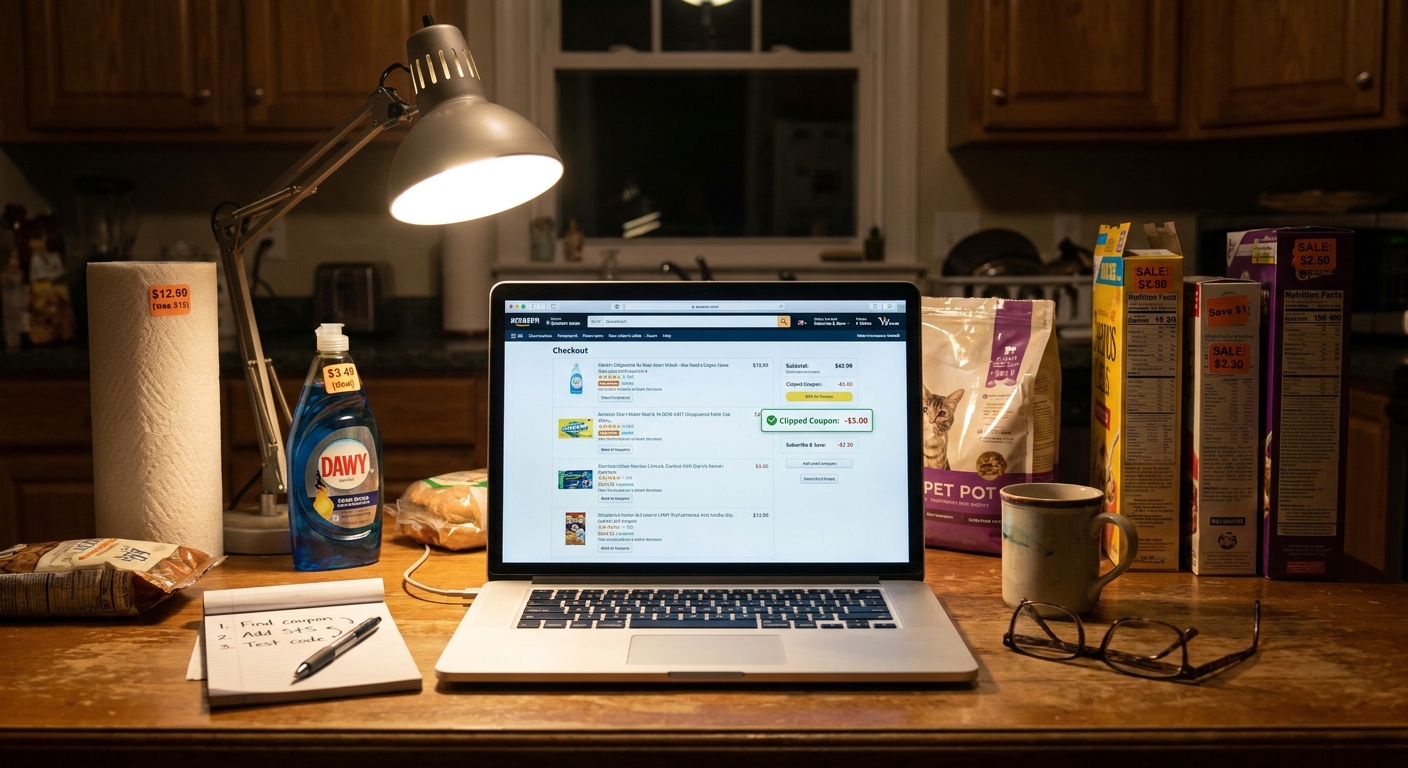
    This is where the truth shows up. In your cart or at checkout, you can see whether the coupon stayed attached and whether any promo came off correctly. If one part disappears, the stack may not be real.

    6. Compare against one-time purchase

    Sometimes the one-time deal plus coupon is better than Subscribe & Save. It happens. The whole point is to use the option with the lower final price, not the one with the prettier badge.

    7. Cancel later if you only want the first shipment

    This is the part many shoppers forget. After your order ships, you can go into your Subscribe & Save settings and cancel future deliveries if you do not need a repeat order. Amazon allows this. Just do not forget to do it.

    What a real triple stack can look like

    Let’s say a household cleaner normally sells for $24.

    The current sale price drops it to $19.20. Then there is a clipped 20 percent coupon, which cuts another $3.84. Then Subscribe & Save takes another 10 percent off the remaining price. Suddenly your final cost is much closer to the low teens than the original $24.

    That is why this works so well during busy sale periods. Amazon is mixing temporary markdowns with category coupons and recurring-order discounts at the same time. If you catch all three, the savings can get very real.

    Where this hack works best

    You will usually have the best luck in a few categories:

    • Groceries and pantry refills
    • Pet food, treats, and litter
    • Cleaning supplies
    • Paper goods
    • Baby products
    • Health and personal care items

    These are the categories Amazon loves to push with rotating coupons and repeat-delivery incentives.

    Common mistakes that ruin the deal

    Forgetting to clip the coupon

    This is the classic miss. The discount does not apply itself just because you saw it.

    Not reading the promo fine print

    Some promos only work on the first Subscribe & Save order. Some need a minimum quantity. Some are for select account holders.

    Buying the wrong size or variation

    The coupon might apply only to the lemon scent, the 32-count box, or the pack of two. Amazon listings are messy like that.

    Trusting the percentage instead of the final number

    “Save 15%” sounds better than it sometimes is. Always compare the final checkout price.

    Leaving unwanted subscriptions running

    If you used Subscribe & Save as a one-time savings tool, put a reminder in your phone to cancel after shipment.

    How to tell if a deal is actually good

    A big percentage does not automatically mean a smart buy. Ask three simple questions:

    • Is this something I buy anyway?
    • Is the final price lower than recent sale prices?
    • Will I remember to manage the subscription if I do not want repeats?

    If the answer is yes to all three, you probably have a winner.

    At a Glance: Comparison

    Feature/Aspect Details Verdict
    Best stack combo Sale price + clipped coupon or promo + Subscribe & Save discount Usually the strongest setup
    Where it works best Groceries, pet supplies, paper goods, cleaning items, personal care Great for repeat essentials
    Biggest risk Missing a coupon, using the wrong product variation, or forgetting to cancel a future shipment Easy to avoid with a quick checkout check

    Conclusion

    Amazon makes discounts feel more confusing than they need to be. That is the frustrating part. But once you know where the savings hide, the system gets easier. Start with the sale price. Clip every relevant coupon. Then test Subscribe & Save and confirm the final total in checkout. That simple routine is the amazon subscribe and save stacking coupons hack in plain English. With Prime Day-style sales already heating up, Amazon is quietly pushing aggressive category promos and short-lived codes on top of standard Subscribe & Save offers. If you use this playbook on real monthly essentials, you can shave 30 to 60 percent off groceries, pet supplies, and household refills without wasting time on dead codes or flashy one-off deals. Better yet, it is a repeatable habit you can use all year, not just during the big sale weeks.

  • The ‘Hidden Checkbox’ Hack: How Amazon’s Quiet Coupons Stack With Promo Codes For Double Discounts

    The ‘Hidden Checkbox’ Hack: How Amazon’s Quiet Coupons Stack With Promo Codes For Double Discounts

    You are not imagining it. Amazon can make discounts feel weirdly slippery. You clip the obvious coupon, add the item to your cart, and then stare at checkout wondering why the total barely changed. Meanwhile, somebody online claims they got the same paper towels, vitamins, or storage bags for half price. Annoying, right? The trick is that some of Amazon’s best deals are split across more than one place. There’s the visible green coupon checkbox on the product page, then there are brand promos, “Apply at checkout” offers, and sometimes an outside promo code that works on that exact listing too. If you catch the right combo, the discounts can stack. That is the hidden checkbox hack people keep talking about. It is not magic, and it is not only for influencers. It is just a simple habit. Once you know where to look, you can check for real stackable deals in under five minutes a day.

    ⚡ In a Hurry? Key Takeaways

    • The real Amazon savings often come from stacking a coupon checkbox, an on-page or checkout promo, and a valid promo code on the same ASIN.
    • Use a simple 3-step routine. Check the listing, test the item in cart, then try a working code before you pay.
    • Always verify the final checkout total and avoid buying just because a coupon looks big. The best value is on things you already planned to buy.

    What the “hidden checkbox” hack actually means

    Despite the dramatic name, this is usually not a secret setting buried deep in Amazon.

    It is more like a discount people miss because Amazon spreads it around. One offer appears as a little coupon checkbox under the price. Another might show up as “Save 20% at checkout” or “Buy 2, save 10%.” A third might be a promo code from a brand page, creator page, email, or trusted deal source.

    If all of those apply to the same item, sometimes they stack. Not always, but often enough that it is worth checking.

    The important part is this. You are not hunting random codes first. You are starting with an item that already has a coupon attached. That is where the deeper discount usually begins.

    Why so many shoppers miss the best price

    Amazon does not always show the full savings in one clean number.

    You might see:

    • A coupon on the listing page
    • A promotion in small text under the price
    • A discount that only appears in cart or at checkout
    • A brand code that is not visible on the product page at all

    That split is exactly why the deal can feel fake until the very last screen.

    And yes, it gets more confusing near major shopping events. In the run-up to Prime Day, brands often throw out short-lived coupons and targeted promos to juice sales. If you only clip the green coupon and stop there, you are seeing just one part of the discount.

    The 3-step daily habit that finds the biggest stackable deals

    This is the part worth saving. You can do it fast, and it works best on basics you buy anyway.

    Step 1. Start with your repeat-buy list

    Pick 5 to 10 things you actually use. Think detergent, supplements, pet supplies, coffee pods, razors, diapers, trash bags, protein bars, batteries.

    This matters because discount hunting gets expensive when you buy stuff just because the percentage looks exciting.

    Search those items on Amazon and open the listings that already show one of these:

    • A green coupon checkbox
    • “Apply X% coupon”
    • “Save extra at checkout”
    • A brand promotion line under the price

    If there is no visible offer at all, move on. The goal is not to force a deal. It is to find a listing that already has one foot in the door.

    Step 2. Add it to cart and read every line slowly

    This is where the hidden part often shows up.

    Once the item is in your cart, look for:

    • Coupon applied messages
    • Extra savings at checkout
    • Subscribe & Save discounts that can combine with a coupon
    • Multi-buy offers like “Buy 3, save 15%”

    Do not assume the product page told you everything. Sometimes the cart reveals a second promo that was easy to miss.

    Also check whether the discount applies per item or only once per order. That changes the math fast.

    Step 3. Test one good promo code before paying

    Now, and only now, try a code.

    This is the piece that people get backward. They start with a random 10% code from social media and hope it works on something. A better method is to find a listing that already has a live coupon and then test a relevant code on that exact ASIN.

    If the code works, great. If it does not, you still may have a decent deal from the first two discounts.

    The final number that matters is the one on the last checkout screen before you place the order.

    What can stack, and what usually does not

    Amazon’s rules are not always perfectly transparent, but here is the simple version.

    Offers that often stack

    • Product page coupon plus checkout promo
    • Coupon plus Subscribe & Save
    • Coupon plus valid brand promo code
    • Checkout savings plus multi-item offer

    Offers that often do not stack cleanly

    • Two promo codes that both try to do the same thing
    • Two different seller promotions on similar versions of the item
    • A code for one size or pack count used on another variation

    One small warning here. Make sure you are checking the exact ASIN or variation. A code might work on the 24-count pack but not the 12-count pack, even though the page looks nearly identical.

    How to tell if the deal is actually good

    A stacked discount is not automatically a smart buy.

    Here is my quick filter:

    • Would I buy this anyway in the next 30 days?
    • Is the final price lower than my normal store price?
    • Is the pack size the same, or am I being fooled by a bigger box?
    • Am I locking into Subscribe & Save just for one discount?

    That last one matters. Subscribe & Save can be great, but only if you remember to manage it. If you use it for a one-time stock-up, set a reminder to review the next shipment date right after your order arrives.

    Common mistakes that kill the discount

    Missing the checkbox entirely

    It sounds obvious, but the coupon checkbox is easy to skip, especially on mobile. If you do not clip it, nothing else matters.

    Testing codes on the wrong seller

    Amazon often shows multiple sellers or slightly different versions of the same product. A code tied to one seller may fail on another.

    Looking only at the product page price

    Some offers do not show up until cart or checkout. If you stop too early, you miss the real savings.

    Buying because the percentage looks huge

    Forty percent off a marked-up item is still a bad deal. Always judge the final dollar amount, not just the badge.

    A realistic example of how stacking works

    Let’s say a household item is listed at $24.99.

    • You clip a 20% coupon on the page
    • The cart shows an extra 10% off at checkout
    • You apply a valid brand code for another 15%

    Amazon may apply those discounts in sequence rather than all at once from the original price, so the math will not always equal a flat 45% off. But the final price can still land much lower than expected. That is why some people end up with “normal-looking” listings at surprisingly low totals.

    The lesson is simple. Do not guess based on the listing page alone. Run the cart test.

    Best times to use this hack

    This works year-round, but it gets especially useful when Amazon and brands are pushing short promos.

    • The weeks before Prime Day
    • Prime Day itself
    • Black Friday and Cyber Monday buildup
    • End-of-month brand pushes
    • Back-to-school and holiday household restock periods

    That is when you tend to see more coupon checkboxes, more “apply at checkout” language, and more outside codes floating around for the same product.

    My plain-English rule for safe deal hunting

    If the price does not make sense after two minutes, skip it.

    Good deals should be satisfying, not exhausting. You should not need a spreadsheet for toothpaste. If a listing has too many conditions, weird shipping delays, or seller issues, move on to the next one.

    Stick with products you know, compare the final checkout total, and keep screenshots if you are testing a time-sensitive offer. That way, if the discount vanishes before checkout, you know it changed and you are not just misreading the page.

    At a Glance: Comparison

    Feature/Aspect Details Verdict
    Visible coupon checkbox Easy to spot on the listing, but often only one part of the total discount. Always clip it first.
    Cart and checkout promos May appear as “Apply at checkout” or extra savings after the item is added. Worth checking every time.
    Outside promo codes Can stack on the same ASIN if they are current and tied to the right seller or variation. Use only after confirming the base deal is already good.

    Conclusion

    The amazon hidden coupon checkbox promo code stacking hack is really about paying attention to the full path of the discount, not just the first coupon you can see. That is why it is useful right now. Amazon is pushing more short-lived coupon checkboxes, targeted brand promos, and “Apply at checkout” offers in the run-up to Prime Day, but most shoppers never realize these can stack with outside promo codes on the exact same ASIN. If you build the simple 3-step habit, start with your regular essentials, check the cart carefully, and test a real code before you pay, you stop guessing. You stop chasing random TikTok codes that may be dead already. And you start catching the deep discounts when they are actually live. Five minutes a day is enough. That is the part most people miss.

  • New Prime Day Pizza Hack: How a Hidden Amazon Promo Slashes Your Dinner Bill to $5

    New Prime Day Pizza Hack: How a Hidden Amazon Promo Slashes Your Dinner Bill to $5

    Feeding everybody during Prime Day week can feel a little ridiculous. You go to Amazon looking for a deal on headphones or a smart plug, and somehow the thing blowing your budget is dinner. That is why this Amazon Prime Day Little Caesars $5 promo code hack is getting attention. It is simple, it is real, and it hits an everyday expense instead of tempting you into buying more stuff.

    Here is the short version. Prime members can grab a hidden Little Caesars promo through Amazon and use it to get a pizza for just $5 during the June 15 to June 26 promo window. The big win is that this is not one of those confusing coupon chains that falls apart at checkout. It is a low-effort discount that works like an off-platform Prime perk. If you already pay for Prime, this is one of the rare cases where your membership can help with dinner tonight, not just shipping tomorrow.

    ⚡ In a Hurry? Key Takeaways

    • This Amazon Prime Day Little Caesars $5 promo code hack can turn your Prime membership into a legit $5 pizza deal during June 15 to June 26.
    • Check the Amazon promo page, claim the offer, then use the code exactly as listed in the Little Caesars app or checkout flow before it expires.
    • Read the terms carefully. Store participation, one-time limits, and pickup or app-only rules can change whether the deal is actually worth it.

    What the $5 Little Caesars Prime promo actually is

    This is the kind of deal most people miss because they are busy watching Lightning Deals and device bundles. Instead of discounting a product on Amazon itself, the offer acts more like a coupon wallet item tied to your Prime account.

    The basic idea is simple. Amazon surfaces a Little Caesars promotion for Prime members. You claim it, copy or activate the code, and use it through Little Caesars to bring the price of a qualifying pizza down to $5.

    That matters because it is practical. A lot of Prime Day “deals” save you money only if you were already going to buy a gadget. This one can lower the cost of dinner tonight.

    How to find the hidden offer

    Start inside Amazon’s promo pages

    Do not just search the main shopping results. The offer is more likely to appear in Prime member promotions, limited-time partner deals, or event landing pages tied to early Prime Day 2026 offers.

    Search for terms like “Little Caesars Prime offer,” “Prime member pizza promo,” or the exact phrase “Amazon Prime Day Little Caesars $5 promo code hack.” If Amazon is surfacing the promotion to your account, you should see a claim button or offer details page.

    Check before you assume it is live for everyone

    Some Amazon promos roll out in waves. That means your friend may see it before you do, or your account may have slightly different terms. It is annoying, but normal.

    If you find the offer, read the fine print. Look for:

    • start and end dates
    • whether Prime membership is required
    • pickup only or delivery eligibility
    • app-only or online-only checkout rules
    • participating locations
    • whether the code can be reused

    How to use the code without getting tripped up

    This is where people lose the savings. They find the promo, get excited, and then rush through checkout.

    Best way to redeem it

    1. Sign in to your Amazon Prime account.
    2. Claim the Little Caesars offer if there is a claim button.
    3. Copy the promo code or follow the redemption link Amazon provides.
    4. Open the Little Caesars app or website.
    5. Add the qualifying pizza or combo to your cart.
    6. Enter the promo code exactly as shown.
    7. Check the final total before you pay.

    If the total does not drop to $5, stop there. Do not assume it will fix itself after payment. Usually the problem is one of three things. Wrong item. Wrong store. Wrong fulfillment method.

    Watch for extra fees

    A $5 pizza is great. A $5 pizza plus service fees and delivery markup is a different story.

    If the terms allow it, pickup is usually the smartest move. It keeps the deal clean and protects the whole point of the promo, which is stretching your dinner budget.

    Why this deal stands out from most Prime Day promos

    Most shoppers focus on screens, speakers, and home gadgets. Fair enough. But this promo shows a smarter way to think about Prime. Sometimes the best value is not on the product page at all.

    Instead, it is in these quiet partner offers that turn your membership into a real-world coupon. That is the life-hack angle here. You are using a Prime perk to cut a routine cost, and that can matter more than saving 18 percent on a charger you did not urgently need.

    If the offer can be used more than once across the June 15 to June 26 window, that is where it becomes especially useful for families, students, and anybody trying to keep food spending under control while all the sale hype is flying around.

    Is it actually a good deal?

    For most people, yes. But only if you keep it simple.

    If the promotion gets you a pizza for $5 with no weird bundle requirement and no delivery padding, that is one of the better no-nonsense Prime tie-ins you will see this season. It solves a real problem. Dinner is expensive, and convenience food is usually where budgets quietly leak.

    The catch is that “up to” language can hide disappointment. If the deal says “starting at $5” or applies only to a limited menu item, then the value depends on whether that item works for your household.

    Common gotchas to avoid

    Not every location may participate

    Franchise restaurants do not always line up perfectly with national promos. Enter your store first and make sure the discount still shows before you get too far.

    One code may not mean unlimited use

    Some deals are one per account. Others refresh during the promo window. Read the terms instead of guessing.

    App-only rules can matter

    If Amazon says redeem through the app, use the app. It sounds obvious, but plenty of restaurant promos fail just because the code was pasted into the website instead.

    Taxes still apply

    Your pizza may ring up at $5 before tax, not out the door. That is still a good deal, just not quite as magical as the headline sounds.

    Who should jump on this first

    This one is best for Prime members who already order Little Caesars once in a while and can do pickup without too much hassle. It is also useful for deal hunters who like squeezing extra value out of subscriptions they already pay for.

    If that sounds like you, this is the sort of promotion worth acting on early. The best off-platform deals tend to get noticed late, then disappear fast once coupon communities pile in.

    At a Glance: Comparison

    Feature/Aspect Details Verdict
    Deal value Qualifying Little Caesars pizza drops to about $5 for Prime members during the promo window. Strong value if you were buying dinner anyway.
    Effort required You need to find the Amazon promo, claim it, and enter the code correctly in the Little Caesars app or site. Low effort compared with most stacked coupon deals.
    Possible downsides Participation may vary by location, and delivery fees or one-time-use limits can reduce the savings. Still worth checking, but read the terms before you count on it.

    Conclusion

    This is the kind of Prime Day deal that deserves more attention because it helps with a real bill, not just a shopping wish list. Early Prime Day 2026 promos are already showing up, and this Little Caesars offer stands out because it is easy, legit, and useful right now. Most people spend the week chasing big-ticket electronics and miss the smarter move. If you can turn a Prime perk into a repeatable $5 dinner between June 15 and June 26, that is real value. It is also a good reminder to think beyond Amazon product pages. Sometimes the best Prime savings are the quiet off-platform coupons hiding in plain sight.

  • Hello world!

    Welcome to WordPress. This is your first post. Edit or delete it, then start writing!