Author: ehudsegev

  • The “Price History Trapdoor” Hack: How To Turn Amazon’s New 1‑Year Price Graph Into Instant Fake‑Deal Detection

    The “Price History Trapdoor” Hack: How To Turn Amazon’s New 1‑Year Price Graph Into Instant Fake‑Deal Detection

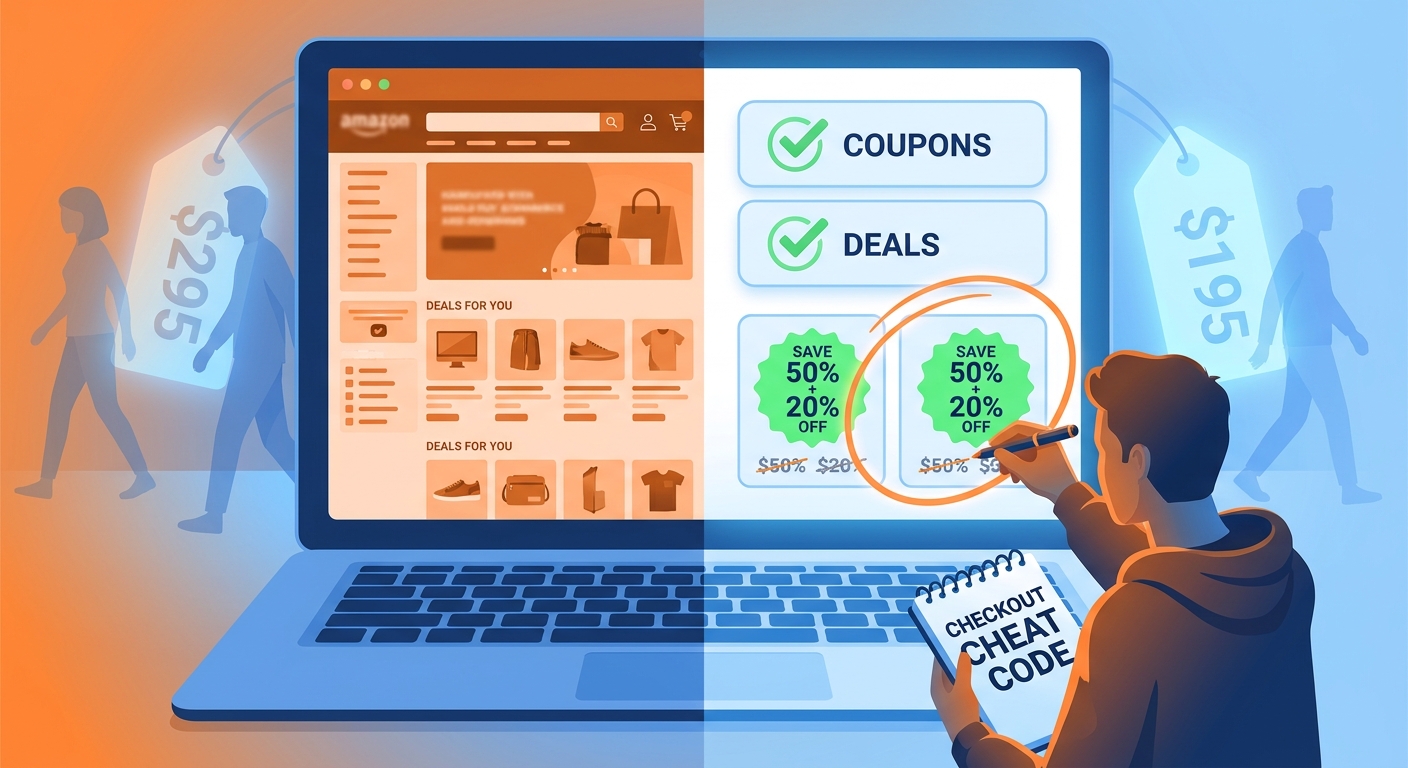
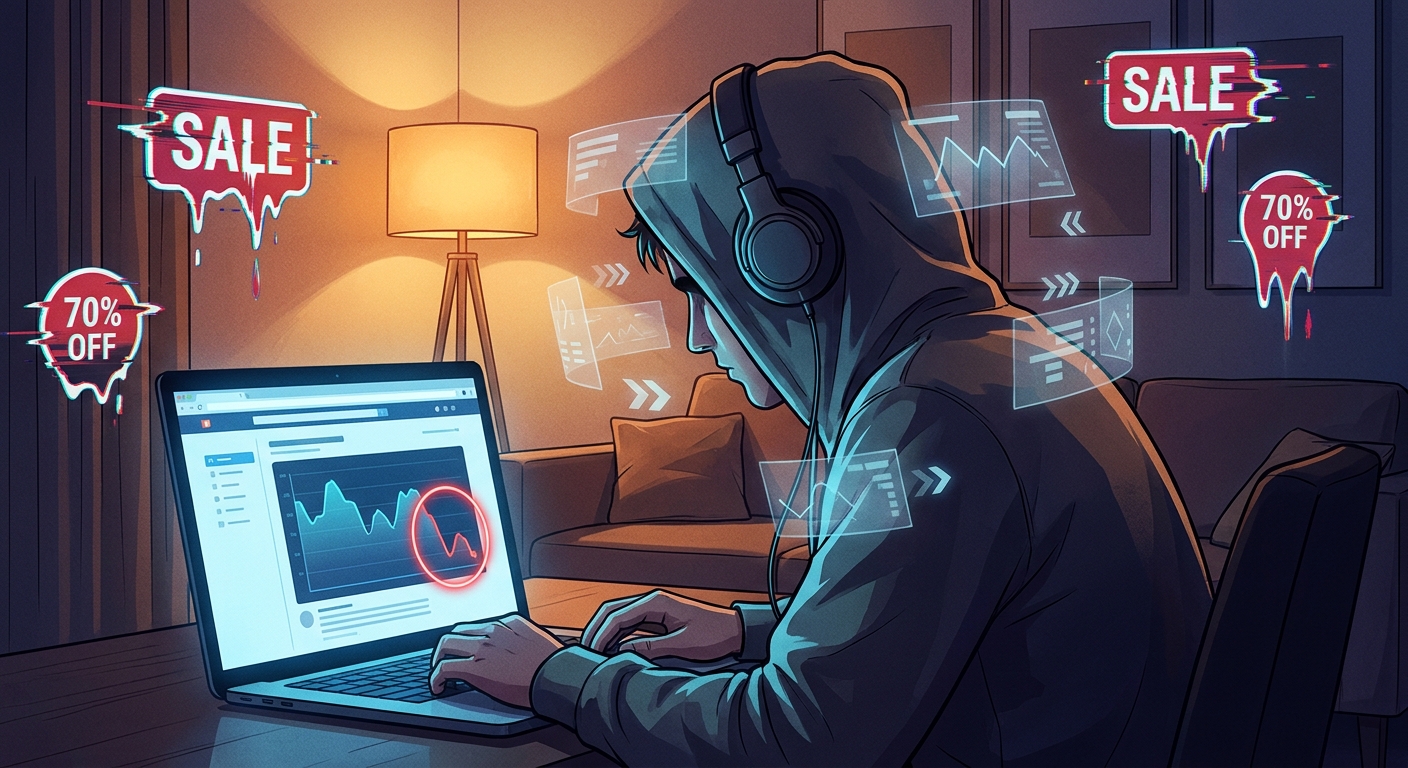
    Nothing stings quite like seeing “70% off,” clipping the coupon, typing in the promo code, and then finding out you still paid more than the item cost a few weeks ago. That is the fake-deal game a lot of shoppers are running into right now, especially after Prime Day when sellers start playing with list prices and flashy badges. The good news is Amazon has quietly made this much easier to catch. Its newer 1-year price graph can act like a little trapdoor under bad deals. Open the graph, look for the real low point, and you can tell in seconds whether that discount is actually a bargain or just a dressed-up markup. If you have been wondering how to spot fake Amazon deals with price history, this is the simple check that can save you from buying “discounted” junk at full-ish price.

    ⚡ In a Hurry? Key Takeaways

    • The fastest way to spot a fake Amazon deal is to compare today’s sale price to Amazon’s 1-year price graph, not the giant percent-off badge.
    • If the “discounted” price is higher than the item’s recent normal price or nowhere near its past low, skip it and wait.
    • Coupons and promo codes only matter after you confirm the base price is real. A stacked fake deal is still a fake deal.

    The “price history trapdoor” trick, in plain English

    Here’s the hack. Ignore the crossed-out list price for a moment. Ignore the coupon too. First, open the product’s 1-year price history graph and look at the actual line of what Amazon has charged over time.

    If today’s “deal” price drops below the product’s usual range, great. That is worth a closer look. If today’s price is still above what it sold for last month without a coupon, the trapdoor opens and the deal falls apart.

    That is why this works so well. Sellers can play games with list prices and limited-time banners. They cannot hide the recent price pattern nearly as well when the graph is sitting right there.

    How to spot fake Amazon deals with price history in two clicks

    Step 1: Find the price graph

    On supported product pages, look for Amazon’s price history section. The exact placement can move around depending on the app or browser, but it is usually somewhere around the pricing or product details area.

    You want the 1-year view, not just a short window. A week or a month can miss the bigger picture.

    Step 2: Compare today’s final price to the real low points

    Now do the only comparison that matters.

    • Take the current price.
    • Subtract any clip coupon or promo code you can actually use.
    • Compare that final number to the lows and the normal range shown on the graph.

    If your final price is below or close to the item’s 1-year low, that is promising. If it is above the product’s recent everyday pricing, the “deal” is mostly theater.

    What a fake deal usually looks like

    Once you know what to watch for, the pattern gets pretty obvious.

    1. The sudden jump before the sale

    An item sits around $39 for weeks. Then it jumps to $69. Two days later it gets a “40% off” badge and lands at $41. That is not a real bargain. That is a costume.

    2. The coupon that only fixes an inflated base price

    You see a 10% coupon and feel like you found something extra. But if the product was cheaper last month with no coupon, you are not saving money. You are just being nudged.

    3. The giant list price that never meant much

    Sometimes the “was” price is more fantasy than history. The graph helps you see whether the product actually sold near that higher number for any meaningful stretch.

    What a real deal looks like

    A real deal usually has a few signs going for it.

    • The current price is at or near the lowest point on the 1-year graph.
    • The item has not been quietly marked up right before the sale.
    • The coupon or promo code pushes the price below its normal selling range.

    That last point is where hidden codes can actually become useful. If the underlying price is already honest, a coupon can turn a good buy into a great one. If you want more ways to find those stackable extras, The “Double Dip Deal Page” Hack: How To Turn Amazon’s Own Coupon Hub Into A Secret Promo Code Mine is worth a look. Just use the price graph first, then stack the savings second.

    A quick example

    Let’s say a kitchen gadget is listed today at $49.99 with a 20% off coupon. That sounds solid. Your final price would be about $40.

    Now check the 1-year graph.

    If the graph shows that same gadget sat at $34.99 for most of last month, your “deal” is not a deal. If the graph shows it usually lived between $47 and $55, and only dipped to $42 once, then your coupon price of $40 is actually pretty good.

    That is the whole system. Compare today’s final price to the item’s real history, not the marketing language.

    Common mistakes shoppers make

    Trusting the percent-off badge

    The percent off is based on a reference price. That reference price may not tell you what normal people were paying recently.

    Checking only the coupon, not the final value

    A big coupon can make people stop thinking. Always ask, “Compared to what this item usually costs, am I really ahead?”

    Buying too fast during “limited-time” events

    Urgency is part of the design. The graph is your pause button.

    When the graph is not enough

    Price history is powerful, but it is not perfect. A few things can still make you slow down.

    • If the item is brand new, there may not be enough history to judge it well.
    • If the product page has changed versions or bundles, old pricing may not match exactly.
    • If the seller quality looks shaky, a low price can still be a bad buy.

    So yes, use the graph. But also check reviews, seller info, return policy, and whether the item is actually the exact model you want.

    Why this matters more right now

    Fake discounts tend to surge after major sale events. Deal sites start pushing codes. Sellers know shoppers are primed to click. That is when old-fashioned price checking becomes your best defense.

    You do not need to become a spreadsheet person. You just need one habit. Before you get excited about the code, verify the floor price.

    At a Glance: Comparison

    Feature/Aspect Details Verdict
    Percent-off badge Looks dramatic, but may be based on an inflated reference price or recent markup. Not reliable by itself
    1-year price graph Shows the product’s real pricing pattern over time, including past lows and normal ranges. Best quick fake-deal detector
    Coupon or promo code Can be useful, but only after you confirm the starting price is not inflated. Helpful only when stacked on a real deal

    Conclusion

    This is one of those small shopping habits that pays off fast. Fake discounts are exploding after Prime Day, and plenty of deal pages are pushing codes on products that were cheaper weeks ago. If you learn how to spot fake Amazon deals with price history, you can verify the real floor price in two clicks and stop getting fooled by shiny banners. Then your hidden promo codes stop “saving” 5 percent on inflated junk and start helping you grab the few items that are actually below market. That is the win. Less hype, better timing, and money staying in your pocket.
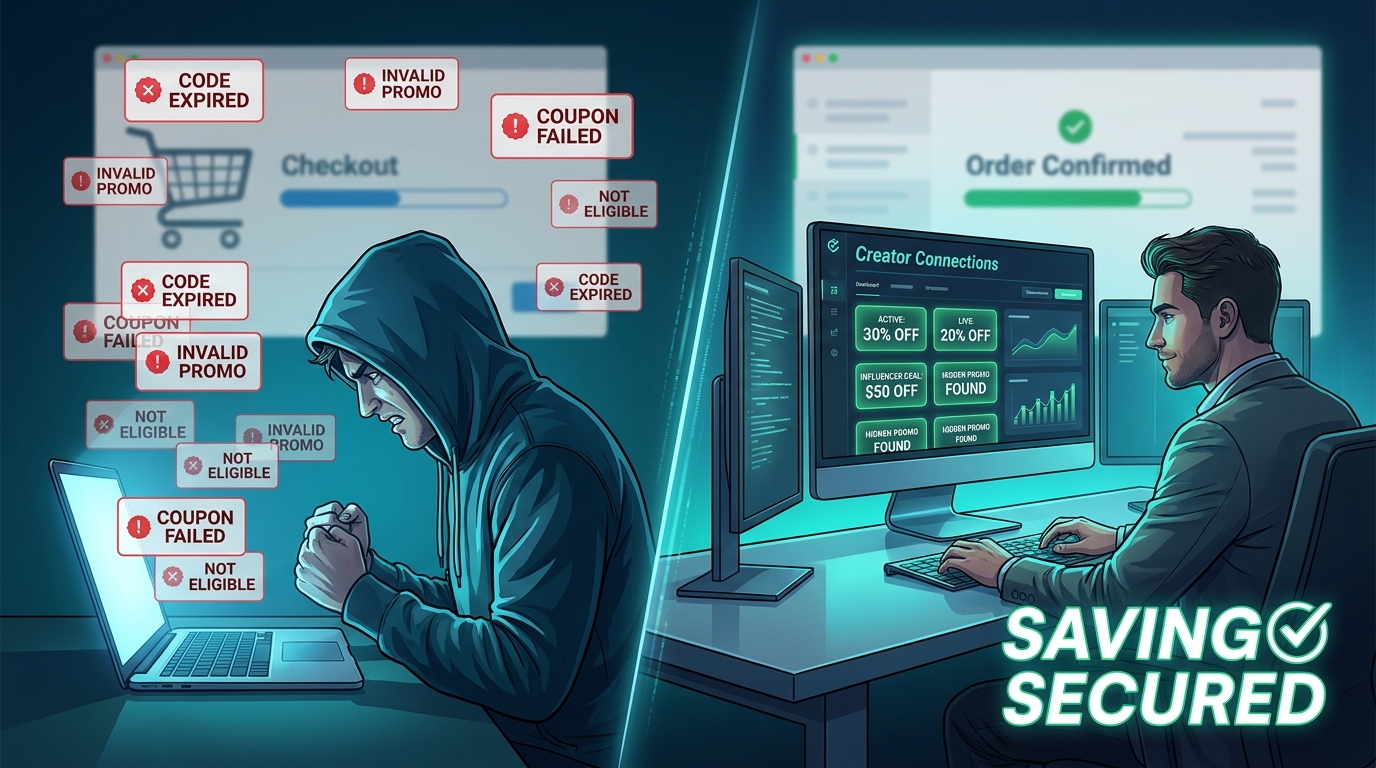
  • The “Creator Connection Scrape” Hack: How Influencer-Only Promo Codes Are Quietly Reappearing After Amazon Killed the Promo Code Page

    The “Creator Connection Scrape” Hack: How Influencer-Only Promo Codes Are Quietly Reappearing After Amazon Killed the Promo Code Page

    If you have been trying to find Amazon promo codes this week, you are not imagining it. The usual tricks are falling apart. The old Promo Codes page is gone, coupon sites are stuffed with expired junk, and even influencer storefronts look weirdly thin. That is why so many shoppers feel like Amazon deals have suddenly “disappeared.” They have not disappeared. They have moved. A lot of the better discounts are now getting pushed through Amazon’s Creator Connections system, where sellers set up campaign-based offers for creators instead of dumping everything onto one public promo page. The good news is that some of those offers still spill into public-facing links, videos, storefront posts, and creator landing pages. That is where the real hunt is now. If you understand that shift, you stop wasting time on dead code lists and start finding the same 30 to 70 percent checkout drops people keep bragging about on TikTok.

    ⚡ In a Hurry? Key Takeaways

    • Amazon did not end promo codes completely. It shifted many of the best ones into Creator Connections and campaign-style creator offers.
    • The smart move is to follow fresh creator posts, storefront idea lists, and product links instead of relying on the dead Promo Codes hub or random coupon farms.
    • Stick to Amazon-hosted pages and checkout-visible discounts. If a code needs weird browser extensions, fake logins, or off-site payment steps, skip it.

    What actually changed

    Amazon quietly killed the old habit loop.

    For years, shoppers could check a central promo code page, stack a coupon, maybe find a code on social media, and call it a day. Now that central page is either gone, trimmed down beyond usefulness, or no longer where the best deals show up first. Sellers and influencers have been pushed toward campaign offers inside Creator Connections instead.

    That matters because Creator Connections is not built for normal shoppers. It is built for creators and brands. Sellers create offers there, creators pick campaigns, and then those promotions get shared through influencer content, custom links, product roundups, and storefront posts.

    So when people talk about an amazon creator connections promo code hack, the “hack” is usually not some shady exploit. It is just understanding where the offers are surfacing now.

    Why the old promo-code hunting method is failing

    Most coupon sites do three things badly.

    1. They recycle old codes

    A code that worked for one ASIN, one seller, or one campaign window gets copied everywhere. A week later, it is still ranking in Google, but it is dead at checkout.

    2. They miss product-level offers

    Many newer Amazon discounts are tied to one exact item, variation, seller, or creator link. That means a code may work only on the beige version of a kitchen organizer sold by one merchant, not the whole brand catalog.

    3. They do not track creator drops fast enough

    Creator-led promos can appear and vanish quickly. By the time a generic coupon site picks one up, the campaign may already be capped, changed, or over.

    What Creator Connections is doing behind the scenes

    Think of Creator Connections like a matchmaking layer between Amazon sellers and content creators.

    A seller says, “I want creators to push this blender, pet bed, or skin serum.” They may attach a commission incentive, a limited-time discount, or a coupon angle to help conversions. Creators then share those products in videos, social posts, storefront collections, or idea lists.

    From a shopper’s point of view, the offer can show up in a few different ways:

    • A visible code in a Reel, TikTok caption, YouTube description, or Amazon Live mention
    • A clipped coupon on the Amazon product page that seems to have appeared “out of nowhere”
    • A discounted price that only appears after clicking a creator’s product link
    • A combination of on-page coupon plus checkout promo code
    • A storefront collection where several products are temporarily tied to campaign discounts

    That is why two people can look at “the same deal” and get different results. One clicked through the creator path. The other searched manually and landed on the plain listing without the campaign context.

    The real “scrape” people are talking about

    Let’s be clear. I am not suggesting breaking into anything, violating terms, or scraping private dashboards.

    What people mean in practice is much simpler. They are watching where creator-only or creator-first offers spill into public view, then following those trails. In plain English, they are piggybacking on the public side of influencer campaigns.

    That usually means:

    • Checking creator storefronts instead of the old promo page
    • Reading captions and comments on recent product videos
    • Opening Amazon product links shared by creators, not just searching the item name yourself
    • Comparing the product page before and after using a creator link
    • Looking for “Apply coupon” checkboxes plus a separate checkout code

    It is less glamorous than the word “hack” makes it sound. But it works better than the old method right now.

    How shoppers can still find these discounts without an influencer account

    You do not need to be an influencer. You just need a better map.

    Start with recent content, not old search results

    If a creator posted about a product three months ago, that deal is probably gone. Look for content from the last few days. Freshness matters more now than it used to.

    Use the creator’s actual Amazon link

    Do not just copy the product name into Amazon search. Click through the creator’s direct link first. Sometimes the discount path is attached to that route, or at least easier to spot once you land there.

    Check both the product page and the cart

    Some offers show on the listing page. Some only show after adding to cart. Some need a coupon box checked before the code will stack. Always test the full path to checkout before giving up.

    Look for storefront roundups

    Many creators gather active deals into themed pages like “home finds,” “travel must-haves,” or “Prime Day prep.” Those pages can be more useful than their standalone social posts because they often get updated faster.

    Search social platforms by product type plus discount terms

    Try practical phrases like “Amazon organizer code,” “Amazon beauty code today,” or “Amazon creator deal.” You are not looking for big polished coupon websites. You are looking for the messy, current posts where creators actually share what is live.

    Signs a creator-linked Amazon code is likely real

    Here is the quick smell test.

    • The product page is on Amazon, not a lookalike site
    • The code is tied to one specific item or seller
    • The creator says when the deal ends or notes it is limited
    • The listing also shows a coupon checkbox, sale badge, or seller promotion
    • Comments from recent viewers say it worked at checkout

    None of that guarantees success, but it is a much better sign than a generic “AMAZON70” code pasted on a random coupon directory.

    Signs it is probably junk

    • The code is described as “sitewide” on Amazon
    • No product link is provided
    • The post is old but still being recycled
    • The discount sounds too broad, like “50 percent off everything in electronics”
    • You are asked to install strange software, join a Telegram group, or pay for access

    If it does not work directly through a normal Amazon checkout flow, walk away.

    Why some deals still look “secret” even when they are public

    Because public does not always mean easy to discover.

    Amazon’s newer setup rewards distribution through creators, not through one central page every bargain hunter can scan in 30 seconds. Sellers like that because it gives them more control. Creators like it because it makes their links more valuable. Shoppers hate it at first because it feels messy.

    But once you understand the system, the pattern is obvious. The discounts are often not hidden. They are just scattered.

    The best way to use this without wasting an hour

    Here is the practical routine I would use.

    1. Pick one category you actually want, like kitchen gadgets, skincare, pet gear, or phone accessories.
    2. Find 3 to 5 creators who post Amazon finds in that category regularly.
    3. Sort for their newest content first.
    4. Open the direct Amazon links they shared.
    5. Check the item page for clip coupons, then test the cart for extra code discounts.
    6. Compare two or three creators if the same product keeps appearing.

    This narrows the chaos. Instead of hunting “Amazon promo codes” in general, you follow the fresh campaign trails where the discounts are actually landing.

    Is this safe and allowed?

    Following public creator links and using public promo codes is normal shopping behavior. That part is fine.

    The line you do not want to cross is pretending to be a creator, trying to access private dashboards, or using scraped private data. None of that is needed anyway. The useful information is already leaking into public view through storefronts, social posts, and product links.

    So the safe version of the amazon creator connections promo code hack is really just this: track public creator deal paths better than everyone else.

    What this means for deal hunters going forward

    The era of one clean Amazon promo-code page is basically over. At least as a reliable shopper tool.

    From here on out, good Amazon discount hunting will be more like following live traffic than reading a printed map. More creator-first. More product-specific. More short-lived. More dependent on timing and exact links.

    That sounds annoying, because it is. But it also means genuine deals still exist for people who adapt faster than the coupon spam sites do.

    At a Glance: Comparison

    Feature/Aspect Details Verdict
    Old Amazon Promo Codes page Used to be the easy first stop, but it no longer surfaces many of the freshest campaign-based discounts. Not reliable anymore
    Generic coupon websites Often packed with expired, copied, or overly broad codes that do not match the exact product or seller. High frustration, low hit rate
    Creator links and storefronts Best place to spot fresh campaign offers, stacked coupons, and item-specific checkout drops tied to current promotions. Best current strategy

    Conclusion

    If Amazon promo codes feel harder to find this week, that is because the old system really did break. Amazon quietly deprecated the classic Promo Codes hub and pushed sellers and influencers toward Creator Connections campaigns, so the old “just check the promo code page” advice is dead. The upside is that the deals did not vanish. They moved into creator-driven paths that are messier, faster, and more item-specific. If you keep relying on stale coupon lists, you will keep hitting expired garbage. If you follow fresh creator links, storefronts, and checkout-tested product pages, you still have a real shot at those 30 to 70 percent discounts people keep whispering about online. That is the edge right now. Not a magic code. Just knowing where Amazon moved the treasure map.

  • The “DealSeek Shadow Search” Hack: How To Turn Viral ‘Comment DEAL’ Lists Into Real Amazon Promo Codes In 30 Seconds

    The “DealSeek Shadow Search” Hack: How To Turn Viral ‘Comment DEAL’ Lists Into Real Amazon Promo Codes In 30 Seconds

    You’ve probably seen the reel. Some creator flashes a kitchen gadget or random home find, says “comment DEAL,” and promises a secret Amazon promo list in your DMs. Then you wait. And wait. By the time the message shows up, the best code is dead, the product is gone, or the “deal” was never that great in the first place. It’s annoying for a reason. These lists often come from public deal databases, and the social post is just the bait. The good news is you do not need to play the comment game. If you want to know how to use DealSeek with viral amazon promo code videos, there’s a much faster shortcut. You can usually find the same product and the same live promo code in about 30 seconds by doing a direct search inside DealSeek. No begging for DMs. No mystery link trees. No expired-code roulette.

    ⚡ In a Hurry? Key Takeaways

    • Most viral “comment DEAL” Amazon videos are pointing to deals you can often find yourself by searching DealSeek with the product name or exact keywords from the clip.
    • Pause the video, grab 2 to 5 specific words from the item title, then search DealSeek and sort through matching Amazon promo posts before the code gets burned out.
    • This is safer than chasing DMs because you can compare prices, skip sketchy links, and spot fake markdowns before you buy.

    What the “Shadow Search” trick actually is

    “Shadow Search” sounds dramatic, but it’s really just a smart shortcut.

    Instead of waiting for an influencer to send you a deal list, you search the likely source yourself. In many cases, that source is DealSeek or a similar deal-tracking site where Amazon promo codes are posted publicly. The creator is just repackaging the find into a short video.

    That means if the reel shows a rechargeable frother, a foldable walking pad, or a 12-piece storage set, you can often find the exact listing by searching those same words directly.

    The big win is speed. Every minute matters when a promo code is going viral.

    How to use DealSeek with viral amazon promo code videos

    Step 1: Pause the video and ignore the hype

    Do not focus on the “80% off” text splashed across the screen. Focus on the product details.

    You want the clues that actually identify the item, such as:

    • Brand name
    • Product type
    • Color or size
    • Unique feature, like “magnetic lid” or “cordless”
    • Pack count, like 2-pack or 24-piece

    If the caption says “comment DEAL for the standing desk walking pad combo,” your useful search terms are “walking pad standing desk combo,” not “secret Amazon code.”

    Step 2: Pull out 2 to 5 exact keywords

    This is the part that makes the difference.

    Use very specific words from the video. “Blender” is too broad. “Portable smoothie blender glass” is much better. “Lamp” is weak. “Cordless mushroom table lamp gold” is stronger.

    If the creator shows the Amazon product page for half a second, pause it and read whatever you can from the title. Even partial titles help.

    Step 3: Search DealSeek directly

    Go to DealSeek and type those exact product words into the search bar.

    Start with the cleanest version of the phrase. For example:

    • “stainless steel bento box kids”
    • “queen cooling blanket gray”
    • “under cabinet lights motion sensor 6 pack”

    If nothing shows up, remove one word and try again. If you get too many results, add one more descriptive word.

    This is why I call it a shadow search. You’re following the shape of the viral post back to the source.

    Step 4: Look for signs you found the same deal

    You do not need an exact screenshot match. You need enough overlap to be confident it’s the same item.

    Good signs include:

    • Same product photo
    • Same color variation
    • Same pack size
    • Same before-and-after price range
    • Same unusual feature mentioned in the reel

    Once you find the matching deal post, you can usually see whether there’s a coupon box to check, a promo code to copy, or both.

    Step 5: Test the code at checkout, fast

    This part matters because viral codes die quickly.

    Add the item to your Amazon cart. Check the on-page coupon if there is one. Copy the promo code from the deal listing. Then go to checkout and test it right away.

    If it works, great. If it does not, try one more variation of your search because there may be a newer post for the same product from another seller.

    If two or three tries fail, move on. Do not force a bad “deal” just because the video made it look urgent.

    Why this works so often

    Most of these creators are not getting private magic discounts made just for their followers. They are pulling from public promo feeds, affiliate deal sites, seller promotions, or bulk lists that many people can access.

    The social trick is the delay. You comment. Their engagement goes up. They send the list later. Meanwhile, the clock is ticking on the code.

    By searching yourself, you cut out the slow part.

    How to spot fake savings before you buy

    This is the part many people skip.

    Some viral Amazon videos mix real promo codes with inflated list prices, weak products, or random links that route you somewhere you did not expect. So before you hit Buy Now, do a quick reality check.

    Check the final price, not the claimed discount

    A product that is “70% off” can still be overpriced. Ignore the dramatic percentage. Ask one question instead. Is the final price actually good for what this item is?

    Compare seller and ratings

    If a listing has a brand-new seller name, thin reviews, or a suspiciously generic title, slow down. A real discount on a bad listing is still a bad buy.

    Watch for off-site links

    If the creator pushes you to a strange site first, skip it. The safest path is to find the product yourself, then apply the code inside Amazon checkout.

    Best search patterns when the video is vague

    Sometimes the reel barely tells you anything. That’s when search style matters.

    Use product-plus-feature

    Try a combo like “air fryer liners square parchment” instead of just “air fryer.”

    Use product-plus-color

    For home goods especially, color can narrow things down fast. “Velvet hanger beige 50 pack” works better than “hangers.”

    Use product-plus-count

    Pack size is one of the easiest ways to locate the exact post. “Food storage bags reusable 10 pack” is much more useful than “reusable bags.”

    Use product-plus-weird detail

    If the host mentions something oddly specific, that’s gold. Words like “self-stirring,” “mushroom-shaped,” “magnetic,” or “telescoping” can help you find the right listing much faster.

    When DealSeek search will not find it

    This trick works a lot, not always.

    You may come up empty if:

    • The product title in the reel was cropped or hidden
    • The deal already expired and was removed
    • The creator used a different deal source
    • The seller changed the listing title after the video went up

    If that happens, try searching a more distinctive product phrase. Also try the brand name plus one feature. If the reel showed a coupon percentage or a final price, use that as a clue too.

    Why this is better than the DM chase game

    It saves time, obviously. But it also gives you more control.

    You are not relying on someone else to answer comments. You are not clicking whatever link they paste into a bot reply. And you are not stuck with a screenshot that hides the important parts.

    Instead, you can inspect the listing yourself, compare options, and decide whether the discount is real.

    A simple 30-second example

    Let’s say a reel shows a “2-pack cordless wall sconces” and says “comment DEAL.”

    1. Pause the video.
    2. Grab the phrase “cordless wall sconces 2 pack gold” if that matches what you see.
    3. Search DealSeek using that phrase.
    4. Open the matching deal post.
    5. Copy the code and test it in Amazon checkout.

    That is usually faster than typing “DEAL” and waiting for a bot or an overworked creator to reply.

    Smart habits if you do this regularly

    If you like bargain hunting, a few habits make this much more useful.

    Do not impulse buy just because you found the code

    Finding the deal is not the same as needing the item.

    Save your best search phrases

    If certain keywords work well for home gadgets, beauty tools, or kitchen gear, keep a short note on your phone. It speeds things up next time.

    Move early in the day

    Fresh promo posts tend to be strongest before a viral video sends a crowd toward them.

    Expect some misses

    Not every code will work. That’s normal. The goal is not perfection. It’s cutting out the wasted time and finding the real ones faster.

    At a Glance: Comparison

    Feature/Aspect Details Verdict
    Waiting for “comment DEAL” replies Slow, crowded, and often hits after the promo code has already been used up by everyone else. Convenient for creators, not for you.
    DealSeek shadow search Use the product keywords from the video to search DealSeek directly and test the code yourself right away. Fastest way to reach the same public deal.
    Safety and deal quality Direct searching lets you inspect the Amazon listing, compare final price, and avoid risky off-site links or fake markdowns. Much smarter than buying on hype.

    Conclusion

    The best part of this trick is that it puts you back in control. Right now those “comment DEAL for my Amazon code list” clips are everywhere, and that means crowds of shoppers are burning through the same codes faster than ever. If you know how to use DealSeek with viral amazon promo code videos, you can skip the waiting, reverse engineer the list yourself, and get to the exact same hidden discount while it still works. You also cut down the risk of falling for expired junk, fake markdowns, or sketchy links dressed up as savings. Once you get the hang of it, this stops feeling like a social media scavenger hunt and starts working like a simple daily method for finding real Amazon promo codes before the herd gets there.

  • The “Double Dip Deal Page” Hack: How To Turn Amazon’s Own Coupon Hub Into A Secret Promo Code Mine

    The “Double Dip Deal Page” Hack: How To Turn Amazon’s Own Coupon Hub Into A Secret Promo Code Mine

    You know that weirdly deflating feeling when you open Amazon’s Deals page, scroll for a minute, and think, “Really? That’s it?” Meanwhile somebody else is posting a screenshot of a 58 percent discount you never even saw. That’s the part that annoys people. It can feel like the good stuff is gone before normal shoppers ever have a chance. The truth is, a lot of the best discounts are not sitting on the main Deals page at all. They are tucked inside Amazon’s own coupon hub, mixed with short-lived promos, clip coupons, and stackable discounts that behave a lot like promo codes. The trick is not refreshing random coupon sites all day. It’s using Amazon’s own screens in a smarter order. Once you know how to filter the coupon page, sort for bigger discounts, and cross-check those items against active deals and price history, you can turn a quick daily check into a very reliable way to spot real 30 to 60 percent savings.

    ⚡ In a Hurry? Key Takeaways

    • The amazon secret coupon page hack is simple: start in Amazon’s coupon hub, filter by category, sort for the biggest discount, then check whether the item also has a live deal or promo.
    • Look for “Clip coupon” discounts that stack with sale prices, Subscribe & Save offers, and limited-time promotions for the best double-dip savings.
    • Stick to Amazon’s own pages and verify recent price history so you avoid fake “discounts” and don’t waste time on dead codes.

    Why the regular Deals page lets so many good bargains slip past you

    Amazon’s main Deals page is fine if you want to browse. It is not great if you want the biggest hidden discounts fast.

    That page is built to show a broad mix of offers. Some are solid. Some are filler. Some are already picked over. And plenty of the best discounts never look special at first glance because they are split across multiple layers. You might see a sale price on one page, a clip coupon on another, and a promotion note buried near checkout.

    That is why this works as a real amazon secret coupon page hack. You stop relying on the front window and start checking the shelves in the back.

    What the “Double Dip Deal Page” hack actually is

    The method is simple.

    First, open Amazon’s coupon page. This is Amazon’s own coupon hub where you can “clip” discounts directly to your account. Then narrow the category to something you actually buy, like home, beauty, electronics accessories, pet supplies, or groceries.

    Next, sort or scan for the highest percentage-off offers, not just the prettiest product photos. Your goal is to find products showing strong coupon percentages, especially when the listing also appears to be on sale already.

    Then comes the double dip part. Click into the product page and check for three things:

    • A clipped coupon
    • A current sale or limited-time deal price
    • Any extra promotion, such as Subscribe & Save, buy-more-save-more, or a checkout discount

    If two or three of those stack, you have found the sweet spot.

    How to do it in under five minutes

    Step 1: Start at Amazon’s coupon hub, not the homepage

    Search Amazon for “Amazon coupons” or go directly to the coupon section from the menu. This is where many of the hidden percentage discounts live.

    Most people never spend time here. That is exactly why it works.

    Step 2: Filter by category

    Do not leave it on “all.” That is how you end up swimming through junk phone cases and novelty kitchen gadgets.

    Pick categories where Amazon tends to run aggressive coupons. Good hunting grounds include:

    • Beauty and personal care
    • Household supplies
    • Pet products
    • Vitamins and wellness
    • Small electronics and accessories

    These sections often get frequent micro-promos because brands are fighting hard for attention.

    Step 3: Focus on the highest percentages first

    If you are short on time, ignore the tiny coupons. A 5 percent coupon can be fine, but it usually is not the hidden gem people brag about later.

    Look for 20 percent, 30 percent, or higher. That is where this hack starts paying off.

    Step 4: Open the listing and check for stackable extras

    This is the part most shoppers skip.

    On the product page, look for sale badges, Lightning Deal pricing, Prime-exclusive discounts, or Subscribe & Save options. Sometimes the page also mentions a promotion if you buy a certain quantity or apply the coupon before checkout.

    A good deal becomes a great one when the coupon is not working alone.

    Step 5: Check recent price history

    Before you buy, make sure the “discount” is real. Some sellers raise prices and then wave around a coupon to make the final number look better than it is.

    Use a trusted price-history tool or browser extension to compare the current final price against recent pricing. You do not need to study a chart for ten minutes. Just check whether today’s post-coupon price is actually near a recent low.

    What counts as a real double dip

    Here is what you are looking for in plain English.

    Let’s say an item is already marked down from $40 to $28. Then the page offers a 20 percent clip coupon. Now your effective price is closer to $22.40. If there is also a Subscribe & Save option or a buy-two promotion, the price can drop even more.

    That is not a gimmick. That is a layered Amazon discount that many shoppers miss because they never click far enough.

    If you want to stretch those stacked discounts even further, a smart companion read is The ‘Gift Card Shuffle’ Hack: How Discounted Balance Turns Every Amazon Promo Code Into A Bigger Win. It pairs nicely with this strategy because saving on the payment side makes your coupon wins feel even bigger.

    Best categories for this hack right now

    Not every Amazon category plays equally well with coupons.

    The best ones usually have lots of third-party brands competing with each other. Those brands use coupons to climb search results and move inventory quickly. That is why beauty, home essentials, supplements, and pet supplies tend to be packed with short-lived offers.

    Electronics can work too, but usually the better wins are on accessories, chargers, cables, cases, and small gadgets. Big-ticket tech products do get deals, but the coupon stacking is less predictable.

    How to avoid fake savings

    This is the part that matters most.

    Just because there is a coupon does not mean it is a bargain. A few sellers play games with list prices. Others rotate discounts so often that the “sale” is basically the normal price wearing a costume.

    Here are the easy checks:

    • Compare the final price, not the claimed percentage
    • Check recent price history
    • Read enough reviews to make sure the item is real and decent
    • Watch shipping costs and delivery dates
    • Make sure the coupon actually applies before placing the order

    If the final number still looks good after those checks, then you have something worth buying.

    A smart daily routine that does not waste your time

    You do not need to babysit Amazon all day.

    A practical routine looks like this:

    1. Open the coupon hub once in the morning or evening
    2. Filter to one or two categories you care about
    3. Scan only higher-percentage coupons
    4. Open the best candidates in new tabs
    5. Check for stacked promotions and price history
    6. Buy only if the final price beats what you usually see

    That whole process can take five minutes once you get used to it.

    Why this works better than random coupon sites

    Many coupon websites are full of dead codes, expired offers, or vague promises that never show up at checkout. That gets old fast.

    This method is different because you are using Amazon’s own interface. The discount is visible on the platform, tied to a real product, and usually easy to confirm before you pay.

    That makes it safer and less annoying. You are not guessing whether a mystery promo code from a forum post still works. You are checking live discounts where the transaction happens.

    At a Glance: Comparison

    Feature/Aspect Details Verdict
    Main source of hidden savings Amazon’s coupon page often shows clip coupons that do not stand out on the main Deals page, especially in competitive categories. Best starting point
    Double-dip potential Strongest when a coupon stacks with a sale price, Subscribe & Save, or a limited-time promotion. Where the biggest wins happen
    Risk of wasting time Low if you filter by category, aim for higher percentages, and verify price history before buying. Worth doing daily

    Conclusion

    The good Amazon deals are not always gone. A lot of them are just hidden in plain sight. That is why this amazon secret coupon page hack is so useful right now. Amazon’s own coupon hub and Deals surfaces are getting flooded with short-lived, high-percentage coupons and stackable promotions that most shoppers never read as promo-code-level discounts. If you build the habit of filtering the coupon hub by category, scanning for bigger percentages, and then cross-checking those picks against active promotions and recent price history, you give yourself a fast and reliable system. No sketchy websites. No dead codes. No endless scrolling. Just a better way to use Amazon’s own interface to uncover real 30 to 60 percent savings that other shoppers miss.

  • The ‘Gift Card Shuffle’ Hack: How Discounted Balance Turns Every Amazon Promo Code Into A Bigger Win

    The ‘Gift Card Shuffle’ Hack: How Discounted Balance Turns Every Amazon Promo Code Into A Bigger Win

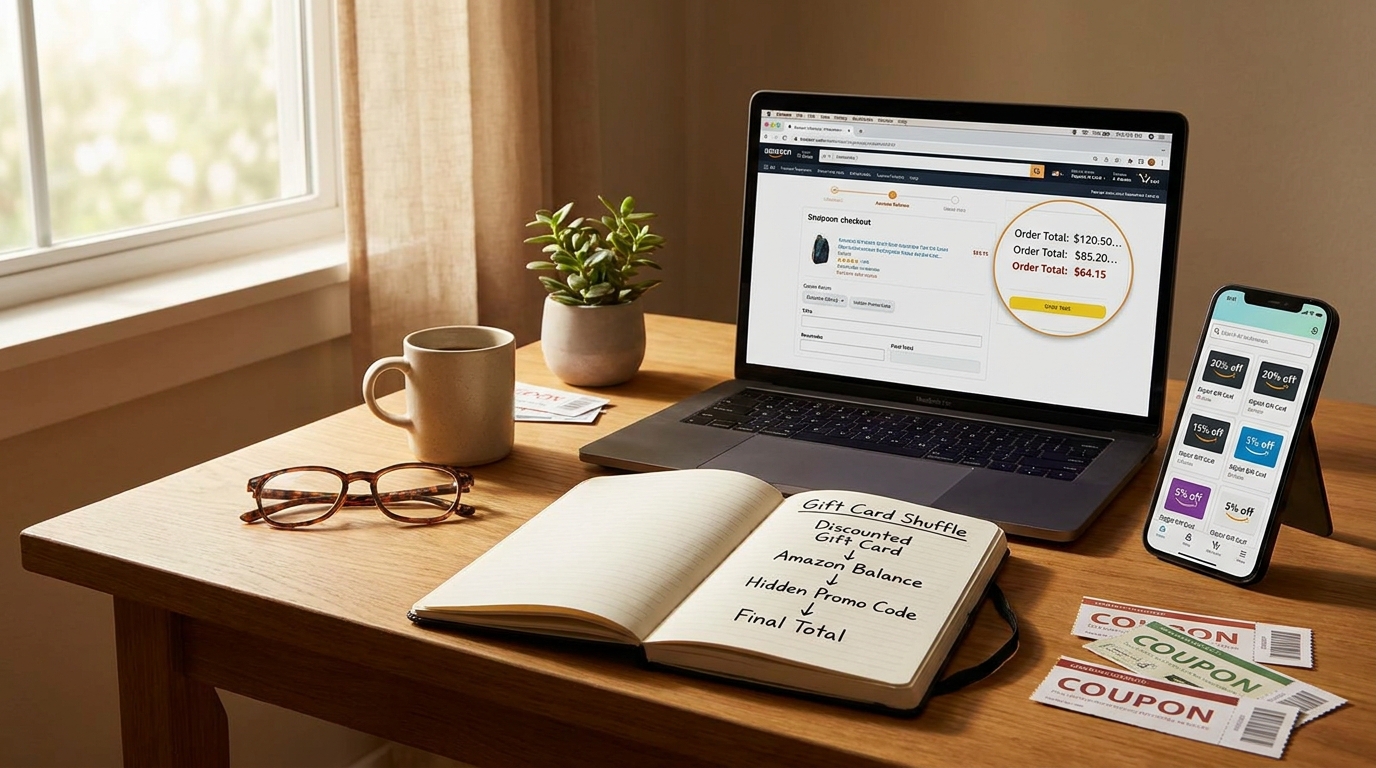
    You know that annoying feeling when Amazon says you saved 32 percent, but your bank account swears it was more like 8? That’s the part that gets people. You clip the coupon. You wait for the Lightning Deal. You paste in a promo code. Maybe you even click through a cashback site. Then the final total still looks weirdly high. You are not doing it wrong. You are just stopping one step too early. The trick many deal hunters are using right now is the amazon discounted gift card hack people call the “Gift Card Shuffle.” It is simple in plain English. Instead of paying Amazon with full-price money, you first buy Amazon gift card balance at a discount, load it to your account, then use that cheaper balance on top of coupons, promo codes, and cashback. That discount on the payment itself is what makes the final number finally look like those Reddit screenshots.

    ⚡ In a Hurry? Key Takeaways

    • The “Gift Card Shuffle” works by paying for Amazon purchases with discounted gift card balance, then stacking that with coupons, promo codes, and cashback.
    • Start with small amounts from trusted gift card marketplaces or card-linked offers, then load the balance before you check out.
    • Big savings are possible, but safety matters. Avoid random sellers, too-good-to-be-true discounts, and any source that feels sketchy.

    What the “Gift Card Shuffle” Actually Is

    Here is the easy version. You buy Amazon credit for less than face value. Then you use that credit to pay for your order.

    Example. You find a $100 Amazon gift card for $92 through a trusted promo, card-linked deal, or reputable resale platform. You load that $100 into your Amazon account. Now every dollar of that balance only cost you 92 cents.

    That means any coupon or promo code you use afterward is hitting an already discounted payment source. It is not magic. It is just math that most shoppers skip.

    Why This Feels Like a “Hack”

    Most people only focus on the product price. Smart deal hunters also focus on the money used to pay for the product.

    If you get 15 percent off the item and 8 percent off the gift card balance that pays for it, your real savings are better than the product page alone shows. Add cashback on top, and that is how ordinary stuff like paper towels, vitamins, phone chargers, and school supplies can land in the 25 to 40 percent savings range.

    If you have ever watched discounts seem to cancel each other out, you might also like The “Cashback Ladder Stack” Hack: How To Turn One Amazon Order Into 3 Hidden Rebates In 5 Minutes. It pairs nicely with this method because the gift card step is often the missing layer.

    Step-by-Step: How To Do the Gift Card Shuffle Safely

    Step 1: Build a short shopping list first

    Do not buy discounted Amazon balance just because you found some. Start with items you already planned to buy tonight or this week.

    That keeps you from turning “saving money” into “buying extra stuff.” It happens fast.

    Step 2: Check the Amazon item page for stackable discounts

    Look for:

    • Clip coupons
    • Limited-time promo codes
    • Lightning Deals
    • Subscribe & Save discounts, if it makes sense
    • Brand promotions like “save 20% when you buy 2”

    This matters because the better the item discount, the more valuable your discounted balance becomes.

    Step 3: Find discounted Amazon gift card balance from safe sources

    This is the important part. You want boring, reputable, and predictable. Not “some guy online with a screenshot.”

    Safer places to start include:

    • Well-known gift card marketplaces with buyer protection
    • Credit card or bank offers that give statement credits on gift card purchases
    • Warehouse clubs or big retail promos that occasionally discount gift cards
    • Cashback portals or apps that run limited promos on gift card merchants

    A good beginner target is 5 to 10 percent off. If you see 25 percent off Amazon balance from an unknown source, slow down. That is where trouble starts.

    Step 4: Buy a small amount first

    Try enough for one order, not your entire holiday budget. A $25 or $50 test run tells you a lot.

    You are checking three things:

    • Did the code redeem cleanly?
    • Did the marketplace deliver exactly what was promised?
    • Did your savings actually survive checkout?

    Step 5: Load the gift card to your Amazon account before checkout

    Redeem it to your Amazon balance first. Do not wait until the last second if the promo code or coupon has time pressure.

    That way, when you are ready to check out, the discounted balance is already sitting there.

    Step 6: Apply coupons and promo codes in the right order

    Amazon usually handles on-page coupons automatically once clipped, but you still need to confirm the discount appears at checkout. Then add any promo code and double-check the subtotal again.

    Only after that should you confirm payment is drawing from your gift card balance.

    Step 7: Add cashback last, and do not break the chain

    If you are using a cashback portal, start the click-through fresh in the same browser session. Avoid opening ten tabs, switching devices, or adding unrelated coupon browser extensions at the last second.

    Cashback tracking can be fussy. Clean and simple wins.

    A Real-World Example

    Let’s say you want household basics totaling $60.

    • The items have a clipped coupon worth 15 percent off, dropping the total to $51.
    • You bought a $50 Amazon gift card for $45 from a trusted source.
    • You use that $50 discounted balance plus $1 from your regular payment method.
    • You also get 4 percent cashback through a portal on the eligible order amount.

    Your sticker total is $51, but your real out-of-pocket cost is closer to $46. That is before counting the cashback. Once the cashback posts, your effective total drops again.

    That is why the amazon discounted gift card hack gets so much attention. The savings hit in layers.

    Best Items for This Strategy

    This works best on practical purchases, not impulse gadgets you did not need.

    Good targets include:

    • Groceries and pantry items
    • School supplies
    • Toiletries
    • Cleaning products
    • Cables and backup chargers
    • Pet supplies
    • Vitamins and household basics

    These are the items where a 20 to 35 percent total savings rate actually changes your monthly budget.

    Where People Mess This Up

    Buying from risky sellers

    If the source feels murky, skip it. A fake discount is not a discount.

    Buying too much balance too early

    Amazon balance is useful, but it is still locked to Amazon. Do not tie up hundreds of dollars just because a deal looked exciting.

    Forgetting the order of operations

    Item discount first. Gift card balance loaded second. Cashback click-through right before checkout.

    Chasing every stack

    Sometimes the clean deal is the best deal. If combining six moving pieces makes you nervous, do three. You do not need a circus act to save money.

    How To Spot a Safe Discounted Gift Card Opportunity

    Use this quick gut-check list:

    • The seller or platform has a solid reputation
    • There is clear buyer protection or refund support
    • The discount is believable, not absurd
    • The delivery method is clear
    • You can test with a small amount first

    If you cannot explain to a friend how the discount is happening, do not send money yet.

    How This Fits With Promo Codes and Secret Coupon Tricks

    The nice thing about this method is that it does not replace your usual coupon hunting. It improves it.

    Think of it like putting cheaper gas in the same car. The route stays the same. The trip just costs less.

    So if you already track hidden Amazon promo codes, category coupons, and limited-time brand discounts, the Gift Card Shuffle becomes your extra layer. It is often the difference between “decent deal” and “why didn’t I do this sooner?”

    At a Glance: Comparison

    Feature/Aspect Details Verdict
    Savings potential Discounted gift card balance can add 5 to 10 percent savings before item coupons and cashback are even counted. Very good when stacked carefully
    Ease of use The process is simple after one practice run, but timing and order matter. Beginner-friendly with a small test purchase
    Risk level Safe if you use reputable sources and modest amounts. Risky if you chase huge discounts from unknown sellers. Low to moderate, depending on source

    Conclusion

    If your Amazon receipts never seem to match the “look what I paid” brag posts, this is probably the missing piece. The Gift Card Shuffle is not about gaming the system. It is about paying with discounted balance first, then letting your coupons, promo codes, and cashback do their job on top. Right now, deal communities are buzzing about stacking these layers to reach 25 to 40 percent savings on everyday buys, not just Prime Day showpieces. Keep it clean. Use safe sources. Start small. Then use it on real-life stuff like groceries, school supplies, or backup chargers. That is where this trick stops being internet chatter and starts saving you money tonight.

  • The “Hidden Social Share” Hack: How Amazon’s Off-Platform Promo Links Unlock Secret Checkout Prices

    The “Hidden Social Share” Hack: How Amazon’s Off-Platform Promo Links Unlock Secret Checkout Prices

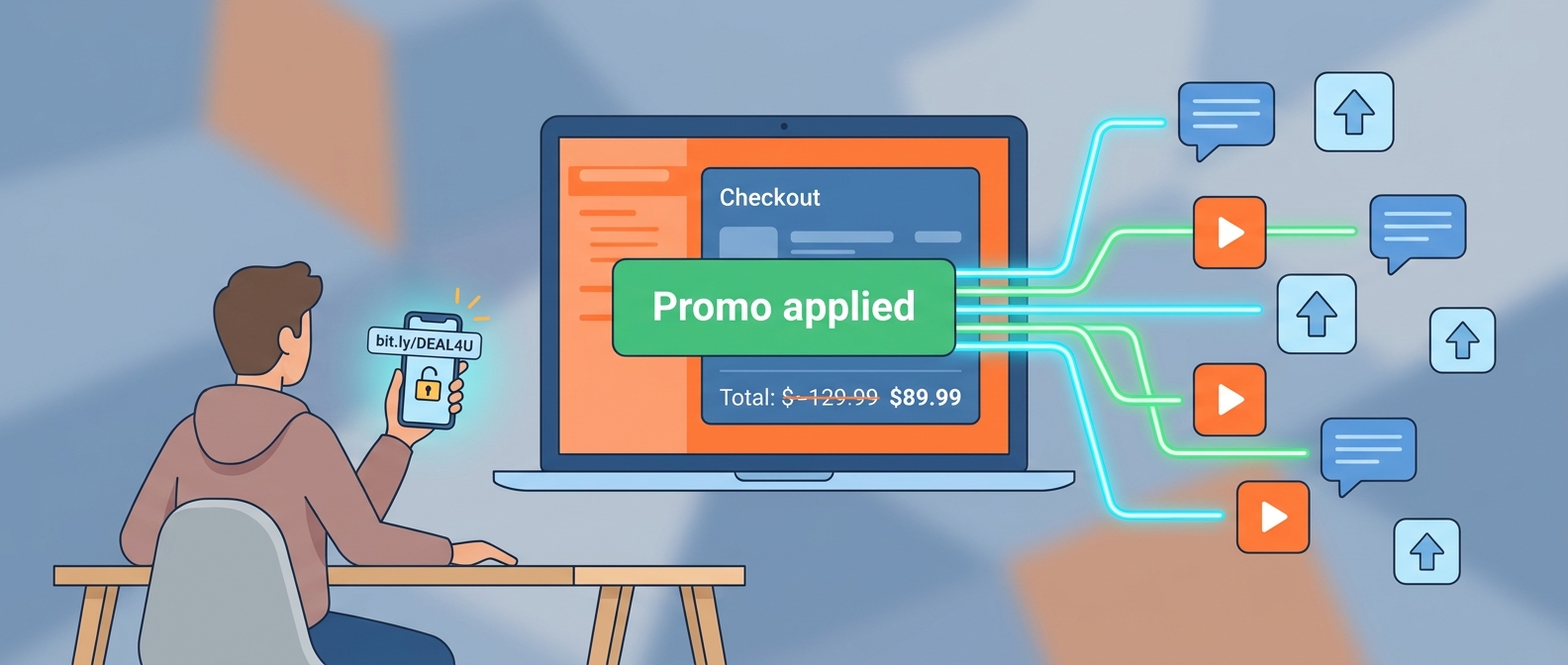
    You are not imagining it. You see someone on TikTok or Reddit grab an Amazon gadget for 60 percent off, then you search the exact same item and get the plain old full price. It is frustrating, and it makes a lot of shoppers feel like they are always arriving five minutes too late. The annoying part is that you are often not doing anything wrong. Amazon has been pushing more of its steep discounts into off-platform campaigns, creator links, and social-share funnels instead of the older public promo pages people used to check. So the deal is real, but it may only appear if you enter through the right link. That is the hidden social share trick. If you know how these links work, and where to find fresh ones, you can often trigger checkout prices that never show up in regular Amazon search results. That is where the real savings are hiding right now.

    ⚡ In a Hurry? Key Takeaways

    • Many of the best Amazon discounts now live inside social-share or creator links, not in normal search results or old promo hubs.
    • If a deal video shows a huge discount, tap the exact link, add the item quickly, and always verify the final price at checkout before paying.
    • Be careful with random coupon sites. Dead codes and recycled listings are common, so tested live links are worth more than copied promo text.

    What the “hidden social share” hack actually is

    Despite the word hack, this is not shady. You are not breaking into anything. You are simply entering Amazon through a campaign link that was built for a creator, a social ad, or a limited promo push.

    Think of it like a side door. The product is the same. The seller is the same. But the discount is attached to that entry path, not always to the public listing you see in search.

    That is why a regular Amazon search can show $39.99 while a weird, shortened social link quietly drops it to $19.99 at checkout.

    Why this is happening more now

    Amazon used to make some discounts easier to spot through public promo pages and broader coupon visibility. That system has become less useful, and some of those old pages have been deprecated or just stopped being the best place to look.

    At the same time, brands still want fast sales. They want outside traffic. They want creators posting “look what I found” videos. So more aggressive percentage-off offers are being routed through off-platform promotions instead.

    That means the best amazon secret promo code social media links often show up in places like:

    • TikTok creator captions
    • Reddit deal threads
    • Facebook deal groups
    • Telegram bargain channels
    • Influencer storefront pages
    • Shortened tracking links shared in comments or bio pages

    Why normal searching fails

    Most shoppers do what seems logical. They copy the product name into Amazon search, find the item, and expect the same discount to appear. Usually, it does not.

    That is because many of these offers are attached to one or more of the following:

    A specific referral path

    The link itself may carry tracking or campaign details that help trigger the promo.

    A clipped coupon plus hidden promo stack

    You might need to enter through the campaign link, then clip a coupon, then see the rest come off at checkout.

    A limited audience or time window

    Some deals are live only for a short burst, or until a set number of redemptions is used up.

    A variation-specific offer

    The blue version might be discounted. The black one might not. The social post often skips that detail.

    How to spot a real social-share discount

    The easiest clue is when a creator or deal hunter does not post a plain coupon code by itself. Instead, they tell you to “use my link” or “tap the product link in bio.”

    That usually means the discount is not fully public.

    Other signs a deal may be tied to a hidden social-share link:

    • The product page shows a small coupon, but the huge savings only appear at checkout
    • The URL looks long, messy, or shortened
    • The deal works for some people but not others after they search manually
    • The creator warns that the promo may disappear fast

    If this sounds familiar, you may also want to read The ‘Influencer Cart Clone’ Hack: How To Hijack TikTok’s Secret Amazon Promo Codes Before They Vanish, which explains why those flashy creator discounts seem to vanish the second you try to copy them.

    How to use these links without wasting your time

    This is the practical part. If you want the best shot at a secret campaign price, use a simple routine.

    1. Open the exact link first

    Do not search the item manually right away. Start with the creator or social-share URL exactly as posted.

    2. Check the listing details carefully

    Look at size, color, pack count, and seller. Social deals often apply only to one specific version.

    3. Clip any visible coupon

    Even when the social link is the key, there may still be a checkbox coupon on the page that needs to be clipped.

    4. Add to cart and go to checkout

    This is where the truth shows up. The final discount often appears only in the last step before payment.

    5. Move quickly, but do not panic-buy

    These promos can expire fast. Still, always confirm the final total before placing the order.

    6. If it fails, do not keep testing random codes forever

    That is where people waste 20 minutes. If the live link no longer works, the promo may simply be dead.

    Why coupon sites keep letting shoppers down

    A lot of coupon websites are basically graveyards. They copy promo text, keep expired pages up, and hope something still sticks. That is why you end up trying five codes at checkout and watching every one fail.

    Social-share links are different because they are often tied to a currently running campaign, not a dusty list of old promo attempts.

    That does not mean every social link works. Plenty expire. But a tested live link is much more useful than a page full of recycled coupon guesses.

    Where these “secret” links usually surface first

    If you want a better system, stop relying on generic searches like “Amazon promo code today.” Those broad searches are usually the slowest path.

    Fresh off-platform promo links usually appear first in smaller communities where people post in real time. That can include niche subreddits, creator comments, short-form video descriptions, and private bargain groups.

    The ugly truth is that the best deal is often hidden inside the ugliest URL.

    How to stay safe while chasing hidden Amazon deals

    You should absolutely be a little cautious here. Not because the concept is dangerous, but because the internet is messy.

    Stick to links that still land on Amazon

    If the final checkout happens on Amazon and the seller looks normal, that is a good sign. If the link sends you through multiple strange pages, back out.

    Never trust screenshots alone

    People love posting “look what I paid” screenshots. Nice, but not proof the deal is still live.

    Watch for fake urgency

    Some promos are truly limited. Others use countdown drama to rush you. The final checkout price is what matters.

    Do not save payment info on random third-party sites

    The whole point is to use an outside link that ends on Amazon, not to buy through a mystery page.

    What to do when the price does not match the video

    This happens all the time. A creator shows a huge discount, but when you click, you get something less exciting.

    Usually, one of four things happened:

    • The promo reached its redemption limit
    • The creator linked a specific variation and you landed on another one
    • The coupon needed to be clipped before checkout
    • The video is old, but still being pushed by the algorithm

    If you miss one deal, do not assume the whole method is fake. It just means these campaigns are moving targets. Timing matters.

    Why this matters for regular shoppers

    You should not need a secret decoder ring to buy a kitchen gadget at the same price you just saw online. But that is where things are right now.

    Amazon and sellers are rewarding outside traffic. Creators are acting like mini deal funnels. Public promo pages are no longer the whole story. So if you only search on Amazon the old-fashioned way, you are often seeing the least interesting price.

    That is exactly why communities that monitor and test working social-share links have become useful. They cut through the dead-code clutter and focus on promos that still fire at checkout.

    At a Glance: Comparison

    Feature/Aspect Details Verdict
    Regular Amazon search Shows standard listing price and visible coupons, but often misses creator or social campaign discounts. Easy, but often not the cheapest path.
    Old coupon-code sites Frequently filled with expired, copied, or generic codes that fail at checkout. Low trust, high time-waste.
    Social-share promo links Can unlock hidden campaign pricing tied to creators, niche communities, or limited external funnels. Best chance at “secret” discounts if the link is still live.

    Conclusion

    The big takeaway is simple. If you keep missing those flashy Amazon deals from TikTok and Reddit, the problem is not always bad luck. Right now Amazon is quietly shifting more aggressive percentage-off promos into creator campaigns, targeted social pushes, and external funnels instead of the old public promo-code hub. That means the best savings are often locked inside short, awkward links that never show up in a normal search. Once you know that, you can stop wasting time on dead code lists and start looking where the live discounts actually are. Better yet, when a community is actively monitoring and testing which social-share links still work at checkout, you get a real shortcut to those hidden prices before they vanish. That is not gaming the system. It is finally shopping with the right map.

  • The “Cashback Ladder Stack” Hack: How To Turn One Amazon Order Into 3 Hidden Rebates In 5 Minutes

    The “Cashback Ladder Stack” Hack: How To Turn One Amazon Order Into 3 Hidden Rebates In 5 Minutes

    You are not imagining it. Amazon discounts really do seem to disappear the second you try to combine them. You clip a coupon, paste in a promo code, click through a cashback app, and somehow the final price goes up or the rebate vanishes into thin air. That is why so many shoppers give up and assume stacking is just internet folklore.

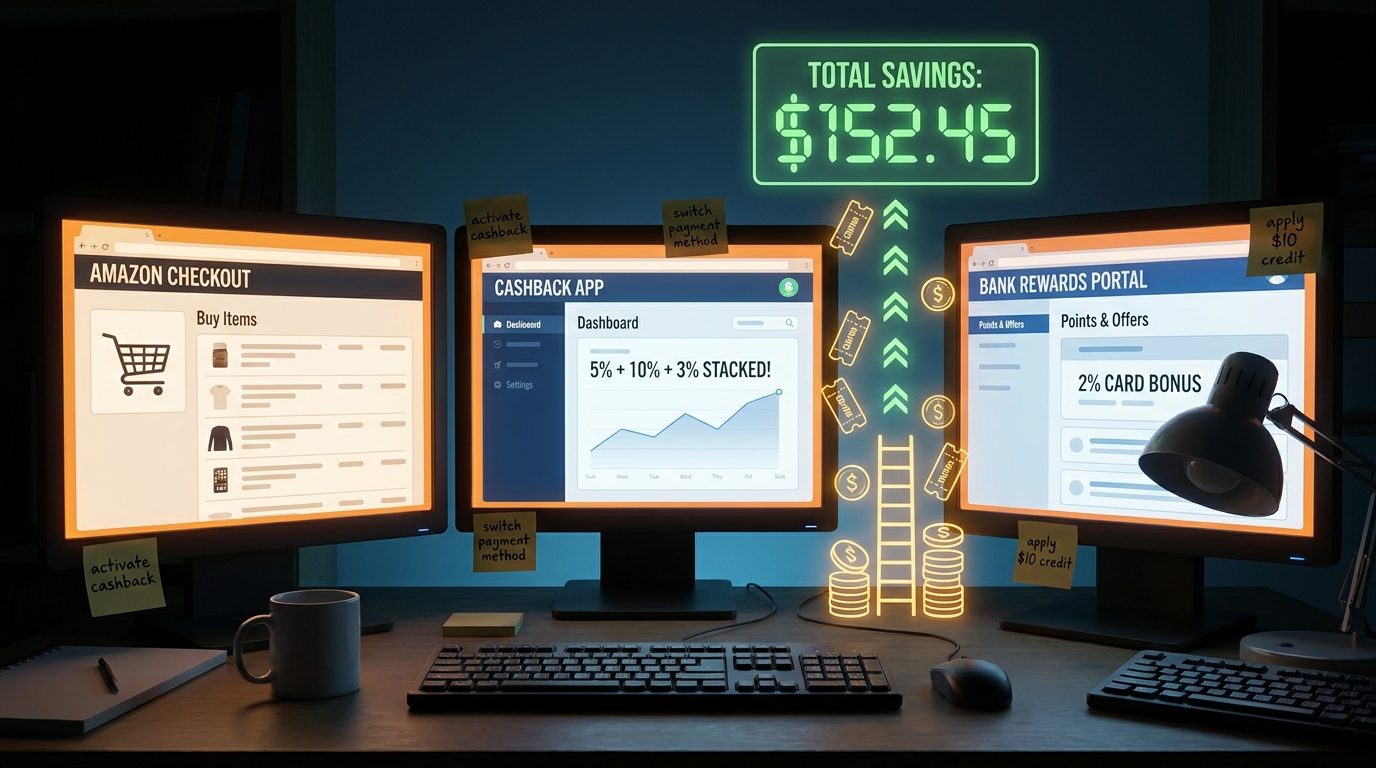
    The good news is there is a repeatable way to do this. If you want to know how to stack amazon cashback and promo codes without breaking the deal yourself, think in layers. First, lock in outside cashback. Second, check for a hidden bank or card portal boost. Third, add Amazon’s own targeted credits, coupons, or promo offers in the right order. The trick is not finding magic codes. It is keeping one discount from canceling another. Once you know the sequence, you can turn one order into two or three real rebates in about five minutes.

    ⚡ In a Hurry? Key Takeaways

    • Yes, you can often stack Amazon savings by combining external cashback, a bank or card portal offer, and Amazon’s own coupon or targeted credit.
    • The safest order is: activate card or bank offer first, click through cashback second, then clip coupons and apply Amazon promos last at checkout.
    • Do not use random browser coupon tools during checkout. They can overwrite your cashback tracking or trigger a different discount path.

    The simple version of the cashback ladder stack

    Think of this as a three-rung ladder.

    Rung 1: External cashback

    This is your Rakuten, TopCashback, BeFrugal, or similar app. You click out from their site or app into Amazon. If the category qualifies, you earn a percent back on the purchase.

    Rung 2: Bank or card portal boost

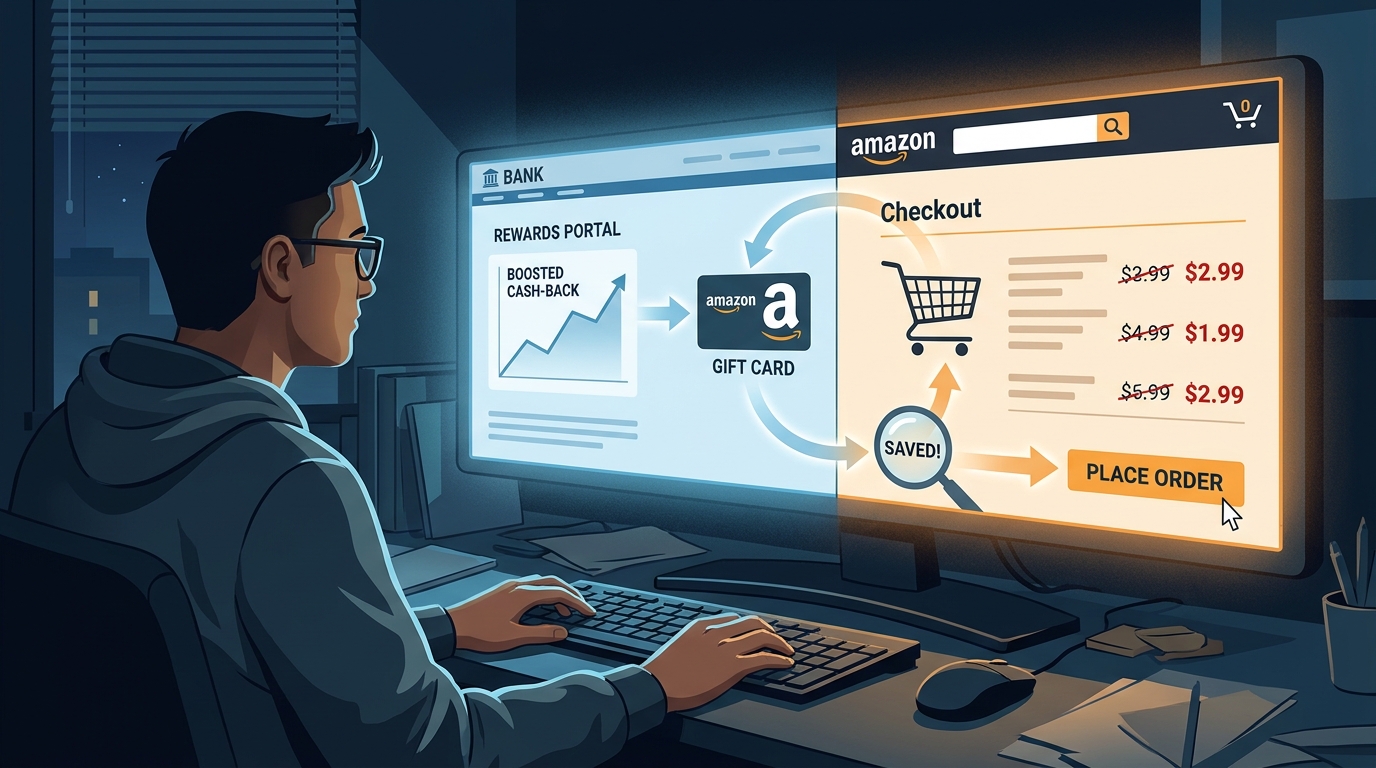
    This is the part most people miss. Some banks, credit cards, and reward malls quietly offer extra points, statement credits, or bonus cash back for Amazon purchases. If you have never checked these, read The ‘Bank Portal Loop’ Hack: How To Turn Boring Reward Malls Into Secret Amazon Promo‑Code Level Prices. It explains why these boring-looking portals can beat the usual coupon hunt.

    Rung 3: Amazon’s own discount layer

    This includes clipped coupons on the product page, spend-X-get-Y credits, gift card reload promos, no-rush shipping credits, Prime card incentives, or one-time promo codes tied to your account.

    The stack works when each layer is activated without breaking the next one.

    The 5-minute playbook that actually works

    Step 1: Start with the item and check if it is even stack-friendly

    Open the Amazon product page first, but do not check out yet.

    Look for these clues:

    • A green coupon checkbox on the product page
    • A line that mentions a promotional credit after purchase
    • A “Shop items” page tied to a spend threshold deal
    • Category exclusions that say cashback may not apply

    If the item is sold by a third-party seller, cashback tracking and promo eligibility can get messy. “Ships from and sold by Amazon” is usually easier.

    Step 2: Save the item for later, then back out

    Add the item to your cart or save it for later. This is just so you do not lose it while checking the other layers.

    Then close extra tabs. Seriously. Amazon tracking gets weird when you bounce around too much.

    Step 3: Activate your bank or card offer first

    Before you click through a cashback site, check these places:

    • Amex Offers
    • Chase Offers
    • Capital One Offers
    • Bank of America merchant deals
    • Your airline or hotel shopping portal

    You are looking for things like:

    • Spend $50 on Amazon, get $10 back
    • Earn 3 extra points per dollar
    • Get a bonus for buying through a shopping portal

    Add the offer to your card if needed. If it is a portal, read the fine print. Some portals want you to start the Amazon session through them. Others are card-linked and do not care how you arrive at checkout.

    Step 4: Open your cashback app and click through to Amazon

    Now go to Rakuten or your cashback app of choice and search Amazon. This is where a lot of people get disappointed, because Amazon cashback is often category-based, not sitewide.

    That means you might get 10 percent on select home goods, 3 percent on tools, and nothing on electronics.

    Check the exact category payout before clicking. Then click through to Amazon and start a fresh shopping session.

    Step 5: Clip Amazon coupons after you land on Amazon

    Once you are back on the product page, clip the coupon if one is available.

    This usually does not break cashback by itself. What can break cashback is using an outside extension that tries multiple codes or sends you through another referral link.

    Step 6: Apply any Amazon promo code or targeted credit at checkout

    This is where targeted offers matter. Amazon often has account-specific promos like:

    • Use one Membership Rewards point, get up to 40 percent off
    • Reload $100 gift card, get $10 credit
    • Spend $60 on select items, get $15 promotional credit

    Apply these carefully. Read whether the deal is instant at checkout or delivered later as a promotional credit. Those are not the same thing.

    If the offer says “credit applied to your account after shipping,” do not expect the cart total to drop. The discount is real, but it comes later.

    Why people accidentally kill their own rebate

    Usually it is one of five things.

    1. They click too many cashback sites

    Only one referral source gets credit. Last click usually wins. If you clicked Rakuten, then Capital One Shopping, then Honey, you probably just overwrote the first one.

    2. They let a browser extension “test codes”

    This is the fastest way to lose tracking. Those tools often inject a new referral path or apply a code that is not compatible with your current offer.

    3. They confuse coupons with post-purchase credits

    A clipped coupon lowers today’s price. A promotional credit may only show up after the item ships, and sometimes only for future eligible items sold by Amazon.

    4. They use the wrong payment method

    If your card-linked offer is on Card A but you check out with Card B, that layer is gone.

    5. They buy in a category with zero cashback

    Amazon cashback portals often exclude gift cards, subscriptions, digital content, some electronics, and certain third-party sellers.

    A real-world stacking example

    Let’s say you are buying a $200 kitchen appliance.

    • Amazon product page coupon: 10% off, saves $20
    • Rakuten category cashback: 8%, earns $14.40 if cashback tracks on the discounted subtotal and excludes tax
    • Amex Offer: Spend $150, get $20 back
    • Amazon targeted promo: Spend $100 on select home items, get a $15 future credit

    Your math could look like this:

    • Starting price: $200
    • Coupon clipped: down to $180
    • Amex statement credit: effective cost down to $160
    • Cashback earned: effective cost down to about $145.60
    • Future Amazon credit: effective value down to $130.60

    That is not a fake coupon site fantasy. That is just proper stacking, in order.

    What counts as a “hidden rebate” on Amazon right now

    Not every deal is a classic promo code. Some of the best savings are hidden in plain sight.

    Targeted payment promos

    Amazon regularly runs offers tied to one tiny reward point from Amex, Discover, or Chase. If your account is targeted, using a single point can unlock a big percentage discount.

    Delayed promotional credits

    No-rush shipping credits, digital credits, and category-specific future credits are easy to ignore because they do not lower today’s total. But they still count if you know you will use them.

    Gift card and reload offers

    Sometimes Amazon gives a bonus for adding funds or buying a gift card. Sometimes banks give a bonus for the same transaction. You need to read the exclusions, but this can be another quiet layer.

    Prime card or store card financing perks

    If your card includes extra back on Amazon purchases or special financing, compare that with portal cashback. Sometimes the instant financing option is less valuable than a stacked rebate.

    The safest checkout sequence

    If you want one simple rule to follow, use this order:

    1. Check the item and confirm it has a coupon or promo eligibility.
    2. Activate card-linked offers in your bank or credit card account.
    3. Click through your chosen cashback portal or app.
    4. Return to the item page and clip the Amazon coupon.
    5. At checkout, use the exact payment method tied to your offer.
    6. Apply any Amazon promo code or targeted payment discount.
    7. Take screenshots before placing the order.

    The screenshot part matters more than people think. Save the cart total, offer terms, and confirmation page. If cashback fails to track or a statement credit never posts, you have proof.

    When not to bother stacking

    Sometimes the stack is more trouble than it is worth.

    Skip the gymnastics if:

    • The item is low-cost and the savings are only a few dollars
    • The portal excludes the category
    • The promo requires subscribing, financing, or using a card you do not want
    • The “credit” is only for digital items you will never buy

    The goal is not to win the internet. It is to pay less without creating a headache.

    If a rebate does not show up, here is what to check

    Missing cashback

    Wait the portal’s tracking window. Some show as pending within hours. Others take days. Then file a missing cashback claim with your click timestamp, order date, and subtotal.

    Missing Amazon promotional credit

    Check your order confirmation and the original promo terms. Many credits post after shipment, not at purchase. Some only work on items sold by Amazon.

    Missing card statement credit

    Look at the merchant coding, the exact card used, and the offer expiration date. Statement credits can take several days to appear.

    At a Glance: Comparison

    Feature/Aspect Details Verdict
    External cashback Best for category-based percent back through apps like Rakuten or TopCashback. Tracking can fail if you click around too much. Worth using, but keep your session clean.
    Bank or card portal boosts Can add statement credits or bonus points that stack with Amazon discounts. Often overlooked because they are hidden inside your bank account. The easiest “extra” layer to miss, and often the most valuable.
    Amazon coupons and targeted credits Includes clipped coupons, payment promos, spend-X-get-Y deals, and delayed promotional credits. Terms vary a lot. Great when targeted, but read the fine print before assuming the savings are instant.

    Conclusion

    Amazon stacking is real. It is just fussy. Right now the best deals are coming from short-fuse promos, rotating cashback rates, and quiet card-linked incentives that most shoppers either miss or accidentally cancel. That is why a simple routine matters so much. If you activate the outside cashback, add the hidden bank or card boost, and then layer in Amazon’s own coupon or credit in the right order, you stop relying on random luck. You start using a system. Done right, this can shave 20 to 40 percent off some purchases without touching shady code sites or wasting half an hour on dead coupon lists. Keep the session clean, use the right card, take screenshots, and treat every Amazon order like a three-step stack instead of a one-click impulse buy.

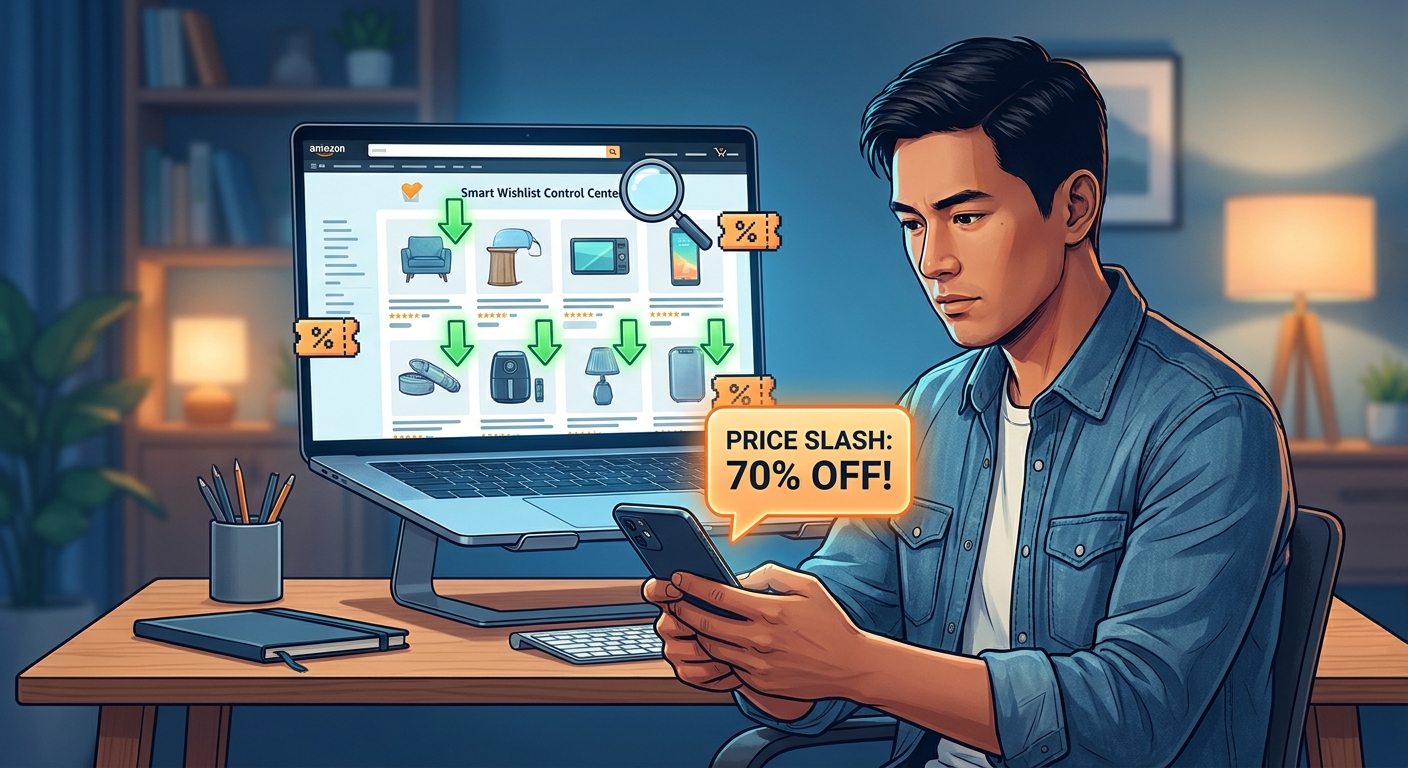
  • The “Auto Wishlist Price-Trip” Hack: How To Turn Amazon’s Price Alerts Into Secret Promo-Code Level Drops

    The “Auto Wishlist Price-Trip” Hack: How To Turn Amazon’s Price Alerts Into Secret Promo-Code Level Drops

    You know the routine. You search for an Amazon promo code, click three sketchy coupon sites, copy a code that expired last month, and still end up paying full price. Meanwhile, the real bargains often come from something much less flashy. A quiet price drop. A tiny coupon box on the product page. A short window right after Prime Day, Black Friday, or a random Tuesday afternoon when Amazon starts nudging prices around. That is why the best Amazon wishlist price drop alerts hack is not code hunting at all. It is building a smart wishlist and setting up alerts that only fire when an item hits your personal buy-now number. Done right, this feels less like bargain hunting and more like having a calm little system working in the background. No endless scrolling. No fake urgency. Just your phone buzzing when a product you actually want drops into real deal territory.

    ⚡ In a Hurry? Key Takeaways

    • The best Amazon wishlist price drop alerts hack is to track specific items with your own target prices instead of chasing random promo codes.
    • Use an Amazon wishlist plus a price tracker like CamelCamelCamel or Keepa, then check for on-page coupons when the alert hits.
    • This method is safer and more useful than coupon-code sites because it focuses on real checkout prices, not fake or expired offers.

    Why this works better than promo code hunting

    Most Amazon shoppers are looking in the wrong place.

    They hunt for codes. Amazon often does not work that way. Many of its best discounts show up as one of these:

    • A direct price drop
    • A clickable coupon on the product page
    • A limited-time sale that stacks with a coupon
    • A seller discount that appears for only a few hours

    The problem is simple. If you are not already watching that item, you miss it.

    That is where the Amazon wishlist price drop alerts hack comes in. You make a shortlist of items you truly want, decide the price that would make you buy, and let tracking tools do the boring part.

    The smart wishlist system, step by step

    Step 1: Build a clean wishlist, not a giant dumping ground

    Start with a dedicated Amazon wishlist for items you are seriously considering. Not every maybe. Not every shiny gadget you saw on social media. Keep it tight.

    A good smart wishlist usually has:

    • 10 to 25 items
    • Products you would actually buy in the next 1 to 3 months
    • Specific models, sizes, and colors

    This matters because alerts are only useful if they mean something. If your list is stuffed with random junk, your phone becomes another source of noise.

    Step 2: Set your personal “buy-now” price for each item

    This is the part most people skip.

    Do not just say, “Alert me when it gets cheaper.” Decide on the exact number. For example:

    • Air fryer at $79 or less
    • Noise-canceling headphones at $199 or less
    • Protein powder when the price per ounce drops below your usual brand

    Your target should be based on what the item normally sells for, not the inflated list price with a giant fake discount next to it.

    If you are not sure what “cheap” really looks like, check the product’s price history. That shows whether today’s “deal” is actually normal.

    Step 3: Use a tracker that watches price history and drops

    Amazon itself does not give great custom alert tools for most shoppers, so you will want a tracker.

    The two most popular choices are:

    • CamelCamelCamel, simple and beginner-friendly
    • Keepa, more detailed and powerful

    Paste the Amazon product link into one of those services and set your desired alert price.

    Now the system starts working for you. When the product dips to your number, you get the alert.

    Step 4: Check for the hidden coupon box before you buy

    This is the part that feels like a secret promo code.

    When your alert arrives, open the Amazon product page and look carefully for:

    • A “Save 5%” or “Save 20%” coupon checkbox
    • A Prime-only coupon
    • A subscribe-and-save extra discount
    • A limited seller promotion shown below the price

    These little boxes often appear and disappear fast. That is why people miss them. The alert gets you to the page at the right moment. The coupon is the bonus layer.

    Sometimes the price tracker catches the drop, but not the coupon itself. That is fine. Your job is to treat the alert as a signal to inspect the page right away.

    Step 5: Take a screenshot before checkout

    This sounds fussy, but it is smart.

    Amazon pricing can change quickly. If you see a price drop and a coupon, take a quick screenshot before adding to cart. That gives you a record in case the discount disappears mid-checkout or you need to compare the final price.

    How to spot a real deal versus a fake discount

    Not every drop is a bargain.

    Here is a simple filter I use:

    • Check the 30 to 90-day price history. If today’s sale price happens every week, it is not special.
    • Compare the final checkout price. Include coupons, subscribe-and-save discounts, and shipping if any.
    • Watch out for inflated “list prices.” A product marked down from $129 to $79 may really live at $82 most of the year.
    • Check the seller. Stick with Amazon or reputable sellers for expensive items.

    The goal is not to get a discount. It is to get a genuinely good price.

    Best times to use this hack

    This method works all year, but it is especially useful right after big sales events.

    Why? Because Amazon often keeps testing prices after the event ends. Some items rebound. Others drop again quietly. Some sellers add coupons to stay competitive after the big rush.

    Watch especially during:

    • The week after Prime Day
    • The days right after Black Friday and Cyber Monday
    • Holiday weekends
    • End-of-month seller push periods

    This is when patient shoppers often beat the people who panic-bought during the main event.

    A simple example of the hack in real life

    Let’s say you want an electric toothbrush that usually sells for about $99.

    • You add it to a dedicated Amazon wishlist
    • You decide your real buy-now number is $69
    • You set an alert in CamelCamelCamel or Keepa for $69
    • Three days after Prime Day, the alert hits because the price falls to $71
    • You click through and notice a hidden 10% coupon box on the product page
    • Your final price drops below $64

    That is the trick. The price alert got you there. The coupon did the rest.

    Mistakes that ruin the system

    Tracking too many items

    If everything is “important,” nothing is. Keep your list focused.

    Setting weak thresholds

    If you ask for an alert every time the price drops by $2, you will tune out the notifications. Set numbers that matter.

    Ignoring the final page

    The whole point is that Amazon’s best discounts are often hiding on the product page itself. Do not buy straight from the alert screen without looking.

    Assuming every alert is urgent

    Some items dip often. If the price history shows regular drops, you may want to wait for an even better one.

    Which tool should beginners use?

    If you want easy, start with CamelCamelCamel.

    If you want more detail, start with Keepa.

    CamelCamelCamel is cleaner for casual shoppers. Keepa is better if you like graphs, seller data, and more advanced tracking. Either one can power this Amazon wishlist price drop alerts hack just fine.

    Is this better than deal forums and coupon sites?

    For most people, yes.

    Deal forums can be useful, but they are noisy. Coupon sites are even worse. You waste time sorting fake wins from real ones.

    This system flips that around. Instead of reacting to everybody else’s deals, you set your own rules first.

    That is why it feels calmer. And usually saves more money.

    At a Glance: Comparison

    Feature/Aspect Details Verdict
    Promo code hunting Often leads to expired, fake, or tiny discounts that do not match the exact product you want. Low success rate. High annoyance.
    Smart wishlist plus price alerts Tracks only your chosen products and alerts you when they hit your preset target price. Best balance of effort and savings.
    Coupon check at alert time Lets you catch hidden on-page coupons or stackable discounts that trackers may not fully show. The secret sauce. Always worth 10 extra seconds.

    Conclusion

    If you are tired of chasing Amazon promo codes that go nowhere, this is the better move. Right after Prime Day and other big events, Amazon quietly plays with prices and rolls out short-lived coupons that almost nobody sees unless they happen to be on the product page at the right second. A smart wishlist changes that. You pick the items, set real thresholds, and let the alerts do the watching. Then, when your phone buzzes, you check the page for that extra coupon box and decide fast. It turns the chaos of price swings into a calm, rule-based setup where your phone only buzzes when an item you actually want drops into genuine steal territory. That is the whole win. Less noise, fewer fake deals, and a much better shot at paying the price you actually wanted.

  • The ‘Bank Portal Loop’ Hack: How To Turn Boring Reward Malls Into Secret Amazon Promo‑Code Level Prices

    The ‘Bank Portal Loop’ Hack: How To Turn Boring Reward Malls Into Secret Amazon Promo‑Code Level Prices

    You know that feeling. You finally find an Amazon item you need, clip the little coupon, try Honey or another browser add-on, search Reddit for a working code, and still end up paying basically full price. Meanwhile, your bank or card rewards portal is sitting there like wallpaper, offering weird promos most people ignore. That is where the real trick often starts. The so-called amazon bank rewards portal hack is not a shady loophole. It is just a smarter route. Instead of hoping Amazon shows you a big public discount, you buy discounted Amazon gift cards or trigger boosted cash back through your bank, card issuer, or shopping portal first, then use that value at normal checkout. The item page never shows a magical promo code, but your final cost can drop like one was applied. It is boring on the surface. That is exactly why so many shoppers miss it.

    ⚡ In a Hurry? Key Takeaways

    • The amazon bank rewards portal hack works by buying Amazon value through a bank, card, or cash-back portal first, then spending that balance on Amazon like a private discount.
    • Check for short-window promos on Amazon gift cards, portal boosts, and card-linked offers before you shop. The order matters.
    • Stay safe by using only official bank portals, major cash-back sites, and terms that clearly allow gift card purchases.

    What the “bank portal loop” actually is

    Let’s make this simple.

    You start outside Amazon. Not on the product page. Not in a coupon extension. You check whether your bank rewards mall, your credit card offers page, or a cash-back shopping portal is paying extra on either Amazon itself or on stores that sell Amazon gift cards.

    Then you buy Amazon spending power at a discount, or earn boosted rewards while doing it. After that, you load the gift card to your Amazon balance and shop as usual.

    That is the loop.

    The reason it feels like a secret promo code is because the savings happen before checkout, not during checkout.

    Why this works better than chasing public Amazon promo codes

    Public Amazon codes are usually limited, item-specific, account-specific, or dead by the time most people see them. Portal offers are different. They are often tied to your bank login, your rewards program, or a partner store promotion. That means fewer people are piling in at once.

    Also, these promos move fast. A bank may offer 5 percent back at Amazon for three days. A card issuer may give a statement credit for a qualifying purchase. A rewards mall might quietly sell gift cards at a discount or with bonus points. Those are not always headline deals, but stacked together they can beat the obvious coupon blogs.

    If you liked the idea of stacking hidden savings, you would probably also like The ‘Gift Card Double-Dip’ Hack: How Stacking Quiet Card Bonuses With Amazon Deals Becomes a Secret Promo Code. It covers the same basic mindset. Get the discount before Amazon ever totals your cart.

    Where to look first

    1. Your bank’s rewards mall or shopping portal

    Many banks have a “shop with us” section buried inside online banking. It may be called rewards, shopping deals, earn more, bonus mall, or offers. Look for Amazon, gift cards, department stores, office supply stores, grocery chains, and big-box retailers.

    You are looking for things like:

    • Extra cash back at Amazon
    • Bonus points per dollar at a store that sells Amazon gift cards
    • Discounted gift cards in the rewards catalog
    • Limited-time spend offers, like spend $100 and get $10 back

    2. Credit card “offers” pages

    American Express, Chase, Citi, Bank of America, Capital One, and others often run merchant-specific offers. Sometimes it is direct Amazon spending. Sometimes it is through places like Best Buy, Staples, Walgreens, Kroger, or other sellers that may carry Amazon gift cards.

    The key point is this. A deal does not have to say “Amazon” to help you save on Amazon.

    3. Cash-back portals

    Rakuten, TopCashback, BeFrugal, and airline shopping portals sometimes run temporary rates that beat your bank’s offer. The winning move is to compare before buying. Some portals track on gift cards, some do not. Some track only on physical cards, some only on e-gift cards, and some exclude them entirely.

    Read the terms. It is not exciting, but it is where the money is.

    How to do the loop step by step

    Step 1: Find the best route

    Before buying anything, compare these three paths:

    • Direct bonus at Amazon
    • Bonus at a retailer that sells Amazon gift cards
    • Discounted gift cards inside a bank or rewards catalog

    Example. Let’s say your bank portal offers 8 percent cash back at an office supply store, and that store sells Amazon gift cards. That may beat a direct 3 percent offer at Amazon.

    Step 2: Check the exclusions

    This part saves headaches later. Look for wording such as:

    • Gift cards excluded
    • Only valid on in-store purchases
    • Only valid on first purchase
    • Maximum reward cap
    • Offer valid only after activation

    If gift cards are excluded, do not assume the portal will pay anyway. Sometimes people get lucky. Luck is not a plan.

    Step 3: Buy only what you can use soon

    Do not turn this into a garage full of digital coupons. Buy Amazon balance in amounts you are likely to use in the near term. A modest $50, $100, or $200 test is smarter than loading up just because the rate looks exciting.

    Step 4: Load to your Amazon account

    Once you have the gift card code, redeem it to your Amazon balance. Now your next purchase is effectively subsidized by the portal or rewards bonus you triggered earlier.

    Step 5: Stack with normal Amazon deals

    This is where the trick gets fun. You can still use:

    • Lightning deals
    • Subscribe & Save
    • On-page coupons
    • Warehouse deals
    • Price drops

    The portal loop does not replace those. It sits underneath them.

    The three versions of this hack that work best

    Version 1: Direct Amazon boost

    Your bank or card gives extra rewards at Amazon this week only. Easy. Click through the portal or activate the offer, buy your item, and get the bonus.

    This is the simplest route, but often not the best-paying one.

    Version 2: Gift card route

    You earn bonus rewards at another merchant, buy Amazon gift cards there, then use them on Amazon.

    This is usually the sweet spot when terms allow it.

    Version 3: Discounted rewards redemption

    Some rewards programs let you redeem points for gift cards at a temporary discount. If a $100 Amazon gift card costs fewer points than usual, your points stretch further.

    This is not cash back in the classic sense, but it still lowers your real cost.

    What can go wrong

    Most problems come from speed and assumptions.

    Portal tracking fails

    Ad blockers, private browsing, cookie blockers, or jumping between tabs can break tracking. If you are using a portal, start clean. Click through once. Finish the purchase in that session.

    Gift card exclusions kill the deal

    Some merchants clearly exclude gift cards. Others are vague. If the wording is muddy, assume nothing.

    People forget the cap

    An offer may say 10 percent back, but only on the first $50 or $100. Anything above that earns nothing extra.

    You buy too much balance

    Amazon balance is useful, but it is still prepaid money tied to one ecosystem. Keep it practical.

    How to spot the best windows

    The strongest promos tend to show up around:

    • Holiday weekends
    • Prime Day season
    • Back-to-school shopping
    • Quarter-end rewards pushes from banks
    • Month-end portal competitions

    That said, random Tuesday offers happen all the time. This is why the pattern matters more than any single deal. Once you know where to check, you stop relying on luck.

    A simple example with real math

    Say you want to buy a $200 item on Amazon.

    • Your bank portal offers 6 percent back at a store that sells Amazon gift cards.
    • Your credit card also earns 2 percent on that purchase.
    • You buy a $200 Amazon gift card there.

    You earn $12 from the portal and $4 from the card. That is $16 back on $200 spent. Your Amazon item still rings up at $200, but your effective cost is $184.

    If the product also has a clipped coupon or drops in price, your real savings get even better.

    Is this global, or only a US trick?

    The exact portals vary by country, but the pattern is widely usable.

    In many regions, banks run shopping portals, cards run merchant offers, and supermarket or electronics chains sell Amazon gift cards. The names differ. The logic does not.

    If Amazon gift cards are available in your market and your bank has shopping promotions, you can test the loop locally.

    Who should use this, and who should skip it

    Good fit for:

    • People who already shop on Amazon regularly
    • Households trying to cut costs without changing what they buy
    • Readers willing to spend five extra minutes comparing offers

    Probably skip it if:

    • You carry credit card debt and chase rewards impulsively
    • You tend to overbuy just because something feels discounted
    • You dislike managing gift card balances

    My practical rule of thumb

    If the loop saves less than 3 percent and takes more than a few minutes, I usually would not bother.

    But when you see 5 percent, 10 percent, or even those occasional 15 to 20 percent style promos on gift cards or partner offers, that is where this gets interesting. Suddenly a very average Amazon price starts acting like a private sale.

    At a Glance: Comparison

    Feature/Aspect Details Verdict
    Direct Amazon portal bonus Fastest option, usually easy to track, but often lower than indirect gift card routes Best for simplicity
    Retailer gift card route Can produce the biggest savings if gift cards qualify for rewards and caps are generous Best for max value
    Discounted rewards redemptions Useful when points buy more Amazon value than normal, but deals can be rare Best for points users

    Conclusion

    The nice thing about this trick is that it does not depend on a viral coupon code surviving long enough for you to use it. Right now, deal subreddits and coupon blogs are obsessed with whatever public Amazon code is floating around, but almost none of them walk through how banks, card issuers, and cash-back portals are running their own mini Prime Days behind the scenes. Those extra 5 to 20 percent back on gift cards, or bonus cash back at Amazon this week only promos, are live today and changing daily. Most shoppers either miss them or use them once and forget the pattern. If you remember nothing else, remember this. Check the portal first, compare the route, then send that value back into your normal Amazon checkout. Done right, the amazon bank rewards portal hack makes ordinary prices act like secret promo-code prices, and that is a pretty useful move when July budgets are tight.

  • The ‘Auto‑Apply Cart Sweep’ Hack: How To Make Amazon Test Every Hidden Promo Code For You In 30 Seconds

    The ‘Auto‑Apply Cart Sweep’ Hack: How To Make Amazon Test Every Hidden Promo Code For You In 30 Seconds

    You know the routine. You find an “Amazon promo code” on a blog, TikTok, or coupon site, copy it, paste it at checkout, and get the same useless message again. This promotion can’t be applied. After the fifth dead code, it starts to feel like saving money on Amazon is a part-time job. The good news is you do not need to test a pile of random codes by hand, and you do not need to install some sketchy browser add-on that wants to read your shopping history. There is a cleaner move. I call it the amazon auto apply promo code hack. You build a small test cart, trigger Amazon’s own deal logic, and let the site reveal what discounts are actually available on that order. It takes about 30 seconds once you know where to look, and it works with the way Amazon already handles auto-applied deals, clipped coupons, and seller promotions.

    ⚡ In a Hurry? Key Takeaways

    • Amazon often reveals valid discounts through auto-applied promos and coupon checkboxes faster than public promo-code lists do.
    • Create a small “test cart,” clip every visible coupon on the product page, then go to checkout and watch for new savings to appear automatically.
    • This is safer than using random coupon extensions because you are using Amazon’s own checkout system, not a third-party tool guessing codes.

    What the “Auto-Apply Cart Sweep” hack actually is

    This is not a secret code generator. It is not a browser exploit. It is just a smarter way to shop.

    The trick is simple. Instead of hunting for public promo codes first, you set up a cart that gives Amazon the best chance to surface every discount already tied to that item, seller, or order. That includes:

    • Checkbox coupons on the item page
    • Auto-applied promotions at checkout
    • Seller discounts that trigger only when the item is in the cart
    • Multi-buy offers such as “save 5% when you buy 2”

    Think of it like this. Most people go looking for a key. This method checks whether the door was already unlocked.

    Why random Amazon coupon lists fail so often

    A lot of public “Amazon codes” are junk for one of three reasons.

    They are expired

    Coupon sites are famous for leaving old codes live because the page still gets traffic.

    They are limited-use

    Some seller promos work for the first few hundred shoppers, then quietly die.

    They are account-specific or influencer-only

    A code may only work for a targeted audience, a certain product variation, or a creator campaign. Everyone else gets the dreaded rejection message.

    That is why this amazon auto apply promo code hack matters. It starts with what Amazon is willing to show your account right now, on that exact product, at that exact moment.

    How to do the 30-second test cart sweep

    Here is the easy version you can use on almost any order.

    Step 1: Open the product page and slow down for 10 seconds

    Before you add anything to your cart, scan the page for these deal areas:

    • A coupon checkbox under the price
    • A line that says “Save X%” or “Apply X coupon”
    • A promo banner in the seller area
    • Multi-buy language like “Buy 2, save 10%”

    If you see a checkbox coupon, clip it. A surprising number of people skip this and then wonder why the deal never showed up later.

    Step 2: Add only the item you want to test

    This part matters. Keep the cart clean at first.

    Do not mix in six unrelated items, because it gets harder to spot which product triggered which discount. Your first pass should be a neat little test cart with one item, or one product family from the same seller.

    Step 3: Increase quantity once, then check the subtotal

    If the product mentions any kind of bundle savings, change the quantity from 1 to 2. Then look again.

    Some discounts do not appear until the quantity threshold is hit. You are not committing to buy two. You are just forcing Amazon to show whether volume pricing exists.

    Step 4: Go to checkout and look for auto-applied savings

    This is the sweep.

    At checkout, Amazon often displays promotions more clearly than the product page does. Look for:

    • “Promotion Applied”
    • “Your order qualifies for”
    • A discount line under order summary
    • A clipped coupon finally showing in dollars off

    If a discount appears here, you have your answer without typing a single random code from the internet.

    Step 5: Test one variation at a time

    If nothing shows up, try one of these small changes:

    • Switch size or color
    • Swap to another listing from the same seller
    • Try quantity 2 instead of 1
    • Try Subscribe & Save if the item offers it

    This last one can be especially powerful on basics. If you buy household staples, you should also read The ‘Triple Stack Subscribe & Save’ Hack: How To Turn One Boring Household Reorder Into A Hidden Promo-Code Payday. It pairs nicely with this method because many hidden savings only appear once Subscribe & Save is in the mix.

    What to look for on the product page before you even hit checkout

    Amazon does not always put promotions in one neat box. You have to know the usual hiding spots.

    1. The coupon checkbox

    This is the easiest win. It usually sits near the price and says something like “Apply 15% coupon” or “Save $5.” Clip it before adding to cart.

    2. The “extra savings” line

    Sometimes you will see text like “Save 20% with promo code, enter at checkout.” If there is no code shown, that can still mean the discount is account-tied or auto-triggered under certain conditions.

    3. The seller promotion block

    Some third-party sellers hide deals in the fine print. Look just below the Buy Now area and in the product details promo section.

    4. Subscribe & Save options

    On repeat-buy items, the cheapest total is often not the regular one-time price. Even if you plan to cancel later, it is worth checking the Subscribe & Save math.

    A few smart test-cart patterns that work well

    You do not need a complicated spreadsheet. Just use the right mini experiment for the type of item.

    Single item test

    Best for electronics accessories, beauty products, and impulse buys. Add one item, clip any coupon, go to checkout, and see what appears.

    Quantity bump test

    Best for snacks, supplements, cleaning products, and office supplies. Change quantity from 1 to 2 or 3 and watch for threshold savings.

    Same-seller bundle test

    Best when a seller offers matching products. Add two related items from the same seller. Some promos only trigger when the order value or item count crosses a threshold.

    Subscribe & Save test

    Best for diapers, detergent, pet food, razors, vitamins, and coffee pods. Compare one-time purchase with Subscribe & Save at checkout, not just on the product page.

    What not to do

    This matters just as much as the hack itself.

    Do not trust every coupon extension

    Some are fine. Some are data vacuums. If an extension promises to “test every Amazon code on the web,” be careful. Many Amazon promos are not public codes in the first place. They are tied to listings, sellers, accounts, or automatic checkout rules.

    Do not fill your cart with unrelated stuff too early

    A messy cart hides the signal. Start clean, test, then add the rest of your order.

    Do not assume the product page shows the final price

    Amazon often waits until cart or checkout to show the real total after coupons and promos are stacked.

    Do not ignore small text

    That boring line under the price can be where the real discount is hiding.

    When this trick works best

    This method shines when:

    • You are buying from third-party sellers
    • The item has a visible coupon checkbox
    • The listing mentions bundle or quantity savings
    • You suspect TikTok or influencer codes are fake, outdated, or limited
    • You want to stay inside Amazon’s own system

    It is less useful on fixed-price items sold directly by Amazon with no visible promotions, but it still takes so little time that it is worth checking.

    How to tell if you found a real deal

    A real deal on Amazon should meet three tests.

    The discount appears in your order summary

    If you cannot see it in the cart or checkout math, it is not real yet.

    The item is still sold by a reputable seller

    A giant coupon on a sketchy listing is not a bargain if the product is fake or low quality.

    The final price beats your usual baseline

    Do not compare only against Amazon’s crossed-out “list price.” Compare against what the item usually costs from trustworthy sellers.

    Why this feels better than code-chasing

    Because it respects your time.

    The old coupon-game mindset says you need to gather codes first, then hope one works. This system flips it around. You let Amazon reveal the discounts your order already qualifies for. That is faster, cleaner, and a lot less annoying.

    It also keeps you from turning your browser into a flea market of add-ons, pop-ups, and fake savings alerts.

    At a Glance: Comparison

    Feature/Aspect Details Verdict
    Manual promo code hunting Requires copying codes from blogs, coupon sites, or social posts, many of which are expired or restricted. Slow and frustrating
    Auto-Apply Cart Sweep Uses Amazon’s own cart and checkout to surface clipped coupons, seller promos, and auto-applied savings. Best all-around method
    Coupon browser extensions May test public codes, but often misses listing-specific deals and can add privacy concerns. Use cautiously

    Conclusion

    If you are worn out by dead promo codes, fake coupon roundups, and influencer deals that never work on your account, this is the cleaner way forward. The point of the amazon auto apply promo code hack is not to beat Amazon. It is to use Amazon’s own checkout logic to your advantage. Right now the promo-code world is packed with expired, faked, or influencer-only deals, which means coupon roundups are wasting people’s time more than they are saving money. This method works better because it leans into what is actually happening under the hood now: auto-applied promotions, checkbox coupons, and seller discounts that never make it onto public lists. Once you get in the habit of building a quick test cart and forcing checkout to show its hand, you have a repeatable system you can use on almost every order. That is a lot more useful than chasing one magic code that disappears tomorrow.