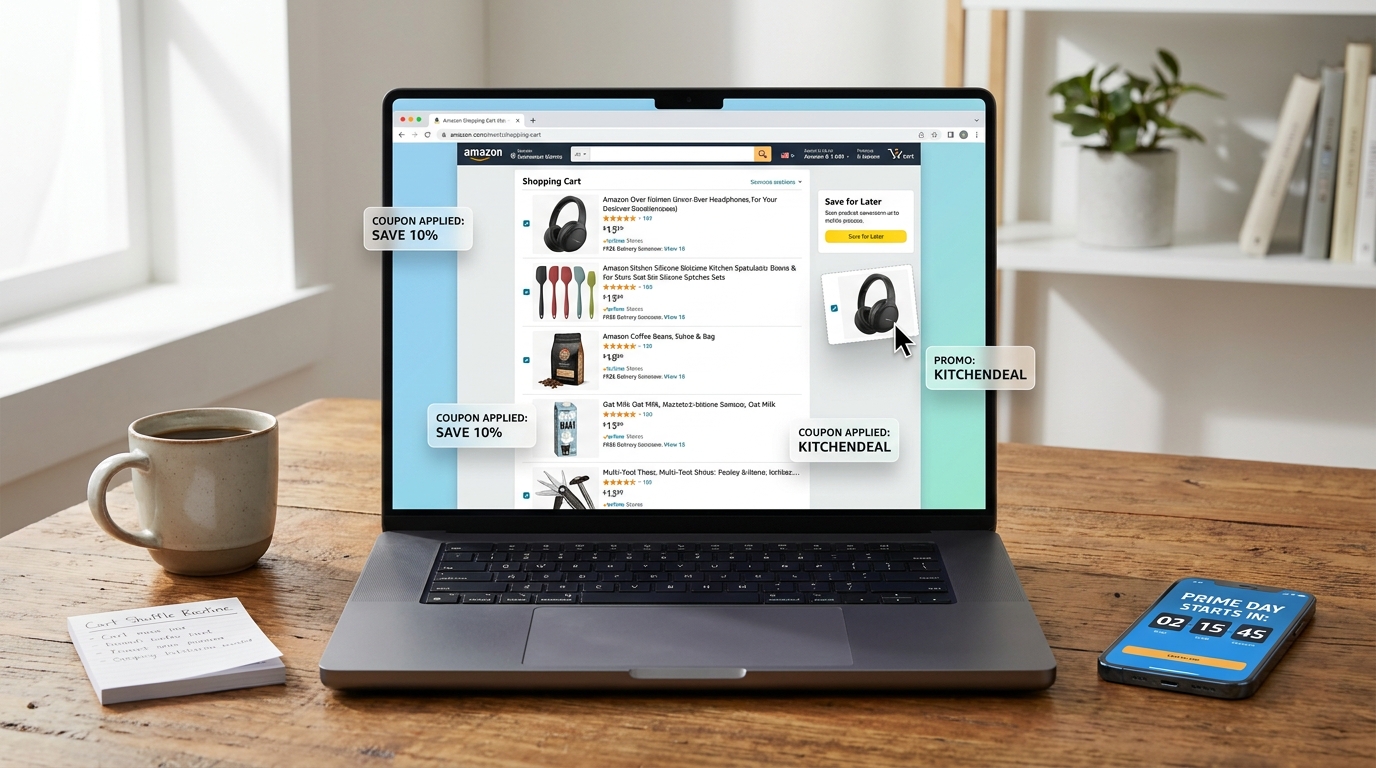
Amazon’s early Prime Day deals can feel like a shell game. The countdown clock is ticking, the orange badge screams “limited-time deal,” and then you realize the price is basically the same one the item had last week. That is why more shoppers are trying a simple amazon prime day hidden promo code hack that does not rely on random coupon sites. It starts in your cart. By adding, saving, removing, and re-adding certain items, you can sometimes trigger fresh on-page coupons, seller discounts, or targeted checkout offers that were not visible the first time around. It is not magic, and it does not work on every account. But when it works, it can shave an extra 10 to 30 percent off products you were already planning to buy. With Prime Day 2026 set for June 23 to 26, now is the time to test this before inventory gets tight and the best promo budgets dry up.
⚡ In a Hurry? Key Takeaways
- The “Prime Cart Shuffle” can surface hidden Amazon coupons by rotating items between your cart and Saved for Later, then refreshing product pages and checkout.
- Focus on items sold by Amazon or major marketplace sellers with coupon boxes, subscribe options, or bundle discounts, because those are the most likely to change.
- Stick to Amazon’s own coupon checkboxes and checkout discounts. Avoid sketchy code sites and never buy something just because a timer is flashing.
What the “Prime Cart Shuffle” actually is
This hack is less dramatic than the name makes it sound. You are not cracking a secret vault. You are nudging Amazon’s pricing and promotion system to refresh what it shows your account.
Amazon runs a messy mix of coupons, seller-funded discounts, Prime-only offers, and targeted promos. Some appear on the product page. Some only show up in the cart. Some do not appear until checkout. And some quietly vanish if you wait too long.
The Prime Cart Shuffle is the habit of rotating an item through those stages to see whether Amazon reveals a better offer on the second or third pass.
How to do the cart-rotation hack
Step 1: Start with items that often get extra promos
This works best on everyday products and popular gadgets, not just big-ticket items. Think batteries, headphones, kitchen tools, smart home gear, coffee pods, protein powder, and cleaning supplies.
Look for listings with any of these signs:
- A coupon checkbox on the product page
- A “Prime exclusive” label
- A Subscribe & Save option
- A multi-buy offer like “Buy 2, save 10%”
- A seller promotion listed under the price
Step 2: Add the item to your cart, then save it for later
Add the item normally. Open your cart. Then move it to Saved for Later. Wait a minute or two. This gives Amazon’s promo engine a chance to refresh your session.
You are basically telling Amazon, “I might buy this, but I am not fully sold yet.” That can matter, especially when sellers are trying to convert hesitant shoppers before Prime Day traffic spikes.
Step 3: Reopen the product page in a fresh tab
Now go back to the item page from your browser history, search results, or wishlist. Do not just stare at the cart. Check the listing again.
Sometimes you will see:
- A new coupon checkbox that was not there before
- A larger coupon amount
- A limited-time seller discount message
- A “redeem at checkout” offer
Step 4: Move it back into the cart and go to checkout
Return the item from Saved for Later to your active cart. Then head all the way to checkout before making a final decision. Some discounts do not show until the last screen.
This is the key part people skip. If you stop at the cart, you may miss the real discount.
Step 5: Test quantity and timing
If there is no change, try one more round. Remove the item completely. Refresh. Re-add it. In some cases, changing the quantity from one to two can trigger a bundle discount or a bigger percentage off.
Morning and late evening are also worth checking. Sellers often adjust promo budgets during the day.
Why this works at all
Amazon is not one single pricing system. It is a stack of systems. Retail pricing, seller-funded coupons, Prime-only discounts, ad campaigns, and account-targeted promos all overlap.
That is why you can see one price on a search page, another in the listing, and a third after clipping a coupon. It is also why fake-looking “deal” badges sometimes hide a real extra discount underneath.
The shuffle works because moving an item around can trigger one of those systems to refresh. Think of it like reloading a page that is pulling from several bins of offers.
If you have ever watched a coupon appear and disappear on the same item within hours, you have seen this in action.
What kinds of hidden promos show up
The most common wins are not giant 70 percent discounts. Usually, they are smaller but real savings that stack nicely.
- 5 to 10 percent clipped coupons that only appear after a refresh
- 10 to 20 percent seller promos at checkout
- Extra discounts on second units
- Prime-only discounts that appear once you are signed in
- Subscribe & Save offers that stack with coupons
If you are buying household basics anyway, these can add up fast.
How to tell a real deal from Prime Day theater
This is where people get burned. A “deal” is not the same as a good price.
Before you buy, check three things:
1. Compare the final checkout price, not the badge
The only number that matters is what you pay after coupons and discounts are applied.
2. Look at recent price history if you can
If the item has sat at roughly the same price for three weeks, that “early Prime Day deal” is mostly decoration.
3. Watch for promo stacking
A boring-looking listing with a clipped coupon and a checkout discount can beat a flashy lightning deal.
That is also why articles like The ‘Overlooked Lightning Deal’ Hack: How TikTok’s New Timer Trick Finds Amazon Promo Codes Before They Vanish have caught on. The real savings are often buried in timing and on-page details, not on coupon farms.
Best practices if you want this to work more often
Stay signed into your Prime account
Targeted discounts are tied to your account. If you are logged out, you may never see them.
Use a wishlist as a holding pen
Save a few likely purchases to a wishlist, then move them into your cart one by one. This makes testing much easier than starting from search every time.
Check mobile and desktop
Amazon sometimes surfaces coupons differently in the app versus the website. It should not be that way, but it often is.
Try Subscribe & Save, then compare
Sometimes the cheapest route is the first delivery under Subscribe & Save, especially if a coupon stacks. Just make sure you cancel later deliveries if you do not want them.
Do not wait until the final Prime Day rush
Promo budgets can run out. So can inventory. If you find a solid stacked discount before June 23, do not assume it will be better on the official event day.
What this hack will not do
It will not magically create a discount on every product. It will not turn a bad price into a great one. And it will not beat every major doorbuster.
It also will not help much if the product is sold by a tiny third-party seller with no coupon activity or if Amazon has locked in the same price across the board.
Think of this as a smart shopping habit, not a cheat code.
Safety notes so you do not get tricked
Use Amazon’s own interface. Clip the coupon there. Read the checkout summary there. That is the safe lane.
Be careful with:
- Browser extensions that ask for too many permissions
- Coupon websites pushing expired or fake promo codes
- Third-party sellers with weak ratings
- Urgency language that pressures you into buying without checking the final price
If the discount only exists on some random external site and not inside Amazon, assume it is junk until proven otherwise.
Who should use the Prime Cart Shuffle
This is best for shoppers who already know what they want and are trying to avoid overpaying in the run-up to Prime Day.
It is especially useful for:
- Households stocking up on repeat purchases
- Parents buying tech, dorm, or summer items
- Anyone replacing small electronics
- People who hate buying on hype alone
If that sounds like you, this little routine can save real money with very little effort.
At a Glance: Comparison
| Feature/Aspect | Details | Verdict |
|---|---|---|
| Prime Cart Shuffle | Move items between cart and Saved for Later, revisit the listing, then check checkout for new coupons or seller promos. | Best low-effort way to surface hidden discounts already inside Amazon. |
| Lightning Deal hype | Flashy timers and limited quantities can make an old price look new, even when the savings are small. | Useful sometimes, but never trust the badge without checking the final price. |
| External coupon sites | Often packed with expired codes, weak info, or offers that do not match the actual listing. | Usually not worth the hassle compared with Amazon’s built-in promos. |
Conclusion
Prime Day 2026 runs June 23 to 26, but the real trap starts before that. “Early deals” are already everywhere, and plenty of them are just old prices wearing a fresh sticker. The good news is you do not need to fall for it. A repeatable amazon prime day hidden promo code hack like the Prime Cart Shuffle gives you a practical way to spot the extra 10 to 30 percent off that sometimes hides in Amazon’s own cart and checkout flow. Use it on the items you already planned to buy, compare the final price carefully, and grab the real savings before the rush hits, inventory tightens, and promo budgets disappear.