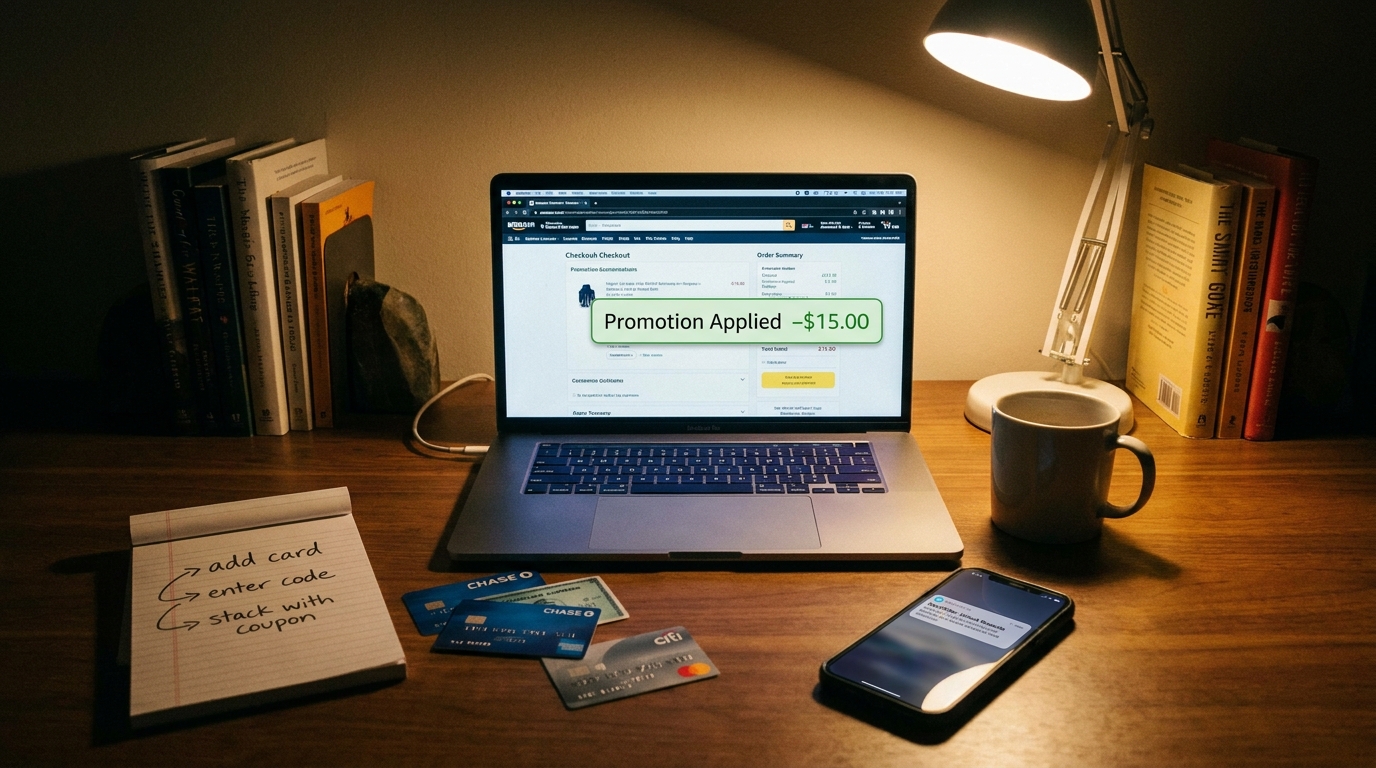
Trying random Amazon promo codes is exhausting. You paste one in, get the little error message, try another, and ten minutes later your cart still costs the same. That is why these hidden wallet-trigger deals matter. Instead of hunting public codes that are already dead, you are looking for account-level offers that can appear after you add the right card to your Amazon wallet. Right now, some shoppers are seeing targeted offers tied to eligible American Express cards, with private checkout codes that knock $10 to $15 off orders they were already going to place. The trick is not magic, and it is not shady. It is simply knowing where Amazon and card issuers hide these promos, then testing whether your account qualifies before you buy. Once you know the pattern, this becomes a fast little routine you can do in about 30 seconds before checkout, and it can save real money on boring everyday purchases.
⚡ In a Hurry? Key Takeaways
- Amazon targeted credit card promo code hack works by adding an eligible card to your Amazon wallet, then testing for private offers that can trigger $10 to $15 off at checkout.
- Check your Amazon payment settings, promo landing pages, and old Amazon or card emails before buying, because many offers only show up after the right card is linked.
- Stick to real Amazon checkout pages and official issuer messages. Never pay for “secret codes,” and do not share card details outside Amazon.
What this “wallet trigger” hack actually is
Let’s make this simple.
The so-called amazon targeted credit card promo code hack is not a software trick or a loophole. It is a shopping habit. You add or re-add an eligible credit card to your Amazon account, then check whether that action unlocks a private promotion tied to your account.
Sometimes the deal is automatic. Sometimes you need a code at checkout. Sometimes Amazon shows a banner on a promo page that says you are eligible after you sign in.
The key idea is this. The discount is often linked to your wallet setup, not to a public coupon page.
Why most people never see these offers
Amazon used to make promo hunting a little easier. Now a lot of the good stuff is buried.
You might find these offers in:
- small-print email footers from Amazon
- American Express or bank offer emails
- limited promo landing pages that only work when signed in
- checkout messages after adding a new card
- targeted account banners that other shoppers never get
That is why coupon extensions often miss them. They are built to test public codes, not account-specific offers that depend on your payment method.
The 30-second routine to test for hidden card-link promos
1. Open your Amazon wallet
Go to Your Account, then Payment Options. Look at the cards already saved there.
2. Add an eligible card if you have one
American Express is the big one people are seeing lately, but other issuers sometimes show up too. Add the card cleanly, even if you think it is already on file. In some cases, removing and re-adding can help refresh eligibility signals.
3. Search your email for Amazon and card-offer terms
Use search terms like:
- Amazon Amex offer
- Amazon promo code
- add card get $10 off
- eligible card Amazon
Look at the footers, not just the subject line.
4. Test on a real cart
Add something you were going to buy anyway. Go to checkout. Enter the promo code if you have one, or look for a message saying the discount was applied.
5. Stop if it does not work
Do not force it. These are targeted deals. If your account is not eligible, another person’s code usually will not magically work for you.
What a real example looks like
A common version goes like this. Amazon runs a promotion that says eligible shoppers can add a qualifying American Express card and get $10 to $15 off a minimum purchase after entering a private code.
You sign in. Add the card. Build a cart over the minimum. Enter the code. If your account matches the offer, the discount appears instantly.
If it does not, you usually get a generic error, which is annoying but useful. It tells you the offer is targeted, not broken.
Where to look without wasting your night
If you want this to be repeatable, keep your search focused.
Best places to check
- Your Amazon account messages and promo banners
- Emails from Amazon about payment methods
- Emails from American Express or your bank
- Deal communities that discuss account-targeted offers, not just public coupon dumps
What to ignore
- Old coupon blogs reposting expired “Amazon code” lists
- Social posts promising a universal code for everyone
- Sites asking you to buy access to secret promo databases
Why this works better than random coupon hunting
Public codes get copied to death. By the time they hit every deal site, they are often expired or capped.
Targeted wallet promos are different. They are smaller, quieter, and tied to account behavior. That makes them less visible, but also more useful when you qualify.
Think of it less like finding a code and more like turning on a switch.
Can you stack this with other savings?
Sometimes, yes.
You may be able to combine a wallet-trigger promo with a clipped coupon, a sale price, or cashback. But stacking on Amazon can get messy fast. If you want a cleaner system for that side of the game, take a look at The “Cashback Ladder Stack” Hack: How To Turn One Amazon Order Into 3 Hidden Rebates In 5 Minutes. It does a good job explaining why one discount can knock out another, and how to test the order without losing savings.
Important fine print people miss
This is where the “friendly IT neighbor” voice has to step in and save you a headache.
Minimum spend rules
The offer may require a subtotal over a certain amount. Tax, shipping, gift wrap, and digital credits may not count.
Sold by Amazon vs. third-party sellers
Some promos only apply to items shipped and sold by Amazon. Marketplace items can break the discount.
One-time use limits
Many of these offers are one per account or one per cardholder.
Enrollment windows
You may need to add the card during the promo period, not before it.
Private code does not mean transferable
A code from someone else’s email may still fail if your account was not targeted.
How to do this safely
You do not need any sketchy tools for this.
- Only add your card through Amazon’s official payment settings page.
- Only enter promo codes at Amazon checkout.
- Do not upload screenshots of your card details into forums or chat groups.
- Use your bank app to confirm any temporary verification charge is normal.
If a site asks for your full card number to “check eligibility,” close the tab.
How to make this a repeat habit
The smartest shoppers are not finding one miracle code. They are building a tiny pre-checkout routine.
Before you place an Amazon order, do this:
- Check if the item already has a clipped coupon.
- Open your wallet and confirm which cards are saved.
- Search your email for Amazon payment offers.
- Test one targeted card promo if you have a likely match.
- Then place the order only after the final total looks right.
That sounds fussy, but once you do it a couple of times, it is quick.
At a Glance: Comparison
| Feature/Aspect | Details | Verdict |
|---|---|---|
| How the promo is triggered | Usually by adding an eligible card to your Amazon wallet, then applying a targeted offer or private code on a qualifying cart. | Worth testing. Fast and low effort. |
| Reliability vs public coupon codes | Less visible, but often more real because the offer is tied to your account instead of blasted all over the internet. | Better than random code hunting. |
| Risk and downside | Low risk if you stay on Amazon and official bank emails. Main downside is that not every account qualifies. | Safe, but targeted and not guaranteed. |
Conclusion
If you are tired of dead promo codes and fake coupon promises, this is a much smarter move. Right now Amazon is running fresh, targeted card-link promos like “add an eligible American Express card and get $10 to $15 off when you enter a private code at checkout,” and most shoppers never see them because they are buried in fine print or email footers. Once you know to check your wallet, your email, and your real cart before buying, you stop guessing and start testing. That is the real value of this amazon targeted credit card promo code hack. It gives you a repeatable way to create savings opportunities on purchases you were already making, instead of hoping a generic coupon site somehow stumbles onto a live code. And with Amazon’s old public promo pages fading away, that little habit is becoming one of the most useful tricks serious deal hunters have.