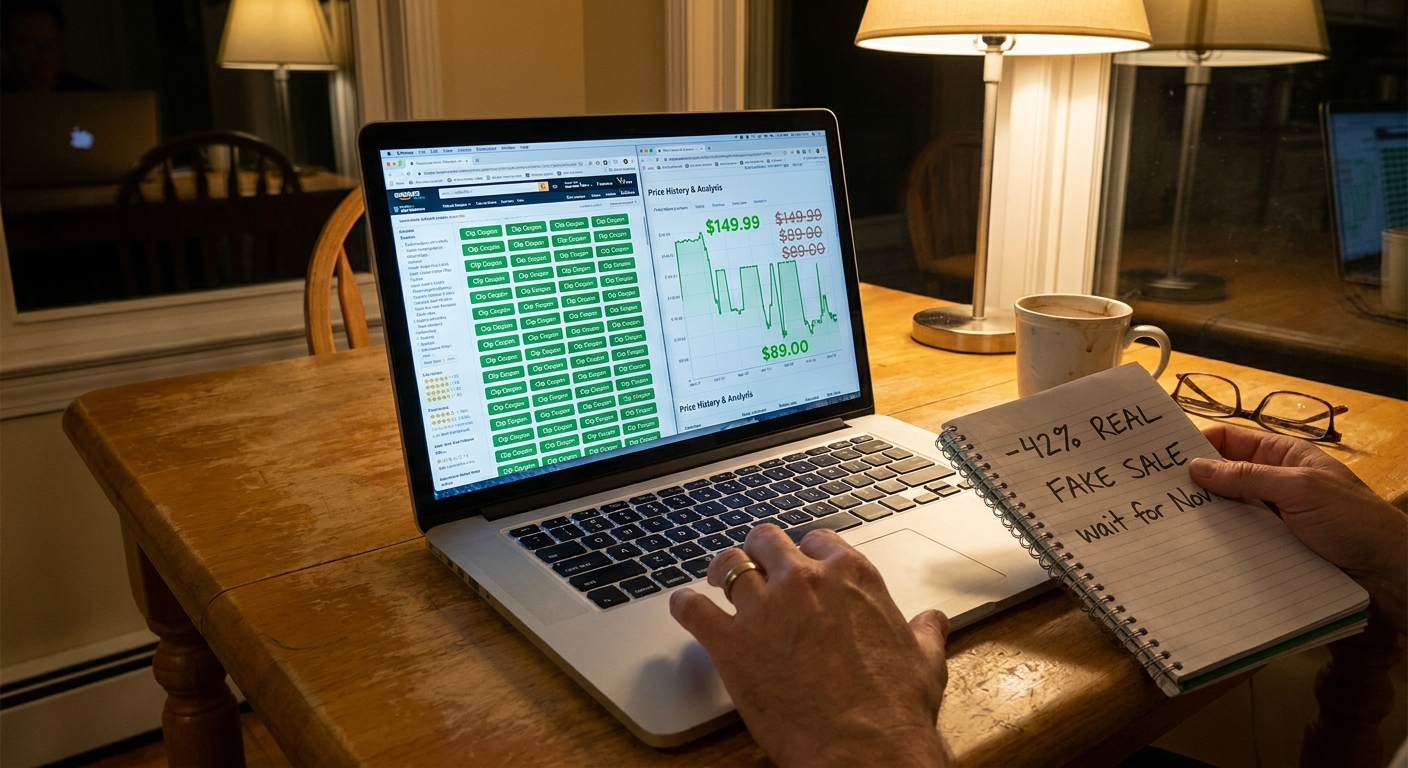
Prime Day coupon hunting is frustrating for a reason. Amazon makes it very easy to see a big orange coupon badge, and very hard to tell whether that “save 40%” is a real deal or just a dressed-up markup. Most shoppers end up doing the same thing. Click fast, hope for the best, and assume the coupon page must be showing the lowest price. A lot of the time, it is not. The good news is you do not need a complicated tracker or a dozen browser tools to spot the difference. You can run a simple two-tab split test in about five minutes. One tab shows the item through Amazon’s hidden coupon hub. The other shows the exact same product through normal search, alternate sellers, and any stackable Prime or multi-buy offer. That quick side-by-side check is the amazon secret coupon page hack that helps you stop chasing fake percentages and start finding the few coupons that really matter.
⚡ In a Hurry? Key Takeaways
- The best amazon secret coupon page hack is a two-tab test: compare the coupon-page price against the same item’s actual checkout price from regular search.
- Always check for stacked savings like Prime-only discounts, Subscribe & Save, and multi-buy offers before trusting the coupon badge.
- A giant percentage off means very little if the starting price was inflated. Judge the final total, not the flashy claim.
Why the Secret Coupon Page Trips People Up
Amazon’s coupon hub is useful, but it is also noisy. It mixes real bargains with items that only look cheap because the list price was puffed up first.
That is the trap. Your eyes see “50% off” and your brain thinks, “I need to grab this now.” But the number that matters is the final checkout total, not the marketing label.
On Day One of Prime Day 2026, that matters even more. Prices move fast. Sellers change. Coupons appear and disappear. A deal list from this morning can be stale by lunch.
The Two-Tab Split-Test Hack
This is the simple move. Open two tabs for the same item.
Tab 1: The coupon-page version
Go through Amazon’s coupon hub and open the product listing from there. Clip the coupon if one is offered. Write down three numbers:
- The displayed price before clipping
- The coupon amount or percentage
- The estimated final total at checkout
Tab 2: The normal listing version
Now search for the exact same item in regular Amazon search. Match the size, color, pack count, and seller if possible. Then check for:
- A lower everyday price with no coupon needed
- A Prime-exclusive discount
- A multi-buy deal like “save $20 when you spend $100”
- Subscribe & Save if the item is household stuff
- Alternate sellers on the same listing
Then compare the final total in both tabs. Not the claimed savings. The real total.
What You Are Actually Testing
You are testing whether the coupon badge is adding real value or just adding drama.
Here is what often happens:
- The coupon tab shows 35% off, but the base price is higher.
- The regular listing has a lower starting price, plus a Prime discount at checkout.
- The “huge” coupon turns out to be worse by a few dollars.
That is why this works so well. It turns a vague shopping hunch into a quick price test.
The 5-Minute Routine That Works During Prime Day
Step 1: Start with the final price
Ignore the list price and the crossed-out number for a minute. Go straight to what you will actually pay.
Step 2: Match the item exactly
This is where people get fooled. A coupon may be attached to a smaller size, a weaker model, or a different seller. Make sure both tabs are truly the same product.
Step 3: Check stackable offers
Some of the best deals are not obvious on the coupon page. Prime offers, “buy 2 save 10%,” and category promos can quietly beat a flashy clip coupon.
Step 4: Look at shipping and delivery speed
A lower price from a third-party seller is not always better if shipping is slower, return policies are weaker, or the item is not sold by a seller you trust.
Step 5: Make a quick call
If the coupon version wins by a meaningful amount, buy it. If not, skip the badge and use the better path.
Red Flags That Usually Mean the Coupon Is Not Special
- The item has a giant discount percentage but still costs about the same as similar products.
- The coupon only works on one odd color or low-demand variation.
- The listing shows a high “was” price that does not match what people usually pay.
- The coupon page version is sold by a different seller than the cheaper search result.
- The coupon disappears at checkout, or only applies after a quantity requirement you did not notice.
When the Secret Coupon Page Really Does Win
To be fair, there are real gems in there. The best ones usually have one or more of these traits:
- A coupon on top of an already reduced Prime Day price
- A stack with a multi-buy offer
- A brand trying to move inventory fast in a crowded category
- A listing where the coupon beats not just today’s search price, but the recent normal sale price too
Those are the deals worth pouncing on.
Use This Hack Alongside Email-Only Discounts
If you also chase promo codes from brand emails and Amazon storefront messages, pair this trick with The ‘Newsletter Bait-and-Switch’ Hack: How Off-Amazon Email Deals Turn Into Real Secret Promo-Code Savings. It is a smart companion strategy because some of the best savings never show up cleanly on the coupon page at all.
A Few Common Mistakes to Avoid
Do not trust the percentage
A 20% coupon on a fair base price can be better than a 50% coupon on an inflated one.
Do not forget quantity math
Multi-pack items can look cheaper until you compare the per-unit price.
Do not assume all sellers are equal
Returns, shipping times, and seller ratings still matter. A “deal” becomes expensive fast if the product is wrong or late.
Do not wait too long on a verified winner
Once your two-tab test proves a coupon is genuinely better, act. The real bargains are the ones that disappear first.
At a Glance: Comparison
| Feature/Aspect | Details | Verdict |
|---|---|---|
| Coupon page discount | Fast to spot, but often based on inflated anchor pricing or incomplete savings info. | Good starting point, not proof of a real deal. |
| Two-tab split test | Compares the coupon version against regular search, alternate sellers, and stackable offers in real time. | Best quick method for Prime Day shoppers. |
| Stacked savings | Prime-only promos, multi-buy offers, and Subscribe & Save can quietly beat clip coupons. | Always check before you buy. |
Conclusion
Today is Day One of the 2026 Prime Day window, and the internet is already filling up with giant “Top 100 Deals” lists that go stale almost as soon as they are published. What most people need is not another pile of links. They need a fast sanity check. This amazon secret coupon page hack gives you exactly that. Open two tabs, compare the same item, test the final total, and look for stacks that beat the flashy coupon label. It is simple, repeatable, and it helps you separate fake urgency from the rare discounts that are actually worth your money. If you use it while you shop this week, you will waste less time, skip more fake bargains, and catch the real winners before they vanish.