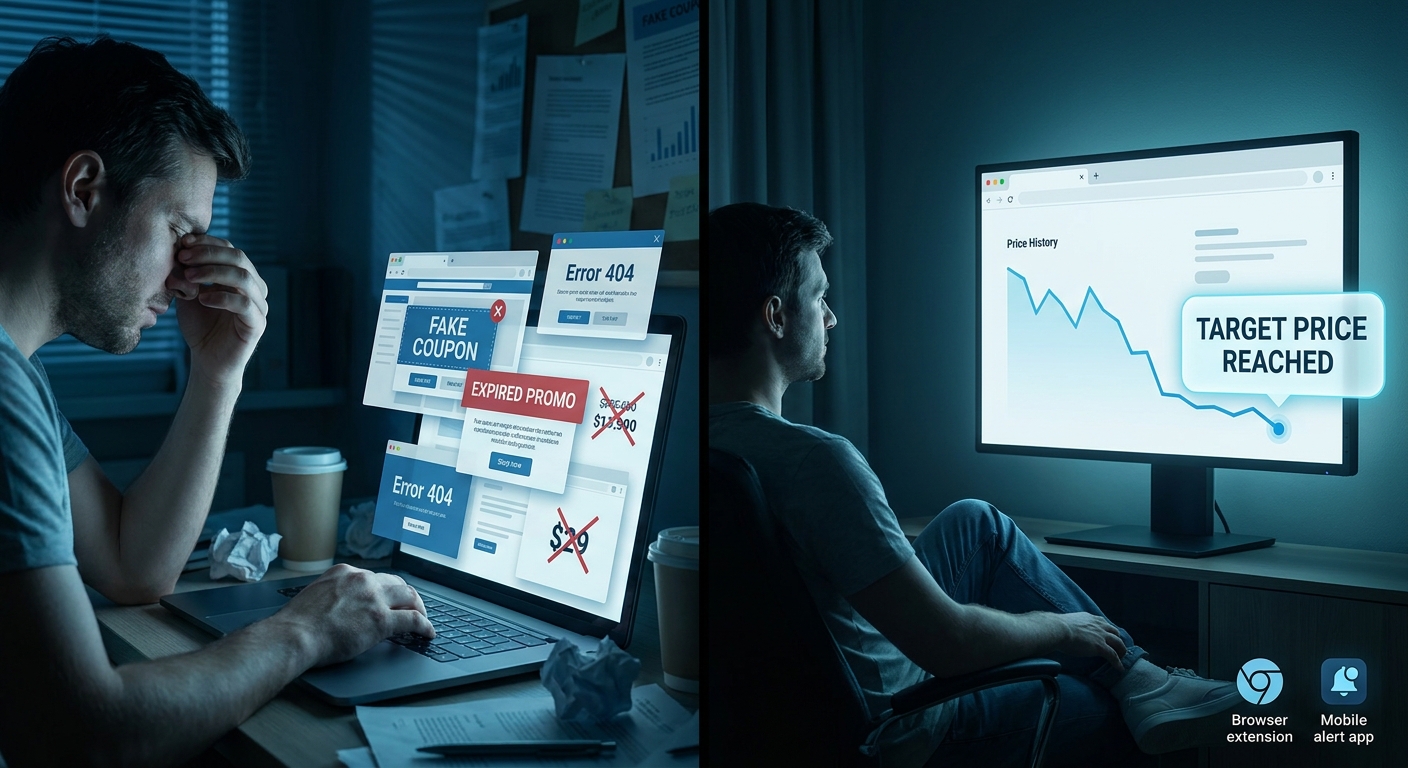
You know the routine. You find a coupon code site promising a huge Amazon discount, click through, paste the code, and get nothing. Or worse, the “sale” turns out to be the same price the item was last week. That gets old fast. The more annoying part is that the real deals often do exist, but they show up quietly for a few hours, then vanish before most people even notice. If you are at work, asleep, or just not checking Amazon every afternoon, you miss them.
That is where the amazon price drop alert hack comes in. Instead of hunting random promo codes, you let a 24-hour price tracker watch the exact item you want and notify you only when it drops into a price range you actually care about. It is simple, low effort, and a lot smarter than refreshing product pages or trusting inflated “list prices.” For expensive gear, household staples, and things you buy again and again, this little setup can save real money without turning bargain shopping into a part-time job.
⚡ In a Hurry? Key Takeaways
- The best Amazon deals are often short price dips, not public promo codes, and a price alert catches them automatically.
- Set a target price on a tracker like CamelCamelCamel or Keepa for the exact product version you want, then wait for the alert.
- Always check price history before buying so you can spot fake “discounts” and avoid impulse purchases dressed up as deals.
Why Amazon “sales” can feel fake
Amazon pricing is messy. One item can have multiple sellers, different colors with different prices, clip-on coupons, lightning deals, and temporary markdowns that disappear by lunch.
That is why a big red discount badge does not always mean much. Sometimes the price was lower a week ago. Sometimes the “regular” price is inflated. Sometimes only one variation is actually discounted.
So when people talk about getting secret promo-level savings on Amazon, they often are not using secret codes at all. They are catching a real price drop at the right moment.
What the “Price Drop Trap” hack really is
The name sounds sneaky, but the method is very simple. You pick an item. You check its price history. Then you tell a tracking service to alert you when it falls to a number you like.
That is it.
The trick is that these tools watch the listing all day and all night. They do the boring part for you. When the item suddenly dips because of seller competition, low stock movement, or a brief algorithm change, you get the email or notification.
That turns random discounts into something useful. Not guaranteed, but useful.
How 24-hour watchdogs help you buy smarter
A good tracker gives you two things that promo-code sites usually do not.
1. Actual price history
You can see whether today’s “deal” is really special or just normal pricing with a marketing sticker on it.
2. A target-based alert
You decide what counts as a deal. Not Amazon. Not a coupon blog. You do.
That matters because a 10 percent drop on a phone charger is nice, but a 15 percent drop on a robot vacuum, laptop, air fryer, or baby formula subscription can be worth waiting for.
The easiest way to set up the amazon price drop alert hack
You do not need to be technical for this. Most people can do it in five minutes.
Option 1: CamelCamelCamel
This is one of the best-known Amazon price trackers. You paste in an Amazon product link, create a free account, and set your target price.
When the item drops to that amount, you get an alert.
Option 2: Keepa
Keepa is more detailed and especially handy if you like charts, seller history, and browser integration. It can feel a little busier at first, but it is powerful once you get used to it.
Basic setup steps
- Open the exact Amazon product page you want.
- Copy the product URL.
- Paste it into your price tracker of choice.
- Look at the price history for at least the last 30 to 90 days.
- Set a target price based on the low end of that history, or a number you would be happy to pay.
- Turn on email or push alerts.
Then leave it alone. That is the beauty of it.
How to pick the right target price
This is where people either save money or set themselves up for disappointment.
If your target is unrealistically low, you may never get an alert. If it is too high, you will get notified for a price that is not special.
A simple rule
Look at the product’s recent history and ask, “What price would make me buy this today without second-guessing it?”
For example:
- If a blender usually sits at $99 and drops to $79 every few weeks, set your alert near $79 or $75.
- If a laptop normally ranges between $899 and $999, an alert at $849 may be realistic and worth waiting for.
- If a household item bounces between $22 and $30, even a $4 drop can matter if you buy it often.
What kinds of items work best with this trick
Not every item is worth tracking. The best candidates are products where timing matters.
Great items to track
- Electronics
- Kitchen appliances
- Robot vacuums
- Headphones and earbuds
- Office chairs and desks
- Coffee, vitamins, and repeat household buys
- Baby gear
- Seasonal items
Less useful items to track
- Cheap impulse buys under about $10
- Products with unstable listings or lots of knockoff replacements
- One-off novelty items where quality matters more than price
Common mistakes that ruin the savings
This hack works best if you avoid a few easy traps.
Tracking the wrong variation
That blue version may be $20 more than the black one. The 128GB model may behave very differently from the 256GB model. Always track the exact listing you want.
Ignoring seller details
A low price from a third-party seller is not always the same as a low price sold by Amazon. Check shipping, return policy, and seller ratings.
Buying just because you got an alert
An alert is not a command. It is a signal. If you no longer need the item, skip it.
Forgetting lightning deals and coupons can stack oddly
Sometimes the tracker catches the base price, but Amazon also adds a coupon checkbox on the product page. That can make the final price even better, so always look before checking out.
How this compares to coupon-code hunting
Coupon-code hunting feels active, but it often wastes time. Price alerts feel passive, but they are usually more accurate.
Why? Because you are tracking the item itself, not hoping a generic promo works on a category or seller.
Coupon lists also go stale quickly. A price tracker does not care whether a deal is trendy. It just watches the number.
Is it safe to use price trackers?
Generally, yes, if you stick to reputable services and use common sense.
- Use well-known trackers.
- Do not give your Amazon password to random extensions or deal sites.
- Read the privacy policy if you install a browser add-on.
- Use email alerts if you want the simplest and lowest-risk setup.
The safest version of this hack is also the easiest one. Paste in the item link, set a target price, get an email later.
When this trick saves the most money
The biggest wins usually come from patience.
If you need something tonight, you buy tonight’s price. But if you can wait two weeks for an air purifier, one month for headphones, or a couple of days for printer ink, you give the system time to work.
This is especially good for:
- Holiday shopping done early
- Back-to-school gear
- Home office upgrades
- Big-ticket appliance replacements
- Everyday supplies you buy on repeat
A smart routine that takes almost no effort
If you want this to become a habit, keep it very simple.
- Any time you think, “I want this, but not at this price,” add it to a tracker.
- Set one realistic target.
- Check the alert when it arrives.
- Buy only if it still makes sense.
That is a lot better than opening ten coupon tabs and wondering which one is lying to you.
At a Glance: Comparison
| Feature/Aspect | Details | Verdict |
|---|---|---|
| Price alerts vs promo codes | Alerts track the exact item and notify you when the live price drops. Promo codes are often expired, limited, or not as good as they sound. | Price alerts are usually more reliable. |
| Time required | A tracker takes a few minutes to set up, then runs in the background. Manual deal hunting can eat up a lot of time. | Set-and-forget wins. |
| Best use case | Works best for expensive items, seasonal purchases, and repeat-buy products where a small drop adds up. | Excellent for planned purchases. |
Conclusion
If you are tired of chasing shaky coupon codes and wondering whether an Amazon sale is real, this is one of the easiest shopping habits to start. Amazon prices are changing multiple times per day across different sellers and product variations, and most of those drops never show up in the big coupon roundups. A simple set-and-forget alert system flips the whole process in your favor. Instead of hunting for deals, you let the deals come to you. For big-ticket products and repeat-buy essentials, one well-timed alert can save more than a pile of generic promos ever will. That is the real value of the amazon price drop alert hack. It saves money, yes, but it also saves your time and your patience.