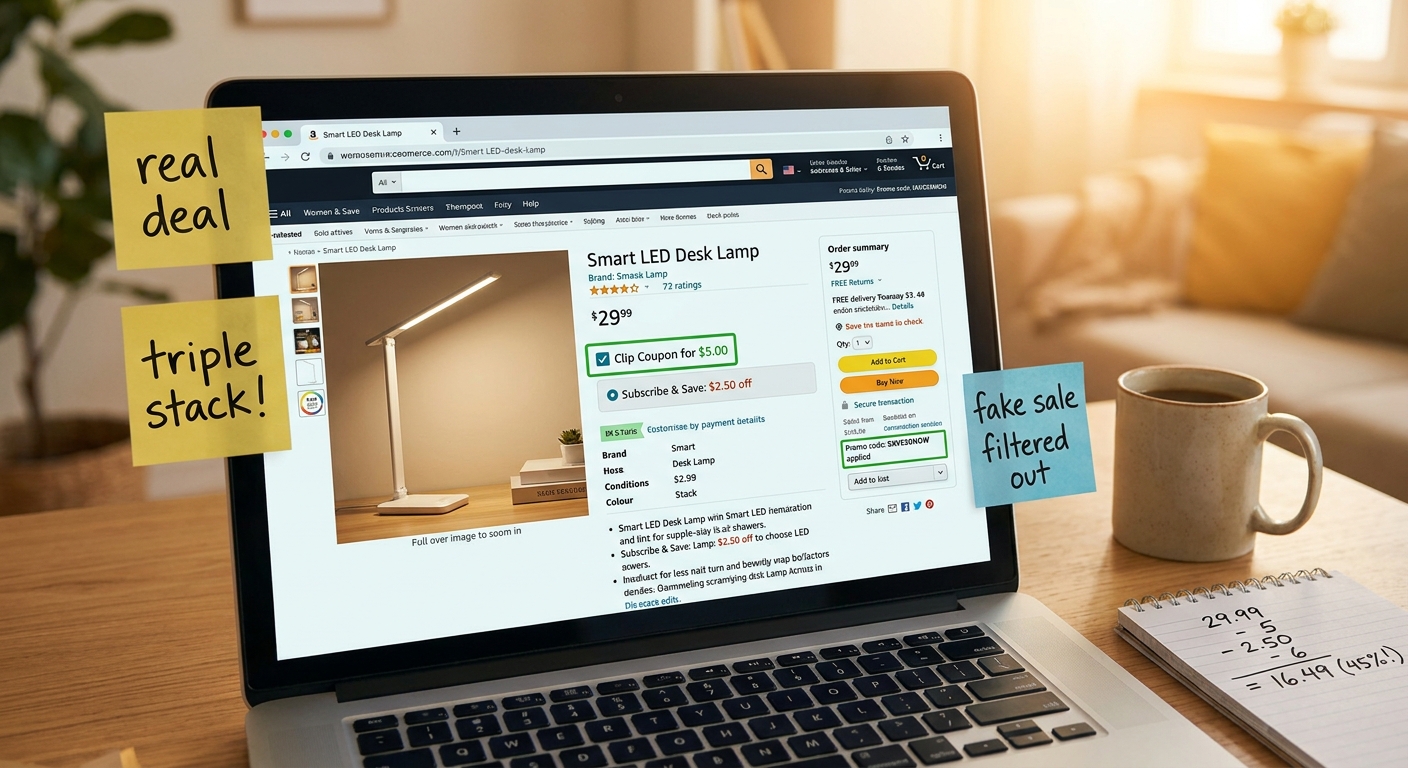
If Amazon deals have started to feel like a shell game, you are not imagining it. You click a product with a bright coupon badge, see a promo code on the page, maybe even spot a Subscribe & Save discount, and it looks like a steal. Then checkout happens. The code vanishes, the coupon no longer applies, or the “sale” turns out to be a tiny drop from a made-up list price. That is the kind of shopping whiplash that makes people give up and just pay full price.
The good news is there is a simple filter combo that cuts through most of that noise. If you want to know how to stack Amazon coupons promo code and Subscribe and Save, the trick is to look only for listings that clearly show all three on the product page before you add anything to cart. Done right, this is less about chasing random code blogs and more about using Amazon’s own signals to find real stackable deals fast. That can turn a basic $40 household or beauty order into something much closer to $25, without spending half your night testing dead codes.
⚡ In a Hurry? Key Takeaways
- The real triple stack is this: on-page coupon, checkout promo code, and Subscribe & Save on the same eligible item.
- Before adding to cart, check the product page for all three signals and confirm the discount appears in the order summary, not just in the listing.
- Skip “deal” tags by themselves. If the math is not visible before checkout, treat it as unproven.
The hidden triple-stack coupon trick, in plain English
Here is what actually works. You are looking for one item that has:
- A clickable coupon box, usually “Save 10%” or “Save $5.”
- A promo code on the page, often shown as “Apply 20% coupon at checkout” or a code field promotion.
- Subscribe & Save eligibility.
When those three line up on one listing, the discount stack can be surprisingly good. The coupon clips first. The promo code usually applies at checkout. Subscribe & Save then takes another percentage off if the item is eligible.
Not every product allows all three together. That is the catch. But enough do that it is worth using a fast screening method instead of browsing blindly.
Why Amazon deals feel fake lately
A lot of the frustration comes from how Amazon presents discounts. You may see a “Limited time deal” badge, a strikethrough price, a coupon flag, and a promo mention all on one page. That does not always mean every discount can combine.
Common problems include:
- The coupon works, but the promo code excludes Subscribe & Save.
- The code applies only to one variation, like a different scent or pack size.
- The item shows a discount on the search page, but not on the actual product page.
- The list price is inflated, so the “savings” are not meaningful.
That is why the goal is not to trust the badge. The goal is to trust the math.
How to stack Amazon coupons promo code and Subscribe and Save
Step 1: Start with products that already show a visible coupon
If there is no on-page coupon to clip, move on unless the base price is already excellent. The easiest wins usually start with a visible checkbox or button under the price.
This matters because the coupon is the first sign that Amazon is actively supporting stacked savings on that listing. It is not a guarantee, but it is a strong clue.
Step 2: Open the product page and look for a second promotion
Now scan the page for any promo code language. This might say:
- “Save an extra 20% at checkout”
- “Redeem code”
- “Promotion available”
- “Apply 15% coupon and save at checkout”
If the page has both a coupon and a promo mention, you are in business. If it only has one, it may still be decent, but it is not the full triple stack.
Step 3: Check if Subscribe & Save is offered on that exact variation
This is where many deals fall apart. A product may offer Subscribe & Save on one size but not another. Or the coupon works only on a one-time purchase. Do not assume. Click the exact option you want and see whether Subscribe & Save still appears.
If you can select Subscribe & Save and the coupon remains clipped, that is a strong sign the stack may hold.
Step 4: Add it to cart and read the order summary carefully
This is the moment of truth. You want to see:
- The coupon deducted
- The promo code applied or scheduled to apply at checkout
- The Subscribe & Save discount reflected in the price
If one piece disappears, do not force it. Delete the item and move on. The whole point of this method is speed. You are filtering for easy wins, not arguing with a checkout page.
Step 5: Compare the final price, not the advertised savings
This is the part people skip. If a shampoo set starts at $39.99 but ends at $24.87 after coupon, promo code, and Subscribe & Save, great. That is a real deal. If it starts at $39.99 and ends at $35.50, the stack exists but it is not exciting.
The final total is what counts. Not the red text. Not the percentage badge.
The fastest filter combo to use
If you want a repeatable shortcut, use this mental filter:
- Only click listings with a visible coupon.
- On the product page, confirm there is a second promo mention.
- Make sure Subscribe & Save is available on that same version.
- Verify all discounts survive in cart.
That is it. Four quick checks. Most fake-looking deals fail by step two or three, which saves you time.
What categories tend to work best
This trick works most often in categories where brands are aggressive with promotions. Think:
- Beauty and skincare
- Vitamins and supplements
- Household cleaners
- Laundry supplies
- Paper goods
- Pet consumables
These brands often want repeat buyers, so they are more likely to support Subscribe & Save and extra promos at the same time.
Red flags that usually mean “skip it”
Some listings practically announce that they are about to waste your time. Watch for these:
- The coupon appears in search results but not on the product page.
- The promo is vague and has no percentage or dollar amount.
- Subscribe & Save disappears when you choose the discounted variation.
- The discount only works on a quantity you do not need.
- The final price is barely lower than the item’s normal street price elsewhere.
If you run into those, keep moving. Amazon has too many listings to get stuck on a bad one.
A smart extra move if you are buying multiples
If you are shopping items with multi-buy discounts, there is another layer worth knowing about. Some “buy 2” or “save when you buy more” offers can combine with promo codes if you build the cart the right way. I covered that in The Hidden ‘BOGO Stack’ Hack: How One Bundle Trick Turns Amazon’s Multi‑Buy Deals Into Secret Promo‑Code Jackpots. It pairs nicely with this triple-stack method when you are buying household basics in bulk.
One important caution about Subscribe & Save
Subscribe & Save is useful, but do not forget it is a subscription. If you only want the first discounted order, set a reminder to cancel after the item ships, or adjust the next delivery date.
That is not a trick. It is just good housekeeping. The deal is only a deal if it matches what you actually want.
At a Glance: Comparison
| Feature/Aspect | Details | Verdict |
|---|---|---|
| Visible coupon | A clip coupon on the product page is the first signal that real stacking may be possible. | Worth checking |
| Promo code at checkout | A second discount must be clearly shown on-page, not guessed from a random blog or expired code list. | Essential for the triple stack |
| Subscribe & Save eligibility | Must apply to the same variation and survive through checkout for the best final price. | Best value when it sticks |
Conclusion
Amazon is crowded right now with noisy coupon pages, expired code blogs, and “deal” tags that make weak discounts look bigger than they are. That is why this triple-stack filter works so well. It gives you a dead-simple, repeatable way to spot only the listings where coupons, promo codes, and Subscribe & Save truly combine. Once you stop trusting the badges and start checking for those three signals, you can cut through the hype fast and find the real wins. And yes, that can absolutely turn an ordinary $40 household or beauty cart into something closer to $25 in under five minutes. In a sea of fake-looking deals, that is the kind of practical trick worth keeping.