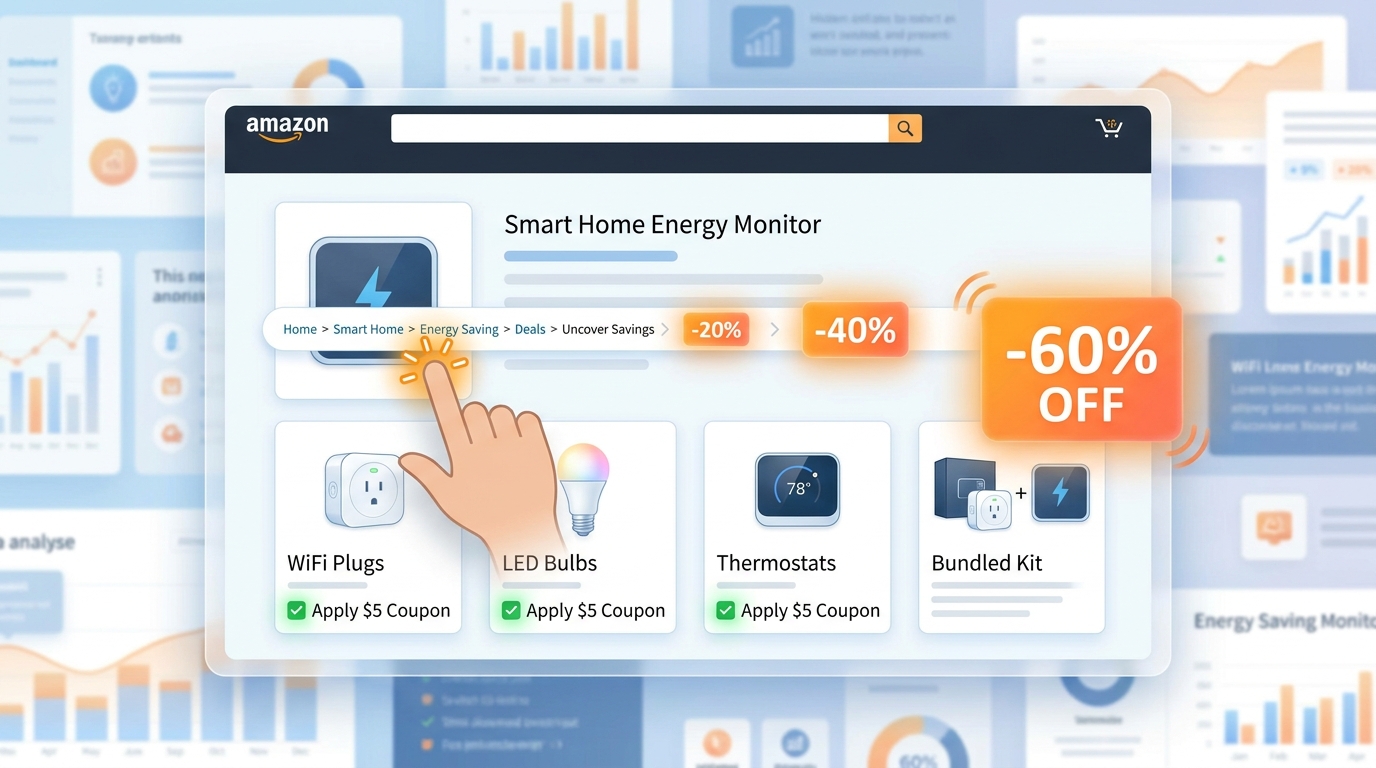
You are not imagining it. Amazon makes discount hunting feel weirdly harder than it should. You click a product, spot one tiny coupon checkbox, and think, “Fine, that must be it.” Then later you find out the same item, or a near-identical twin listing, had a bigger coupon, a subscribe-and-save discount, or a seller promo hiding one click away. That is the annoying part. The savings were there, just not where most people would think to look. The good news is you do not need sketchy browser tricks or hours of searching. A simple method can turn one product page into a mini trail of extra discounts. I call it the hidden coupon ladder. Once you know where to click, you can jump from one listing to related versions, then into brand and category coupon pages, and quickly see which deals are actually live today. It is one of the most useful amazon hidden coupon hacks for everyday shopping.
⚡ In a Hurry? Key Takeaways
- The best Amazon discounts are often hidden in small seller coupons, alternate listings, and subscribe-and-save offers on the same item family.
- Start with one product page, then check variations, the seller storefront, the brand name search results, and the Amazon coupons page for matching offers.
- Only count savings that appear at checkout. Some coupons expire fast, and not every duplicate listing is truly the same product.
Why this trick works
Amazon is not one neat department store shelf. It is more like a giant flea market with better shipping. Brands, third-party sellers, and even the same brand under different pack sizes can all create separate listings with separate promotions.
That means one item can have several discount paths at once:
- A clickable coupon on the main page
- A bigger coupon on a different color, size, or pack listing
- A separate promo from the same brand storefront
- A subscribe-and-save discount
- A limited-time deal tied to a near-duplicate product page
Most shoppers stop at the first green checkbox. That is where they leave money on the table.
The hidden coupon ladder, step by step
Step 1: Start on the product page and clip the obvious coupon
First, look under the price. If you see a small coupon box, clip it. This is the easy part. But do not stop there.
Also check for these common discount spots:
- “Save X% with coupon”
- “Redeem” style promo buttons
- “Join Prime to save”
- “Subscribe & Save” discounts
- Multi-buy offers like “Save 20% on 2”
If the item is something repeatable like vitamins, detergent, razors, or coffee pods, the subscribe-and-save line can be worth more than the visible coupon.
Step 2: Open every variation
This is where the ladder starts. Click the different sizes, colors, scents, bundles, and pack counts. Yes, even the boring ones.
Why? Because Amazon often treats each variation like its own deal bucket. A 2-pack may have a 25 percent coupon while the single pack has only 10 percent. A lavender version may be discounted harder than the unscented one, even if the formula is basically the same.
Check each variation for:
- A different coupon amount
- A lower base price
- A better subscribe-and-save discount
- A shipping difference that changes the real final cost
If you are buying household supplies or beauty products, this one step alone often finds the better discount.
Step 3: Click the brand name or seller name
Now move sideways. Click the brand link if Amazon shows one, or click the seller name under the Buy Box area.
What you are looking for is not the fancy storefront design. You want the rest of that brand’s active listings. Many sellers spread coupons unevenly across similar items. A toothbrush head refill page may show no coupon, but the same brand’s bundle page might have one. A skincare item may have a 15 percent coupon on the “new packaging” listing while the old page still ranks higher in search.
If the storefront has a search bar, use it. Type the product keyword, like “vitamin C serum” or “air fryer liners.”
Step 4: Search Amazon with the exact brand plus product type
This is the fastest way to expose hidden twins. In Amazon search, type the brand name plus the item category. For example:
- Brand + paper towels
- Brand + shampoo
- Brand + Bluetooth earbuds
Then scan the results for the little coupon tags. You are not trying to read every listing. You are comparing discount badges and package sizes.
Look for:
- Near-identical photos
- Slightly different titles
- Different quantities
- “New version” or “updated packaging”
- Coupon labels directly in search results
This is the heart of the hidden coupon ladder. One product page leads to a family of related deals.
Step 5: Check Amazon’s coupon page with that brand or category
Amazon has a dedicated coupons section, and it is far more useful than most people realize. Search there by brand or category.
If you are on desktop, you can usually find it through Amazon’s menu or by searching “Amazon coupons” in your browser. Once inside, search the brand name from the product you started with.
This helps because some coupon offers are easier to spot in the coupon hub than on the product page itself. You may find:
- Other items from the same brand with better coupon values
- Category-wide coupon sorting for household, beauty, and gadgets
- Freshly added discounts that are not obvious in standard search
Step 6: Add the top two or three candidates to your cart
Do not trust the product page alone. Add your best options to the cart and compare the checkout math.
Amazon can stack or block discounts in ways that are not obvious until the cart page. One listing may look cheaper, but another might win once the coupon and subscribe-and-save are applied.
Your real comparison should be:
- Base price
- Coupon value
- Subscribe-and-save discount
- Shipping cost or delivery minimums
- Pack count or ounce count
If two items are very close, calculate the unit price. That keeps a flashy coupon from fooling you into overpaying.
What counts as a “secret” discount?
Nothing here is illegal, hidden behind a paywall, or some hacker trick. “Secret” just means easy to miss. Amazon’s layout does not put all discounts in one clean place, so you have to do a little ladder climbing.
The most common hidden deals are:
- Coupons on alternate pack sizes
- Coupons on duplicate or refreshed listings
- Brand-level coupon offers
- Seller offers visible only on a related page
- Deals that show in search results but not clearly on the original listing
Best categories for amazon hidden coupon hacks
Some departments are much better for this than others. You will usually get the best results with:
- Household supplies
- Beauty and skincare
- Vitamins and wellness products
- Pet supplies
- Phone accessories and small gadgets
- Kitchen basics
These categories have lots of third-party sellers, frequent promo changes, and many near-duplicate listings. That is exactly where the hidden coupon ladder works best.
Common mistakes that kill the savings
Stopping at the first coupon
This is the biggest one. The first coupon is often not the best coupon.
Ignoring pack size math
A bigger coupon on a giant bundle can still be a worse deal per item.
Forgetting subscribe-and-save
If you use an item regularly, this can beat the visible coupon. Just remember you can manage future deliveries in your Amazon account.
Not checking duplicate listings
Same product. Different ASIN. Different promo. It happens all the time.
Waiting too long
Seller coupons can disappear fast. If the deal is good and you already planned to buy the item, do not assume it will still be there tomorrow.
A simple example
Say you find a face moisturizer for $19.99 with a 10 percent coupon. Nice, but nothing exciting.
You click the 2-pack variation. Now there is a 20 percent coupon. Then you click the brand name and find a nearly identical listing with updated packaging and a 25 percent coupon. Then you search the Amazon coupon page for that brand and spot a separate cleanser bundle with a larger discount if you were planning to buy both anyway.
Same shopping trip. Same brand. Very different result.
That is the ladder. You start with one page and climb outward until you find the best live discount.
How to do this quickly without making it a chore
The trick is not to turn bargain shopping into a part-time job. Give yourself a two-minute rule.
Here is a fast routine:
- Clip the visible coupon.
- Open all variations.
- Search the brand plus the product type.
- Check the Amazon coupons page.
- Add the top options to cart and compare.
If nothing better appears in two minutes, buy the original one and move on. The point is better odds, not perfection.
Is it safe?
Yes, as long as you use normal common sense. You are simply checking Amazon’s own listings and seller promos.
Still, keep an eye on:
- Seller ratings
- Return policy
- Reviews that mention product changes
- Whether the “twin” listing is truly the same item
A giant coupon is not worth much if the seller is unreliable or the product is not the version you wanted.
At a Glance: Comparison
| Feature/Aspect | Details | Verdict |
|---|---|---|
| Single product page coupon | Fast and easy to clip, but often not the best available deal on that item family. | Good starting point, not the final answer. |
| Variation and duplicate listing check | Can reveal bigger coupons, lower pack pricing, or separate promos on near-identical listings. | Best source of hidden savings. |
| Cart and checkout comparison | Shows the real final cost after coupons, subscribe-and-save, and shipping are applied. | Always do this before buying. |
Conclusion
Amazon’s best discounts are often hiding in plain sight. Not in huge homepage sales, but in scattered seller coupons, small green checkboxes, and alternate listings that most people never open. Once you use the hidden coupon ladder, you stop guessing and start checking the places that actually matter. One product page becomes a shortcut to all the live offers around that brand and category. That means less time messing with dead codes, and more real savings on everyday buys like household supplies, beauty products, and gadgets. A couple of extra clicks can make a bigger difference than most promo codes ever do.