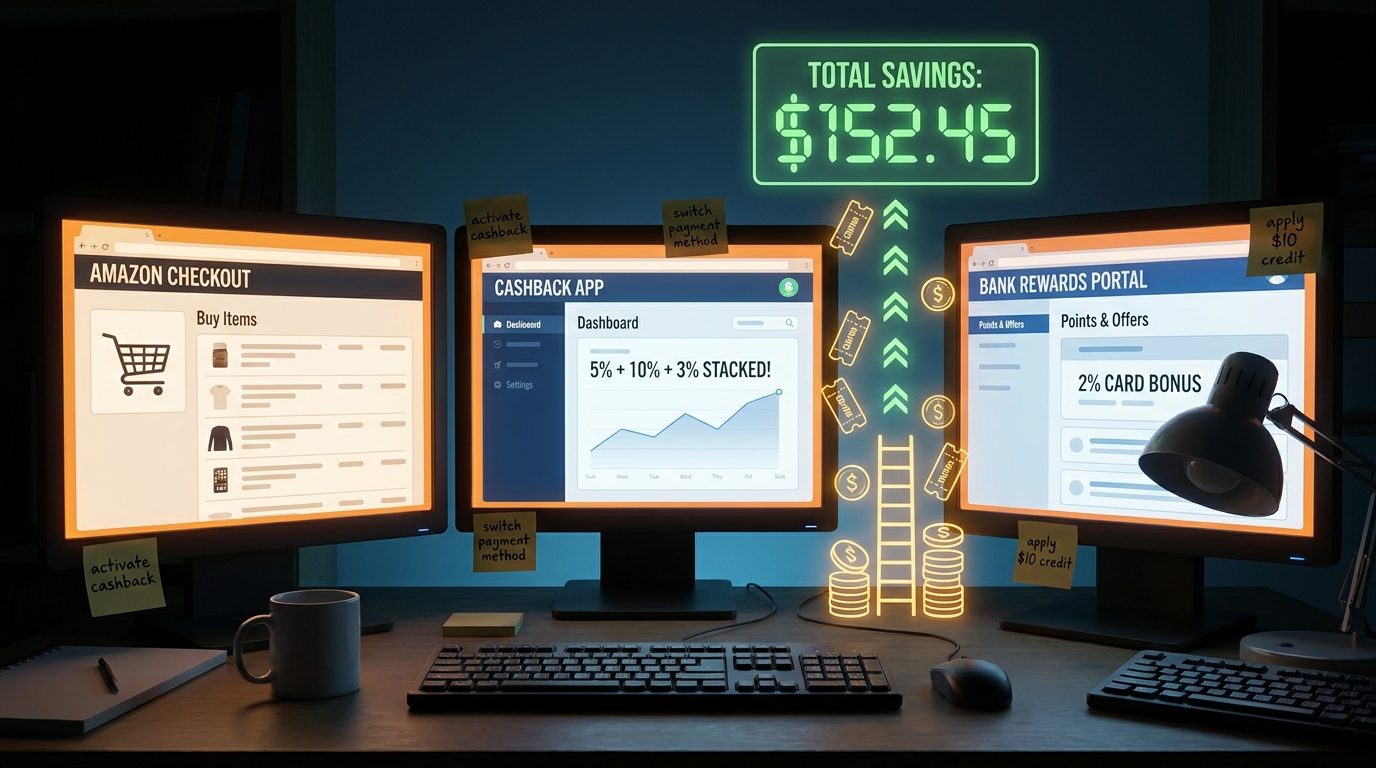
You are not imagining it. Amazon discounts really do seem to disappear the second you try to combine them. You clip a coupon, paste in a promo code, click through a cashback app, and somehow the final price goes up or the rebate vanishes into thin air. That is why so many shoppers give up and assume stacking is just internet folklore.
The good news is there is a repeatable way to do this. If you want to know how to stack amazon cashback and promo codes without breaking the deal yourself, think in layers. First, lock in outside cashback. Second, check for a hidden bank or card portal boost. Third, add Amazon’s own targeted credits, coupons, or promo offers in the right order. The trick is not finding magic codes. It is keeping one discount from canceling another. Once you know the sequence, you can turn one order into two or three real rebates in about five minutes.
⚡ In a Hurry? Key Takeaways
- Yes, you can often stack Amazon savings by combining external cashback, a bank or card portal offer, and Amazon’s own coupon or targeted credit.
- The safest order is: activate card or bank offer first, click through cashback second, then clip coupons and apply Amazon promos last at checkout.
- Do not use random browser coupon tools during checkout. They can overwrite your cashback tracking or trigger a different discount path.
The simple version of the cashback ladder stack
Think of this as a three-rung ladder.
Rung 1: External cashback
This is your Rakuten, TopCashback, BeFrugal, or similar app. You click out from their site or app into Amazon. If the category qualifies, you earn a percent back on the purchase.
Rung 2: Bank or card portal boost
This is the part most people miss. Some banks, credit cards, and reward malls quietly offer extra points, statement credits, or bonus cash back for Amazon purchases. If you have never checked these, read The ‘Bank Portal Loop’ Hack: How To Turn Boring Reward Malls Into Secret Amazon Promo‑Code Level Prices. It explains why these boring-looking portals can beat the usual coupon hunt.
Rung 3: Amazon’s own discount layer
This includes clipped coupons on the product page, spend-X-get-Y credits, gift card reload promos, no-rush shipping credits, Prime card incentives, or one-time promo codes tied to your account.
The stack works when each layer is activated without breaking the next one.
The 5-minute playbook that actually works
Step 1: Start with the item and check if it is even stack-friendly
Open the Amazon product page first, but do not check out yet.
Look for these clues:
- A green coupon checkbox on the product page
- A line that mentions a promotional credit after purchase
- A “Shop items” page tied to a spend threshold deal
- Category exclusions that say cashback may not apply
If the item is sold by a third-party seller, cashback tracking and promo eligibility can get messy. “Ships from and sold by Amazon” is usually easier.
Step 2: Save the item for later, then back out
Add the item to your cart or save it for later. This is just so you do not lose it while checking the other layers.
Then close extra tabs. Seriously. Amazon tracking gets weird when you bounce around too much.
Step 3: Activate your bank or card offer first
Before you click through a cashback site, check these places:
- Amex Offers
- Chase Offers
- Capital One Offers
- Bank of America merchant deals
- Your airline or hotel shopping portal
You are looking for things like:
- Spend $50 on Amazon, get $10 back
- Earn 3 extra points per dollar
- Get a bonus for buying through a shopping portal
Add the offer to your card if needed. If it is a portal, read the fine print. Some portals want you to start the Amazon session through them. Others are card-linked and do not care how you arrive at checkout.
Step 4: Open your cashback app and click through to Amazon
Now go to Rakuten or your cashback app of choice and search Amazon. This is where a lot of people get disappointed, because Amazon cashback is often category-based, not sitewide.
That means you might get 10 percent on select home goods, 3 percent on tools, and nothing on electronics.
Check the exact category payout before clicking. Then click through to Amazon and start a fresh shopping session.
Step 5: Clip Amazon coupons after you land on Amazon
Once you are back on the product page, clip the coupon if one is available.
This usually does not break cashback by itself. What can break cashback is using an outside extension that tries multiple codes or sends you through another referral link.
Step 6: Apply any Amazon promo code or targeted credit at checkout
This is where targeted offers matter. Amazon often has account-specific promos like:
- Use one Membership Rewards point, get up to 40 percent off
- Reload $100 gift card, get $10 credit
- Spend $60 on select items, get $15 promotional credit
Apply these carefully. Read whether the deal is instant at checkout or delivered later as a promotional credit. Those are not the same thing.
If the offer says “credit applied to your account after shipping,” do not expect the cart total to drop. The discount is real, but it comes later.
Why people accidentally kill their own rebate
Usually it is one of five things.
1. They click too many cashback sites
Only one referral source gets credit. Last click usually wins. If you clicked Rakuten, then Capital One Shopping, then Honey, you probably just overwrote the first one.
2. They let a browser extension “test codes”
This is the fastest way to lose tracking. Those tools often inject a new referral path or apply a code that is not compatible with your current offer.
3. They confuse coupons with post-purchase credits
A clipped coupon lowers today’s price. A promotional credit may only show up after the item ships, and sometimes only for future eligible items sold by Amazon.
4. They use the wrong payment method
If your card-linked offer is on Card A but you check out with Card B, that layer is gone.
5. They buy in a category with zero cashback
Amazon cashback portals often exclude gift cards, subscriptions, digital content, some electronics, and certain third-party sellers.
A real-world stacking example
Let’s say you are buying a $200 kitchen appliance.
- Amazon product page coupon: 10% off, saves $20
- Rakuten category cashback: 8%, earns $14.40 if cashback tracks on the discounted subtotal and excludes tax
- Amex Offer: Spend $150, get $20 back
- Amazon targeted promo: Spend $100 on select home items, get a $15 future credit
Your math could look like this:
- Starting price: $200
- Coupon clipped: down to $180
- Amex statement credit: effective cost down to $160
- Cashback earned: effective cost down to about $145.60
- Future Amazon credit: effective value down to $130.60
That is not a fake coupon site fantasy. That is just proper stacking, in order.
What counts as a “hidden rebate” on Amazon right now
Not every deal is a classic promo code. Some of the best savings are hidden in plain sight.
Targeted payment promos
Amazon regularly runs offers tied to one tiny reward point from Amex, Discover, or Chase. If your account is targeted, using a single point can unlock a big percentage discount.
Delayed promotional credits
No-rush shipping credits, digital credits, and category-specific future credits are easy to ignore because they do not lower today’s total. But they still count if you know you will use them.
Gift card and reload offers
Sometimes Amazon gives a bonus for adding funds or buying a gift card. Sometimes banks give a bonus for the same transaction. You need to read the exclusions, but this can be another quiet layer.
Prime card or store card financing perks
If your card includes extra back on Amazon purchases or special financing, compare that with portal cashback. Sometimes the instant financing option is less valuable than a stacked rebate.
The safest checkout sequence
If you want one simple rule to follow, use this order:
- Check the item and confirm it has a coupon or promo eligibility.
- Activate card-linked offers in your bank or credit card account.
- Click through your chosen cashback portal or app.
- Return to the item page and clip the Amazon coupon.
- At checkout, use the exact payment method tied to your offer.
- Apply any Amazon promo code or targeted payment discount.
- Take screenshots before placing the order.
The screenshot part matters more than people think. Save the cart total, offer terms, and confirmation page. If cashback fails to track or a statement credit never posts, you have proof.
When not to bother stacking
Sometimes the stack is more trouble than it is worth.
Skip the gymnastics if:
- The item is low-cost and the savings are only a few dollars
- The portal excludes the category
- The promo requires subscribing, financing, or using a card you do not want
- The “credit” is only for digital items you will never buy
The goal is not to win the internet. It is to pay less without creating a headache.
If a rebate does not show up, here is what to check
Missing cashback
Wait the portal’s tracking window. Some show as pending within hours. Others take days. Then file a missing cashback claim with your click timestamp, order date, and subtotal.
Missing Amazon promotional credit
Check your order confirmation and the original promo terms. Many credits post after shipment, not at purchase. Some only work on items sold by Amazon.
Missing card statement credit
Look at the merchant coding, the exact card used, and the offer expiration date. Statement credits can take several days to appear.
At a Glance: Comparison
| Feature/Aspect | Details | Verdict |
|---|---|---|
| External cashback | Best for category-based percent back through apps like Rakuten or TopCashback. Tracking can fail if you click around too much. | Worth using, but keep your session clean. |
| Bank or card portal boosts | Can add statement credits or bonus points that stack with Amazon discounts. Often overlooked because they are hidden inside your bank account. | The easiest “extra” layer to miss, and often the most valuable. |
| Amazon coupons and targeted credits | Includes clipped coupons, payment promos, spend-X-get-Y deals, and delayed promotional credits. Terms vary a lot. | Great when targeted, but read the fine print before assuming the savings are instant. |
Conclusion
Amazon stacking is real. It is just fussy. Right now the best deals are coming from short-fuse promos, rotating cashback rates, and quiet card-linked incentives that most shoppers either miss or accidentally cancel. That is why a simple routine matters so much. If you activate the outside cashback, add the hidden bank or card boost, and then layer in Amazon’s own coupon or credit in the right order, you stop relying on random luck. You start using a system. Done right, this can shave 20 to 40 percent off some purchases without touching shady code sites or wasting half an hour on dead coupon lists. Keep the session clean, use the right card, take screenshots, and treat every Amazon order like a three-step stack instead of a one-click impulse buy.