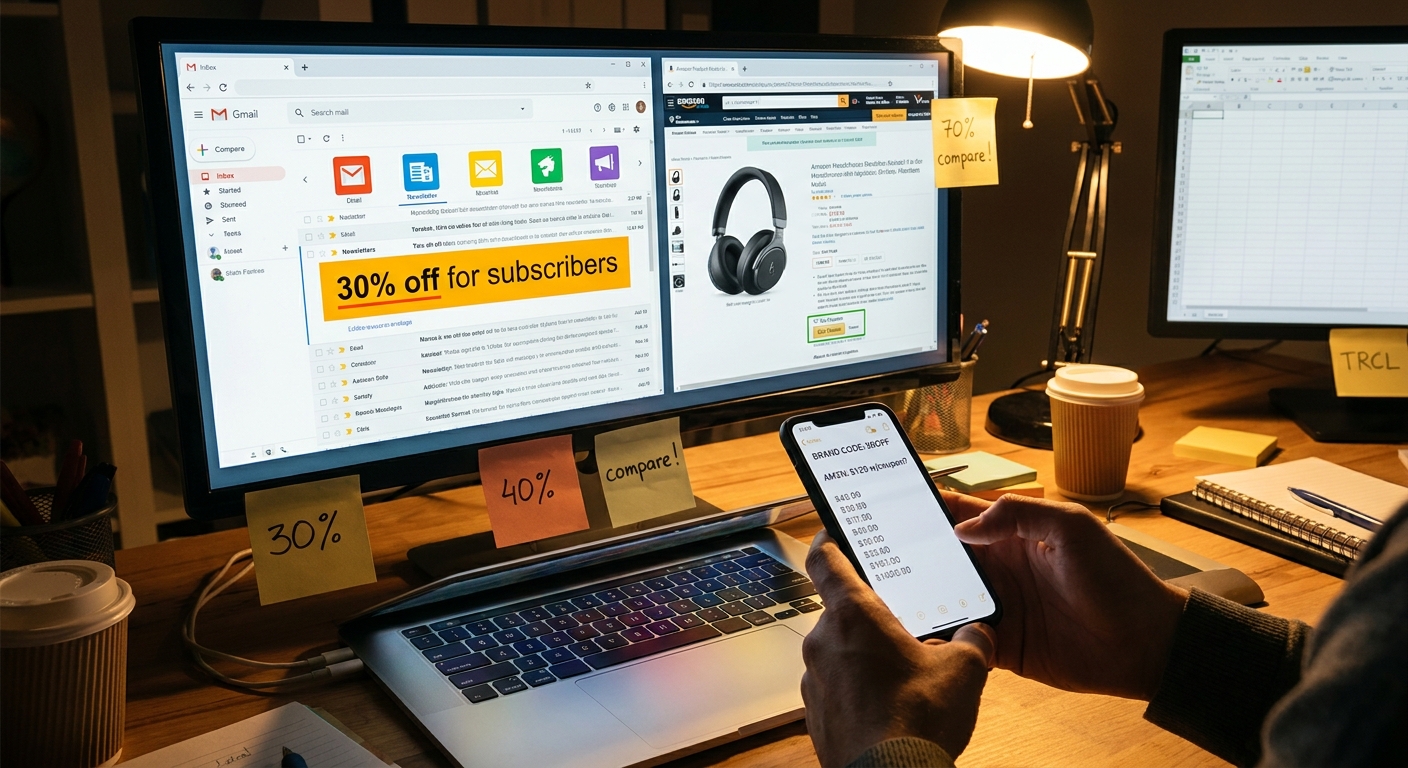
You are not imagining it. Hunting for Amazon promo codes has become a mess. You find a code on a coupon site, paste it in at checkout, and get the same dead-end message every time. Expired. Not eligible. Only valid on one weird color, one size, or one seller you would never pick. Worse, the internet is now full of fake “generator” pages, shady PDFs, and social posts that promise secret Amazon discounts and deliver nothing but spam. The smarter move is not chasing public codes after everyone else has already used them. It is watching for brand email newsletters, welcome offers, and influencer discount blasts, then comparing those deals against Amazon listings. That is the real bait-and-switch here. The “newsletter deal” looks like it is only for the brand’s own store, but it often reveals the real sale price you should be targeting. Sometimes Amazon quietly matches it. Sometimes a marketplace seller beats it. Either way, you stop guessing and start saving.
⚡ In a Hurry? Key Takeaways
- The best amazon promo code hack using brand email newsletters is to use brand-direct offers as your price signal, then check whether Amazon has quietly matched or beaten that discount.
- Sign up for a few trusted brand newsletters, save the welcome code, and compare the final price on the brand site versus Amazon before you buy.
- Avoid coupon generators, random PDF “code lists,” and social posts that push sketchy links. Legit savings usually come from the brand itself, not a mystery website.
The problem with public Amazon promo codes
Most public Amazon promo codes are bad by the time regular people see them.
That is the simple truth. Good codes spread fast. Once they hit coupon sites, deal forums, and TikTok slideshows, they are often picked over, restricted, or already gone. Some were never meant for the general public in the first place. They may be tied to one seller account, a tiny inventory batch, or a limited ad campaign.
That is why shoppers keep feeling tricked. The code looks real. The listing looks close enough. Then checkout says no.
It is not always a scam. Sometimes it is just stale information. But the result is the same. Wasted time, frustration, and a cart full of things you no longer trust.
What the “newsletter bait-and-switch” hack really is
This is less of a magic trick and more of a change in direction.
Instead of starting on Amazon and hunting for a code, you start with the brand that makes the product. Sign up for its email newsletter, look for a first-order discount, seasonal sale, or influencer code, and use that offer as your benchmark. Then check Amazon for the same product.
Here is the switch. The email makes you think the only savings live on the brand’s own site. But many brands and sellers know shoppers compare prices. So one of three things often happens:
- Amazon already has the same item at a matched sale price.
- An Amazon seller drops the price close to the brand’s email offer.
- The Amazon listing adds a coupon checkbox or limited-time deal that makes the final price similar or better.
You are not using the newsletter code on Amazon. Usually, you cannot. You are using the newsletter to expose the real market price.
Why this works better than chasing random codes
Brands reveal the real discount first
Brands often send their best direct offers to email subscribers before deal sites notice. That means you get an earlier view of what the “true” sale price should be.
Amazon reacts fast
Amazon pricing changes constantly. If a brand runs 20 percent off on its own site, Amazon or a third-party seller may quietly move to stay competitive. It may not be advertised as a promo code at all. It may just show up as a lower price, a clipped coupon, or a bundle discount.
It cuts out the junk
You stop relying on mystery sites with made-up codes and start using offers from actual brands. That is a much safer place to begin.
How to use this amazon promo code hack using brand email newsletters
1. Pick a product you were already going to buy
This works best when you start with intent, not impulse. Think headphones, skincare, supplements, kitchen gadgets, phone accessories, pet supplies. Things that are sold both on brand sites and on Amazon.
2. Visit the brand’s official site
Look for the little pop-up or header bar. Many brands offer 10 percent, 15 percent, or even 20 percent off for joining their email list. Some also text a code, but email is usually enough.
3. Check your inbox for the welcome offer
Do not just look at the percentage. Look at the final price after the code, and check shipping costs. A 15 percent discount is not exciting if the brand charges $9.95 for shipping.
4. Open the same product on Amazon
Now compare carefully. Same model. Same size. Same count. Same color if that matters. A lot of fake “savings” disappear the second you notice you were comparing a two-pack to a single item.
5. Look for hidden discounts on Amazon
Check for:
- A coupon checkbox under the price
- A “Save with Prime” note
- A Subscribe & Save option
- A lower price from another seller on the same listing
- A limited-time deal that appears only on the product page
6. Compare the final checkout price, not the sticker price
This is where people get fooled. The brand may show $40 with 20 percent off, while Amazon shows $33.99 with a 5 percent coupon. Once you factor in shipping, tax, and delivery speed, the winner may flip.
7. Save the newsletter for later
Even if Amazon wins today, keep that email. Brands often send follow-up offers a week later. Sometimes the second email is better than the welcome code.
A quick example
Let’s say a grooming brand emails you a 20 percent off code for a beard trimmer listed at $49 on its own site. That brings the price to $39.20, but shipping adds $6.
Now your real comparison number is $45.20 before tax.
On Amazon, the same trimmer might be listed at $44.99 with a clipped $5 coupon. Suddenly the Amazon price is effectively $39.99, with faster shipping and easier returns.
No Amazon promo code needed. The brand newsletter did the heavy lifting by showing you that the item was ripe for a discount.
Where this trick works best
It is especially useful for products from brands that sell in multiple places and run frequent email campaigns.
- Beauty and skincare
- Supplements and wellness products
- Small electronics
- Kitchen tools
- Pet products
- Fitness gear
- Home organization items
It is less useful for Amazon-exclusive items or no-name products that only exist inside Amazon’s marketplace.
Red flags to avoid
“Amazon code generator” sites
These are almost always nonsense. At best, they waste your time. At worst, they try to collect your email, push malware, or bait you into surveys.
Coupon PDFs and giant code dumps
If a file claims to contain hundreds of active Amazon codes, be skeptical. Real Amazon discounts are usually limited, targeted, or tied to specific listings.
Influencer posts with no product match
Some social posts recycle old codes or attach them to the wrong item. Always verify the exact product and seller.
Off-site checkout tricks
If a site says you need to “verify” your Amazon account somewhere else to unlock savings, leave immediately. That is not how legitimate discounts work.
Make your inbox useful without turning it into a junk drawer
I know the obvious objection. “Great, now I have to sign up for even more email.” Fair point.
The easy fix is to make a separate shopping email account or use your main inbox with filters. Create a folder for store offers. That way, you can keep the good discounts without drowning in daily marketing messages.
Also, be picky. Do not sign up for every store on earth. Start with brands you already buy or have been meaning to try.
When the brand site is still the better deal
Sometimes Amazon does not match the offer. That is fine. The hack still worked because it kept you from overpaying on Amazon just because it felt convenient.
Brand sites can win on bundles, gifts with purchase, loyalty points, and better warranty support. If the price difference is small, those extras may matter more than two-day shipping.
The point is not to force every purchase through Amazon. The point is to stop treating Amazon as the only place where a “real” discount exists.
At a Glance: Comparison
| Feature/Aspect | Details | Verdict |
|---|---|---|
| Public coupon sites | Codes are often expired, overused, restricted, or copied from old deals | Low success rate |
| Brand email newsletters | Welcome offers and seasonal discounts reveal the real sale price for a product | Best starting point |
| Amazon cross-check | Look for matched pricing, clipped coupons, Subscribe & Save, and seller competition | Often where the final savings appear |
Conclusion
Right now, there is a flood of bad “Amazon promo code” advice online. Some of it is harmless but useless. Some of it is outright scammy. The better approach is simpler and safer. Stop chasing public codes that have already been picked clean. Start with brand-direct email offers, use them as your benchmark, and then cross-check Amazon for a matched or better final price. It is a repeatable habit, not a one-time trick. And it fits this moment perfectly, because inboxes are already stuffed with early summer sale emails and influencer discount blasts that most people ignore. Hidden in that pile are real, legit savings. You just need to use them as a clue, not a destination.