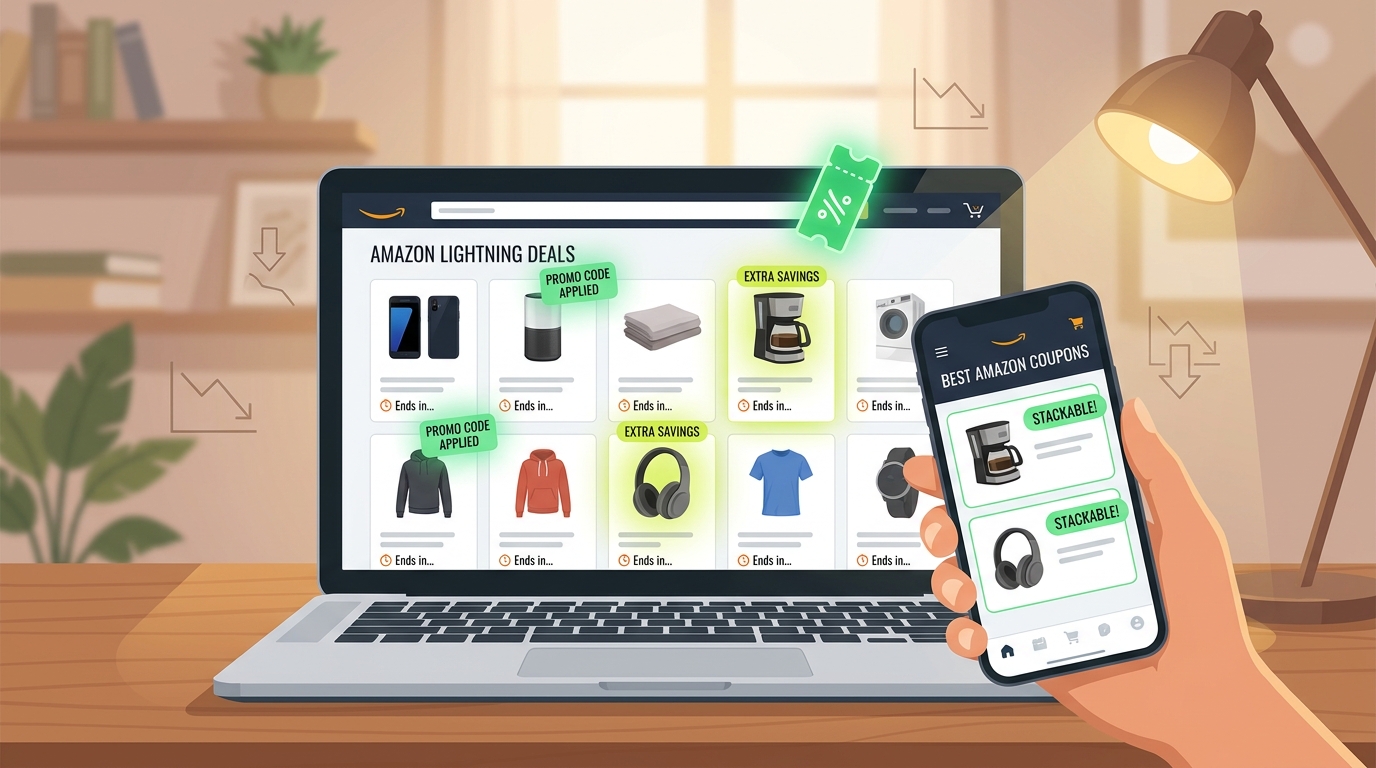
You are not imagining it. Those TikTok “I got this for 82 percent off on Amazon” posts are often missing one annoying detail. The big savings only show up when a Lightning Deal, a clipped coupon, and a live promo code all happen to stack at the same time. If you click too late, skip one tap, or trust an old code, the discount falls apart fast. That is why so many shoppers feel tricked when the cart total barely changes. The good news is there is a simple way to check whether the deal is real before you waste time. Think of it as a 3 tap routine. First, open the Lightning Deal. Second, clip any coupon on the page. Third, test the listed promo code at checkout before buying. If all three line up, that is when the real steals happen. If not, move on and save your money.
⚡ In a Hurry? Key Takeaways
- The amazon lightning deal promo code stack hack works only when a Lightning Deal, clipped coupon, and active promo code overlap.
- Before you buy, tap the deal, clip the coupon, and test the code in cart or at checkout to confirm the real final price.
- If the discount does not appear clearly in checkout, skip it. That helps you avoid fake savings and impulse buys.
Why these “secret Amazon code” deals so often disappoint
Most viral deal posts leave out the timing problem. Amazon discounts are layered, and each layer can expire on its own. A Lightning Deal may still be live, but the promo code might be dead. The coupon may be there, but only for one color or size. Or the price in the video may have included a short-lived seller promotion that ended hours ago.
That is why regular shoppers open the same product page and see a much smaller discount. It is not always fake, but it is often incomplete.
The trick is not finding “magic” codes. It is finding products where all the moving parts are already lined up.
The 3 tap routine that makes the stack easy to check
1. Open the Lightning Deal first
Start on the item page and look for the Lightning Deal box or sale banner. Tap it so the deal is actually applied. If you do not do this first, the rest of the math may never show up correctly.
2. Clip the coupon on the product page
Look right under the price or near the discount area for a checkbox or green coupon badge. Tap “Apply coupon” or “Clip coupon.” This is the part many people miss, especially when they rush in from social media links.
3. Test the promo code before you place the order
Add the item to cart and enter the promo code at checkout if one is listed on the page or in a trusted deal post. If the code works, Amazon will show the discount clearly in the order summary. If it does not, stop there.
That is the whole amazon lightning deal promo code stack hack. It is less of a hack and more of a quick filter for real deals.
What a real stacked deal looks like
Here is a simple example. Say a gadget is listed at $40.
- The Lightning Deal drops it to $28.
- A clipped coupon takes off another 10 percent or $3.
- A promo code removes another 20 percent at checkout.
Now you are no longer looking at a boring sale. You may be down near $20 or less, which is the kind of price people brag about online.
Without all three pieces, though, that same item might still cost $30 to $36. That is not terrible, but it is not “viral deal” territory either.
How to tell if a promo code is worth your time
Dead codes are everywhere right now. If you are chasing random screenshots or old captions, you are probably wasting clicks.
A code is worth testing only if:
- The product page still shows a live discount.
- The code has a clear expiration window.
- The item has the same seller and exact variation listed in the deal post.
- The checkout screen shows the discount before you pay.
If any of those are missing, be skeptical.
One smart extra step most shoppers miss
Before you settle for the first sale badge you see, check whether Amazon is hiding an extra coupon layer inside its deals pages. Our readers who use The “Hidden Deal‑Of‑The‑Day Coupon Tab” Hack: How One Click Unlocks Amazon’s Secret Extra Promo Codes On Already‑Discounted Items know that some of the best discounts are not on the main product image at all. They show up one click deeper, which is exactly why so many people miss them.
Common mistakes that ruin the stack
Buying from the wrong seller
Promo codes often apply only to one seller listing. If Amazon auto-switches you to another seller, the code may stop working.
Choosing the wrong color or size
That huge discount might only work on one variation. Change the color, and the coupon disappears.
Waiting too long
Lightning Deals are short. Promo codes can hit usage limits even faster. If all three discounts are live, do not leave the cart sitting for hours.
Confusing list price with real savings
Some products always look discounted because the list price is inflated. What matters is the final checkout total, not the biggest red percentage on the page.
When this stacking method is actually worth using
This works best for things you were already planning to buy. Household basics. Small electronics. Accessories. Gifts you need soon.
It is not a good excuse to buy random gadgets just because the price drop looks dramatic. A fake need at 80 percent off is still wasted money.
At a Glance: Comparison
| Feature/Aspect | Details | Verdict |
|---|---|---|
| Lightning Deal only | Fast discount, but often modest once you reach checkout. | Good, but usually not the viral bargain people expect. |
| Lightning Deal plus coupon | Better savings if you remember to clip the coupon on the product page. | Worth checking, especially on everyday items. |
| Lightning Deal plus coupon plus promo code | The full stack. Best chance of getting a true 40 to 80 percent cut when all parts are active. | Best option, but only if checkout confirms every discount. |
Conclusion
The big lesson here is simple. Do not trust the screenshot. Trust the checkout total. Social feeds are packed with “hidden Amazon promo codes,” but a lot of shoppers are burning time on dead codes or buying items that only look deeply discounted. A simple Lightning-plus-code stack helps you zero in on short-lived deals where a real promo code is already working. That means fewer fake saves, fewer impulse buys, and more legit 40 to 80 percent cuts on things you were going to buy anyway. If the three pieces line up, great. If they do not, close the tab and keep your cash.