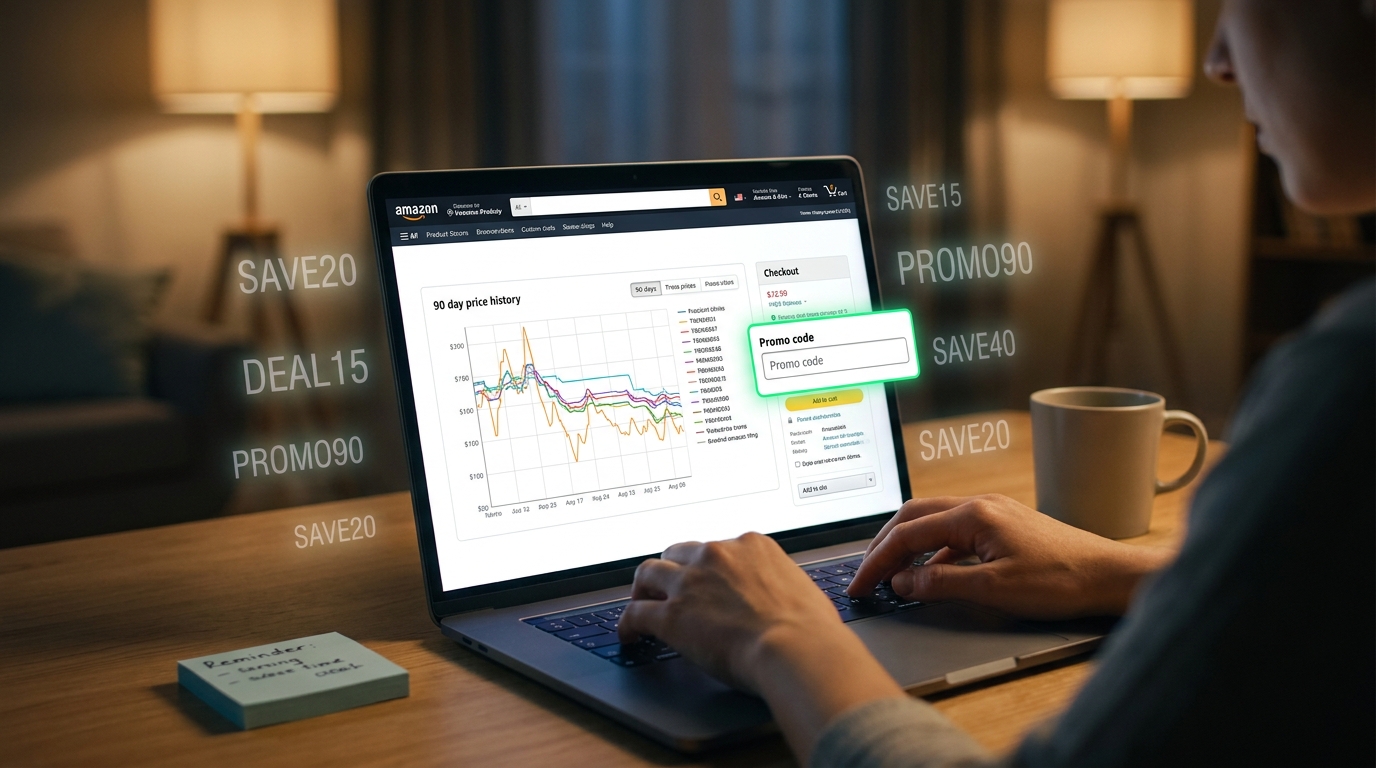
You are not crazy if those “secret Amazon code” videos are starting to feel like a part-time job. One TikTok says 50 percent off. A Facebook post says “run, don’t walk.” Then you paste the code in and get $1.87 off, or worse, the item was cheaper last week before the creator started yelling about it. That is exactly why this new Amazon Rufus price history promo code hack matters. Amazon has quietly added 30-day and 90-day price history right inside Rufus, its shopping assistant. So now, with one smart question, you can check whether a “deal” is actually a deal before you waste time at checkout. The trick is simple. Ask Rufus about recent price history first, then compare that answer to the promo code being pushed. If the code only brings the item back to its normal price, you are not getting a bargain. You are getting marketing.
⚡ In a Hurry? Key Takeaways
- The Amazon Rufus price history promo code hack is to ask Rufus for the item’s 30-day and 90-day price trend before trusting any “secret” discount code.
- If a code only drops the price back to where it sat recently, skip it and wait for a better offer or stack it only if the final price is clearly below the recent average.
- This helps you avoid fake “50 percent off” claims, region-locked codes, and coupon hype built on inflated list prices.
The one-question hack that cuts through promo code hype
Here is the plain-English version. Open the Amazon product page, tap into Rufus, and ask a question like:
What to ask Rufus
“What is this item’s 30-day and 90-day price history?”
You can also try:
“Has this item been cheaper in the last 30 days?”
Or:
“How does today’s price compare with the last 90 days?”
That one step changes everything. Instead of judging a deal by a flashy coupon graphic, you are checking Amazon’s own recent pricing. It is the easiest way to spot a fake discount.
Why this works so well right now
Coupon creators are getting smarter. Many are not technically lying. They just leave out the part where the price was raised before the code was posted. So the “huge” discount only brings the item back to normal.
That is why Amazon’s built-in history matters. It gives you a reality check from inside the same store where you are buying. No extra browser tools. No guessing. No opening six tabs just to figure out if a blender is really on sale.
If this sounds familiar, you may also want to read The “Hidden Rufus Price Trap” Hack: How Amazon’s New AI Quietly Exposes Fake Promo Deals Before You Check Out, which digs into how tiny discounts can look bigger than they really are.
How to use the Amazon Rufus price history promo code hack step by step
1. Start on the product page
Find the exact item from the video or post. Be careful here. Many social posts push one variation, but the code only works on a less popular color, size, or bundle.
2. Ask Rufus about price history
Use one of the questions above. You want the 30-day and 90-day view if possible. That helps you avoid getting tricked by a short-term price spike.
3. Look at today’s base price first
Before entering any code, see where today’s listed price sits compared with the recent range. If today’s price is already near the high end, be skeptical.
4. Apply the promo code
Now test the code. If it works, great. But do not stop there.
5. Compare the final price to the recent history
This is the whole game. Ask yourself one simple question. Is the final checkout price actually lower than what this item usually sold for in the last 30 or 90 days?
If yes, that is a real deal.
If no, the code is mostly noise.
How to tell if a “50 percent off” claim is real
Here is a quick filter I use.
Probably a real deal
The final price after coupon is clearly below the recent 30-day price, and ideally below much of the 90-day range too.
Probably just hype
The product was cheaper or roughly the same price in the recent past without any “secret code.”
Definitely suspicious
The post screams about the percentage off, but the actual dollar savings are tiny, or the code only works on one odd variation.
This is where shoppers get burned. The percentage sounds dramatic. The final price is just okay.
Three common traps this hack helps you avoid
Inflated before-discount pricing
This is the oldest trick in retail. Raise the price, then show a coupon. Rufus helps you catch it.
Expired or region-locked codes
Even when a code is valid, it may only work in certain accounts or areas. If the code fails, at least you will know whether the item was worth chasing in the first place.
Tiny savings dressed up as major wins
A 40 percent coupon sounds exciting. But if it applies to a padded list price, your “deal” may be average at best.
When a promo code is still worth using
Not every social coupon is junk. Some are excellent. The smart move is to use the code only after checking the recent price trend.
A code is worth your time when:
- The final price is lower than the recent 30-day average.
- The final price is near or below the 90-day low.
- The code stacks with an on-page coupon or sale price.
- The item is something you were already planning to buy.
That last one matters. A good deal on something you do not need is still money gone.
A simple example
Say a coffee maker is posted on TikTok with a “secret 50 percent off code.”
Today’s listed price is $79.99.
Rufus shows it spent most of the last 30 days between $54.99 and $59.99.
You apply the code and your final total becomes $57.99.
That is not a terrible price. But it is not some once-in-a-lifetime steal either. It is basically normal. Thanks to Rufus, you know the difference.
Best questions to ask Rufus before you buy
- What is this item’s 30-day price history?
- What is this item’s 90-day price history?
- Has this product been cheaper recently?
- Is today’s price low compared with the last 90 days?
- Does this item go on sale often?
You do not need to sound technical. Just ask like a normal person. Rufus is supposed to handle that part.
One smart habit for peak deal season
Keep a short rule for yourself: no code gets trusted until the final price beats recent history.
That little rule can save you from impulse buys, junk coupon pages, and a lot of checkout disappointment. It also helps you focus on the promos that are actually worth sharing with friends and family.
At a Glance: Comparison
| Feature/Aspect | Details | Verdict |
|---|---|---|
| Rufus price history check | Shows 30-day and 90-day context so you can compare today’s price and post-coupon total to recent norms. | Best first step before trying any promo code. |
| TikTok or Facebook “secret code” posts | Often highlight the coupon percentage, but may ignore recent price increases, limited variations, or weak real savings. | Treat as a lead, not proof of a deal. |
| Final checkout price | The only number that matters. Compare it against recent Amazon pricing, not against a flashy list price. | If it is below the recent range, it is worth a closer look. |
Conclusion
This is a big deal for shoppers right now because Amazon quietly rolled out 30-day and 90-day price tracking inside Rufus just as peak fall deal season is heating up. That means you do not have to guess whether a viral promo code is gold or garbage. You can check Amazon’s own data, use it against the hype, and make a smarter call in seconds. The Amazon Rufus price history promo code hack will not make every code better, but it will help you dodge fake “50 percent off” claims, skip weak discounts, and zero in on offers that are actually under market and worth stacking with verified promos. Less wasted time. Less checkout nonsense. More real savings.