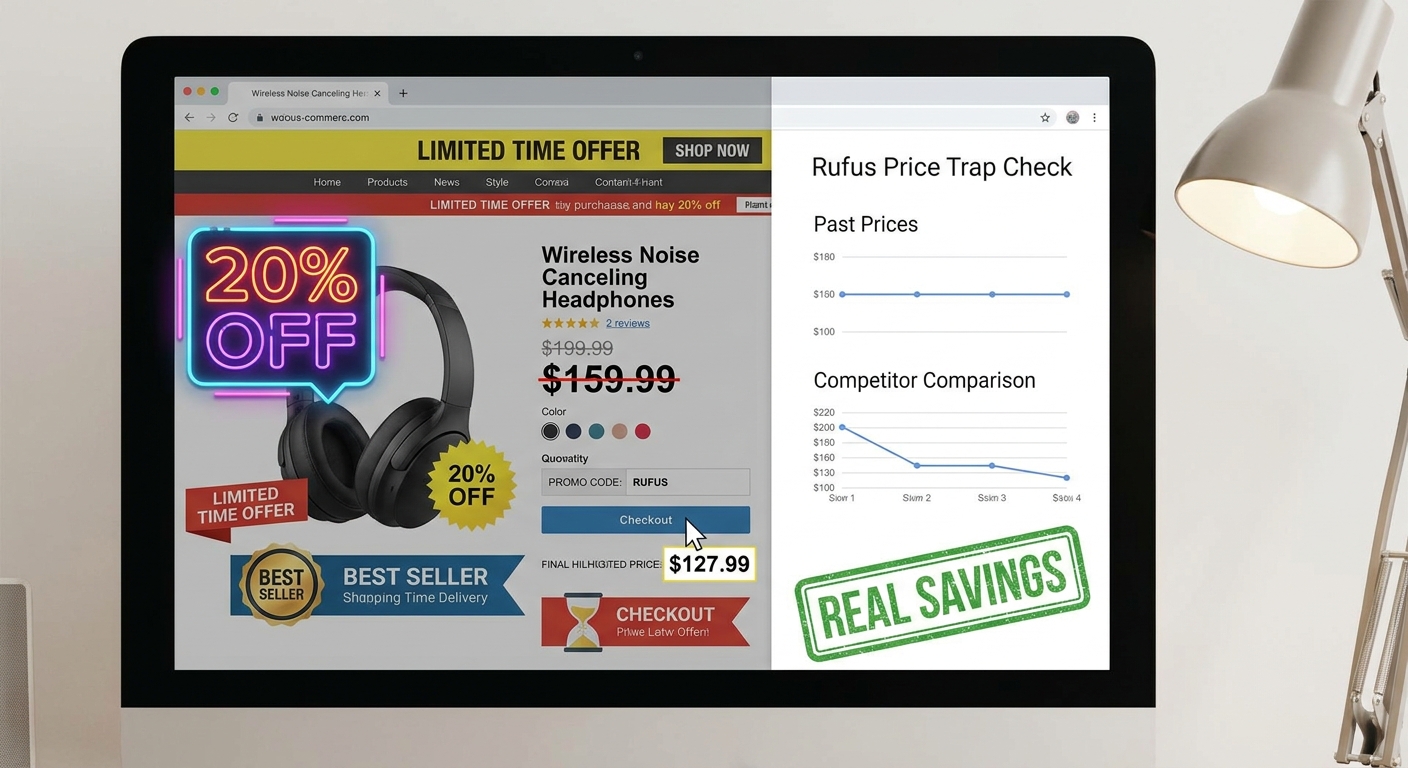
You are not imagining it. Few shopping annoyances are worse than finding an Amazon promo code that looks amazing, pasting it in, and watching your total drop by a laughable amount. Maybe it takes off $2. Maybe it only works on one color. Maybe the item was quietly more expensive to begin with, so the “deal” was never much of a deal at all. That is exactly why the amazon rufus promo code hack is getting attention. Amazon’s Rufus AI can sometimes help you spot the truth before checkout by answering product and deal questions in plain English. It will not magically expose every trick, but it can help you catch inflated list prices, weak coupons, and sketchy “limited-time” markdowns faster. Pair Rufus with a quick price-history check and a vetted code list, and you stop shopping on hype. You start shopping with receipts.
⚡ In a Hurry? Key Takeaways
- The amazon rufus promo code hack is really about using Amazon’s AI to question a deal before you buy, not blindly trusting the discount label.
- Ask Rufus about recent pricing, coupon limits, product variants, and whether the item often sells for less elsewhere on Amazon.
- Rufus is helpful, but not enough on its own. Always pair it with a price-history tool and only use promo codes from sources you trust.
What the “Hidden Rufus Price Trap” actually means
This is less of a secret loophole and more of a smarter shopping habit.
Rufus is Amazon’s shopping AI assistant. Most people think of it as a product Q&A bot. Ask it which air fryer is easier to clean, or whether a coffee grinder is good for espresso. Fair enough.
But it can also be used as a quick reality check when a promo code looks too good to be true.
That matters because promo codes often distract you from the more important question. Was the starting price any good in the first place?
If an item was $19.99 last week, gets bumped to $27.99 today, and now shows a coupon or code that drops it to $22.49, you did not really score a win. You just got nudged into feeling like you won.
Why Amazon deals can feel fake, even when the code works
This is the part shoppers hate. A promo code can be technically valid and still be a bad deal.
1. The base price may have changed first
This is the biggest trap. Sellers can raise the price, then slap on a coupon so the final number looks special.
2. The discount may only apply to one variant
That flashy 20% off may only work on the odd color, weird pack size, or less popular model.
3. The markdown may be based on a shaky “list price”
Some listings show dramatic percentages off a reference price that few people actually paid.
4. Checkout savings may be tiny after all the fine print
You thought you found a sitewide code. Turns out it only works on “select items shipped and sold by Amazon,” excludes subscriptions, and cannot be stacked with the on-page coupon.
By the time you discover that, you have already wasted ten minutes and talked yourself into buying something you did not need.
How to use the amazon rufus promo code hack the smart way
Here is the simple version. Before you apply the code, ask Rufus questions that force clarity.
Questions worth asking Rufus
Try plain prompts like these:
- “Has this item been selling at a lower price recently?”
- “Are there coupons or discounts currently available on this listing?”
- “Does this discount apply to all sizes or colors?”
- “What is different between these variants?”
- “Is this item frequently discounted?”
- “What are shoppers saying about the value for the price?”
Rufus may not give you a perfect price-history chart, but it can surface clues fast. It can point out if shoppers often mention better sale prices, if one variation has a better value, or if the listing itself includes coupon details you might miss.
What Rufus is good at
It is good at summarizing listing details, explaining differences between options, and saving you from clicking through ten tabs.
What Rufus is not good at
It is not a lie detector. It does not replace a real price tracker. And it can only work with the information Amazon gives it access to.
Think of Rufus as your first filter, not your final judge.
The better system: Rufus plus price history plus vetted codes
If you want fewer fake wins, use a three-step check.
Step 1: Ask Rufus what the deal really applies to
Before checkout, confirm whether the code works on the exact item, size, and seller you picked.
Step 2: Check price history
Use a price tracker like CamelCamelCamel or Keepa. You do not need to study charts like a stock analyst. Just answer one question. Is today’s final price actually low compared to the past few weeks or months?
Step 3: Use curated codes, not random social posts
TikTok and Reddit are great for deal chatter. They are awful for context. A code that “worked for me” three hours ago may only apply to one account, one region, or one product version.
That is why vetted codes matter. They cut down on the wild goose chase.
Real-world example: coffee, cables, and cleaning supplies
These are exactly the kinds of products where people get tricked, because they are cheap enough that most of us do not stop and investigate.
Coffee
A 25% promo sounds huge. But if the bag was marked up from $11.99 to $15.99 first, your “deal” may still be above its normal price.
Cables
One cable length gets the coupon. The length you actually need does not. Rufus can help surface variant differences faster than digging through the listing by hand.
Cleaning supplies
Multi-packs often look discounted until you compare the unit price. That is another place where AI summaries help, but you still need your own common sense.
How to spot a fake-feeling promo in under 30 seconds
If you are in a hurry, run through this checklist:
- Is the discount based on the current price, or a suspiciously high crossed-out price?
- Does the code apply to your exact option?
- Is the seller reputable?
- Does the final price beat the recent price history?
- Would you still buy it without the promo excitement?
If the answer to that last question is no, close the tab. That alone will save you more money than any coupon code.
What not to do
Do not treat every posted code like a treasure map.
Do not assume “limited time” means rare.
Do not trust giant percentage claims without checking the final price against history.
And do not let a tiny discount push you into a bigger cart.
Why this matters right now
We are in a weird moment where “stacking” has become content. People are posting screenshots, not context. That makes average shoppers feel like they are missing out on some magical sitewide 20% code when, in reality, most of these wins are narrow, messy, or not very impressive once you do the math.
The useful version of the amazon rufus promo code hack is not flashy. It is practical. Use AI to ask better questions. Use price history to confirm the answer. Use trusted codes to avoid junk leads.
At a Glance: Comparison
| Feature/Aspect | Details | Verdict |
|---|---|---|
| Rufus AI check | Fast way to ask about discount terms, variants, product value, and listing details before checkout. | Useful first pass, but not enough by itself. |
| Price-history tool | Shows whether the “discounted” final price is actually lower than the item’s usual selling price. | Best way to catch fake markdowns. |
| Random social promo codes | Often outdated, account-specific, region-specific, or tied to one odd product variation. | Low trust. Use carefully, if at all. |
Conclusion
You do not need to become a deal detective to shop smarter on Amazon. You just need a better filter. Right now there is a flood of TikToks and Reddit threads hyping random codes, and shoppers are wasting time chasing them without knowing if the base price was quietly marked up first. That is why this works best as a system. Ask Rufus the obvious questions, check price history, and stick with already-vetted promo codes when possible. The result is fewer fake victories, fewer impulse buys, and more real under-market scores on everyday items like coffee, cables, and cleaning supplies. In a week when everyone is talking about stacking, the smarter move is to stop chasing mythical sitewide 20% unicorns and start treating promo codes like a precision tool you can actually trust.