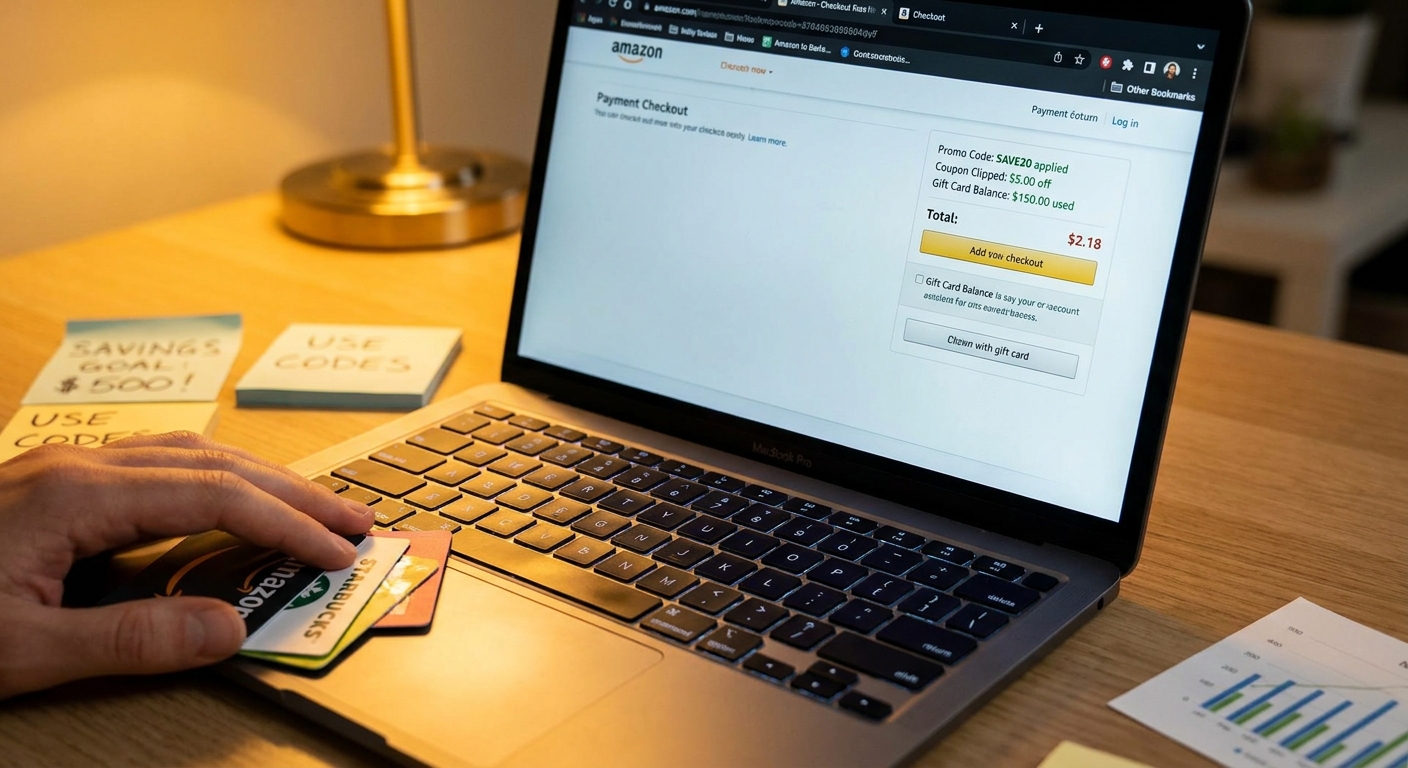
You know the feeling. You finally find an Amazon promo code that actually works, clip the little coupon box on the product page, and get to checkout expecting a victory. Then the total drops a bit, but not enough to feel exciting. That is because most people focus only on the front-end discount and ignore the payment side. They hunt for codes, compare sellers, and refresh deal forums, then pay with a full-price credit card or debit card anyway. That is the quiet leak.
The smarter move is simple. Buy Amazon gift cards at a discount first, load that credit to your account, and then use that balance when you stack promo codes and clippable coupons. If your Amazon balance was funded at 5 to 10 percent off, every deal you already find becomes better automatically. It is not flashy. It is not new. But it works on the boring repeat orders, the urgent next-day purchases, and the bigger buys where a small extra percentage turns into real money.
⚡ In a Hurry? Key Takeaways
- Amazon promo code stacking with discounted gift cards works because the gift card savings happen before checkout, so they often do not interfere with coupons or promo codes.
- Start by building a small Amazon balance using discounted gift cards from trusted sources, then apply Amazon coupons and promo offers on top.
- Stick to reputable gift card sellers and avoid sketchy peer-to-peer deals, because a fake discount is no discount at all.
Why this trick matters more than another random promo code
Amazon deals are not what they used to be. Plenty of listings show a coupon, a sale price, or a promo code, but the base price has often crept up first. So yes, the discount is real, but it may not feel huge.
That is where this hidden stack helps. Instead of asking, “How do I find one more code?” ask, “How do I make every order cheaper before I even start?”
Discounted Amazon credit does exactly that. If you buy a $100 Amazon gift card for $92 to $95 through a legit promo, rewards portal, warehouse club offer, or trusted gift card marketplace, you have baked in an instant discount. Then you use that $100 balance to pay for orders that already have a coupon or promo attached.
It is boring. It is beautiful. And it adds up fast.
How Amazon promo code stacking with discounted gift cards actually works
Think of it in layers.
Layer 1: The product discount
This is the discount most shoppers see. It might be a sale price, a clippable on-page coupon, a Subscribe & Save discount, or a limited promo code.
Layer 2: The payment discount
This is the part most shoppers miss. If your Amazon account balance was loaded using discounted gift cards, then your payment method was effectively on sale too.
That means a product with 20 percent off does not just cost 20 percent less. It can cost another 5 to 10 percent less in practice, depending on how cheaply you bought the gift card balance.
Simple example
Say an item normally costs $100.
You clip a coupon and use a promo code that drops it to $80.
Nice deal.
But if you paid with Amazon balance that you acquired at 10 percent off, your effective out-of-pocket cost was really $72 for that $80 charge.
That is the hidden gift card stack.
Where people find discounted Amazon gift cards
The exact offers change all the time, but the main places are pretty consistent.
Warehouse clubs and retailers
Sometimes wholesale clubs or grocery stores run sales on gift cards. It may be a straight discount, a store gift card bonus, or extra fuel points.
Credit card and bank rewards portals
Some card issuers let you redeem points for gift cards at a discount during promos. This is not always the best value versus travel, but if your goal is Amazon savings, it can be useful.
Cash back sites and card-linked offers
Occasionally you will see offers like “Spend $50 on gift cards, get $5 back” or bonus cash back at a store that sells Amazon gift cards.
Trusted gift card marketplaces
These can offer solid savings, but this is where caution matters most. Use reputable sites with buyer protection and clear refund policies. Avoid random social posts, resale forums, or too-good-to-be-true listings.
What usually stacks, and what does not
This is where people get confused, so let’s keep it plain.
Usually stackable
- Sale prices
- Clippable coupons on the product page
- Subscribe & Save discounts on eligible items
- Amazon gift card balance used as payment
Sometimes stackable
- Promo codes with clippable coupons
- Promo codes with Subscribe & Save
- Prime-only discounts with other listing offers
Often limited
- Two competing promo codes on the same item
- Some lightning deals with extra code-based offers
- Certain brand-funded deals with strict one-off terms
The key point is this. Gift card savings usually sit outside those stacking limits because they are not changing the item’s listed discount. They reduce your real cost of paying for the item.
Why this is a smarter long-term strategy
Promo codes come and go. Amazon changes rules. Sellers stop funding big discounts. Public coupon pages cool down.
But if you keep a discounted Amazon balance ready, you are less dependent on the daily chaos. You still use promo codes when they appear. You still clip coupons when they are available. You are just no longer starting from zero.
That makes this a sustainable edge, not a one-day trick.
It also pairs nicely with other built-in Amazon savings paths. For example, if you are not already checking overstock listings, read The “Hidden Outlet Stack” Hack: How Amazon’s Overstock Page Quietly Acts Like a Built‑In Promo Code. It is another good reminder that some of the best savings are hiding in plain sight.
Best use cases for the hidden gift card stack
Everyday household refills
Paper towels, detergent, coffee pods, pet supplies. These are the orders people place on autopilot. Even when there is no flashy code, paying with discounted Amazon balance still helps.
Big electronics buys
This is where the math gets fun. A 5 percent payment-side discount on a $600 purchase is $30. Add a sale price or checkout promo, and suddenly the deal looks much stronger.
Urgent “need it tomorrow” purchases
Not every order gives you time to shop around. If you already have discounted balance sitting in your account, you still save money when urgency wins.
How to do it without making your life complicated
You do not need a spreadsheet and a detective board on the wall.
Option 1: Keep a small rolling balance
Buy discounted Amazon gift cards in modest amounts. Maybe $50, $100, or $200 at a time. That gives you ready-to-use credit without tying up too much cash.
Option 2: Top up before big sales
Before Prime Day, Black Friday, back-to-school season, or holiday shopping, look for the best discounted gift card opportunities and stock up a bit.
Option 3: Match your normal monthly spend
If you know you spend roughly $150 a month on Amazon, try to acquire that amount in discounted balance whenever a reliable deal appears.
Important safety rules
This hack is only good if the gift card source is good.
Use trusted sellers
Look for established retailers, major warehouse clubs, known rewards portals, or reputable gift card marketplaces with buyer protection.
Avoid weird discounts
If someone is offering Amazon gift cards at 25 or 30 percent off with no clear reason, walk away. That is where trouble starts.
Redeem quickly
Once you buy a legitimate Amazon gift card, add it to your Amazon account soon rather than letting codes sit around in your inbox.
Watch your return math
If you return an item, Amazon usually refunds to your Amazon balance based on its policies. That is fine for frequent Amazon shoppers, but it means your savings stay inside the Amazon system.
Common mistakes people make
Waiting for the perfect discount
Some shoppers hold out for 15 percent off gift cards and miss lots of easy 5 percent wins in the meantime. Small repeat savings beat perfect theoretical savings.
Forgetting the base price still matters
A stacked deal is not automatically a great deal. Always compare the current Amazon price with other retailers.
Buying too much balance
Do not lock up more money than you reasonably expect to use, especially if your budget is tight.
Confusing points with cash
If you are redeeming valuable travel points for Amazon gift cards, double-check whether that is actually worth it for you. Sometimes the gift card discount looks nice but gives weak point value overall.
At a Glance: Comparison
| Feature/Aspect | Details | Verdict |
|---|---|---|
| Discounted gift card balance | Usually creates a 5 to 10 percent built-in savings before checkout discounts are applied | Best long-term stack |
| Public promo codes and coupons | Can deliver strong short-term savings, but availability and stacking rules change often | Great bonus, not enough by itself |
| Buying gift cards from unknown sellers | May promise deeper discounts, but carries a much higher risk of invalid or disputed codes | Not worth the gamble |
Conclusion
Right now, a lot of shoppers are obsessing over finding the next Amazon promo code while quietly paying with full-price money. That is the part to fix. If you build a steady 5 to 10 percent discount into your Amazon balance first, then layer current promo codes and clippable coupons on top, every order gets stronger this week and next week too. Even if the public code scene slows down, you still have an edge. That makes this one of the most practical Amazon saving habits around. It works for pantry refills, expensive electronics, and all those random “I need it tomorrow” buys that rarely come with a flashy coupon. Start small, stay safe, and let your payment method become part of the deal.