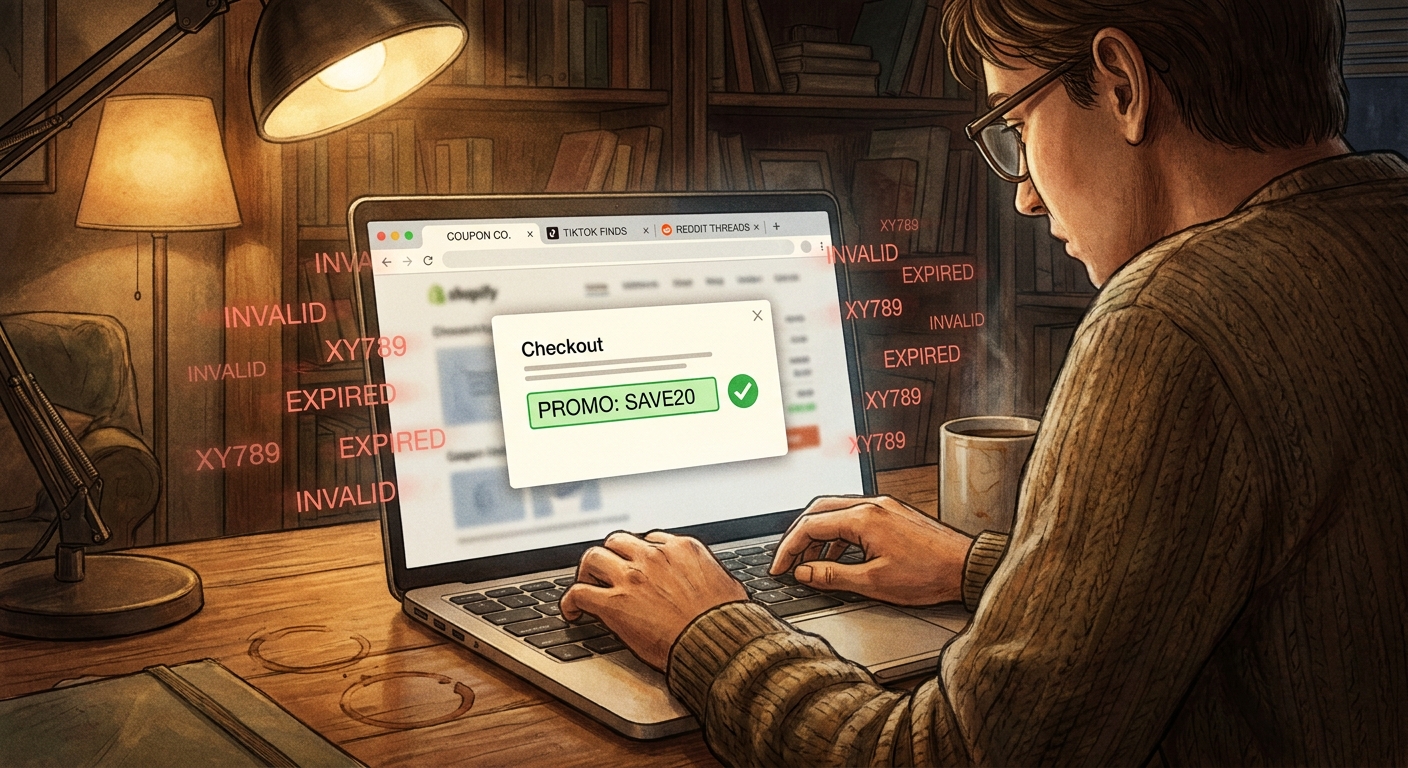
You are not imagining it. Hunting Amazon promo codes has turned into a time sink. You see a “secret” code on TikTok, a Facebook deal group, or a coupon browser extension, rush to checkout, and then get the same dead-end message again. Invalid. Expired. Not for your account. After a few rounds of that, it starts to feel like everyone else is getting the deal except you. The good news is there is a simple way to cut through most of the nonsense. Before you test a code, cross-search it in a few smart places to see whether it is fresh, limited to a tiny group, or already burned out. Think of it like checking a weather report before leaving the house. It takes less than five minutes, and it can save you from wasting twenty.
⚡ In a Hurry? Key Takeaways
- The fastest way to tell if an Amazon promo code is real or fake is to cross-search the exact code plus the product name, then check how recently real people reported success.
- Look for repost chains, identical wording, and old screenshots. Those are big clues that a code has been copied around long after it stopped working.
- Be careful with “90% off” claims. Many are targeted, throttled, or glitchy offers that may not apply to your account even if the code itself once existed.
The simple cross-search trick that saves the most time
If you want to know how to tell if an Amazon promo code is real or fake, start with one habit. Do not test the code first. Search the code first.
Copy the exact promo code and search it in three quick ways:
1. Search the exact code in quotes
Put the code in quotation marks in Google or another search engine. Then add the product name or brand if you have it.
Example: “SAVE82QZ” Amazon blender
This helps you see whether the code appears in one original post or has already spread across ten coupon sites that are all copying each other.
2. Add a freshness clue
Search the same code with words like “today,” “worked,” “expired,” or the current month and year.
Example: “SAVE82QZ” worked September 2026
If every result is from weeks ago, that is a warning sign. Amazon promo codes often die fast, especially when they leak outside a small test group.
3. Check one social platform and one forum
Search the code on Reddit and one fast-moving social platform like TikTok comments, Facebook groups, or X. You are not looking for hype. You are looking for timestamps and real checkout reports.
One person saying “worked for me 2 hours ago” is more useful than twenty flashy reposts with no proof.
What a “leaked-code tracker” really means
This is not some hacker tool. It is just a smarter way to trace where a code started, where it spread, and whether the trail still looks alive.
A lot of “secret” Amazon codes follow the same pattern. A seller or brand quietly tests a promo with a tiny audience. Someone posts it publicly. Then coupon pages, Telegram channels, browser extensions, and social accounts all repeat it. By the time you see it, the code may be throttled, account-limited, or fully dead.
Your job is to spot that repost chain before you waste time at checkout.
How to spot a fake, stale, or misleading code fast
The wording is identical everywhere
If five sites use the exact same sentence, same screenshot, and same “hurry before it’s gone” language, they are probably copying one source. That does not mean the code is fake. It does mean nobody new has verified it.
The post hides the product details
Real Amazon promos are often tied to a specific seller, color, size, or variation. If a post says “works on everything” or leaves out the exact item, be skeptical.
The proof is old
A screenshot from last week might as well be ancient history for a viral Amazon code. Look for same-day or at least recent comments.
The discount sounds too clean
“90% off with one code” gets attention, but many of those offers were never wide open. They may have been targeted to a handful of accounts or stacked with a now-dead coupon box.
People report mixed results for the same item
This usually means the code is real but restricted. Maybe Prime only. Maybe one account segment. Maybe only one seller variation still qualifies.
That is different from fake. But it still may not be worth your time.
The five-minute reality check before checkout
Here is the fast process I would use.
Step 1. Match the exact ASIN or product variation
Amazon discounts often break when the code was posted for a blue version, a 2-pack, or a different seller listing. Make sure the product page actually matches what people were talking about.
Step 2. Search the code plus the brand
If the only hits are low-quality coupon sites, move on. If you see a forum thread or social post with recent success reports, keep going.
Step 3. Check comment dates, not just post dates
A post from three days ago with comments saying “dead now” is dead. A post from last week with comments saying “still worked this morning” may still be worth trying.
Step 4. Watch for account-limited language
Phrases like “select accounts,” “invite only,” “Prime members only,” or “one use per customer” matter. They explain why a code can be real and still fail for you.
Step 5. Test only if the trail still looks warm
If you cannot find one recent human report, skip it. That alone will save you a lot of frustration.
Why so many Amazon codes look real but still fail
This is the part that trips people up. A code can be real and still be useless to you.
Amazon promos are often limited by account history, seller inventory, region, product variation, or a hidden cap on total redemptions. So the question is not only “is this code real?” It is also “is this code still active for someone like me, on this exact listing, right now?”
That is why cross-searching works. You are not just verifying existence. You are checking live conditions.
And if you are trying to squeeze more value out of targeted offers, it is also worth reading The “Hidden Brand Tailored Trapdoor” Hack: How One Quiet Checkbox Turns Targeted Prime Offers Into Stealth Promo Codes At Checkout. It explains why some discounts seem to appear for one shopper but not another.
Good signs that a code is probably worth trying
Not every shared code is junk. Here are the clues I trust most:
- Recent success comments from actual shoppers
- Clear product link or exact ASIN mentioned
- Specific discount amount, not vague hype
- Discussion of limits like Prime-only or one-per-account
- Multiple sources that are not just copying one original post
Bad signs that should make you move on
- No recent comments saying it worked
- Only spammy coupon sites show up in search
- The item details are fuzzy or keep changing
- The post pushes urgency harder than facts
- The “proof” is just a cropped checkout image with no date
At a Glance: Comparison
| Feature/Aspect | Details | Verdict |
|---|---|---|
| Exact code cross-search | Search the full code in quotes, then add the product or brand and check recent reports. | Best first filter. Fast and reliable. |
| Coupon site listing | Useful only if it links to a clear source and shows recent user feedback, not just copied text. | Treat with caution. |
| Social hype posts | Can surface deals early, but many go viral after the code is already capped or dead. | Good for leads, bad for proof. |
Conclusion
Right now there is a huge wave of “secret” Amazon codes getting pushed across TikTok, Facebook reels, deal groups, and coupon extensions. The problem is that many were meant for tiny test groups and have already been killed or throttled by the time regular shoppers see them. That is why checkout keeps turning into a guessing game. The fix is simple. Trace the code first, check how recent the reports are, spot the repost chain, and only test codes that still show signs of life. In under five minutes, you can cut out most of the fake “90% off” noise, avoid dead checkout runs, and spend your energy on offers that actually have a shot. That means fewer declined codes, fewer nasty surprises, and a much better hit rate during a very busy Amazon promo season.