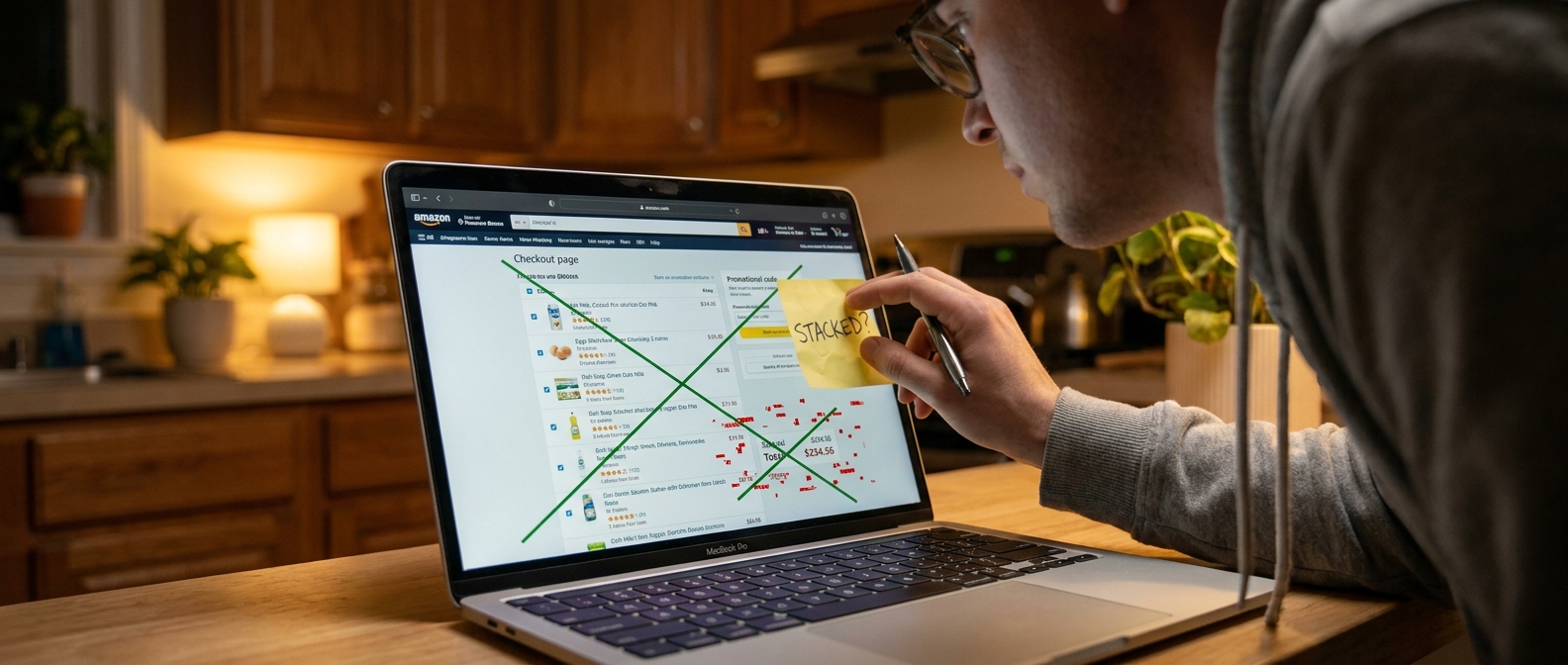
You are not imagining it. Those TikToks about nearly free groceries and mystery checkout wins are exciting, but they also waste a lot of people’s time. By the time most “glitch” videos spread, the deal is gone, the code never worked for everyone, or the creator left out the one detail that made it work. That is why chasing random posts for an amazon promo code glitch usually ends in frustration. The better move is to stop hunting rumors and start checking for a few specific types of Amazon pricing mistakes that sometimes stack by accident. These are usually not magic codes. They are small system misfires, like a coupon combining with Subscribe and Save, a category promo applying too broadly, or a buy-more-save-more deal hitting items it should not. If you know where to look and how to test safely, you can spot real checkout errors without falling for fake screenshots or stale social hype.
⚡ In a Hurry? Key Takeaways
- Most real Amazon “glitches” are not secret codes. They are accidental stacks between coupons, Subscribe and Save, multi-buy promos, and payment offers.
- The safest way to test is to build a small cart, apply every visible discount one at a time, and compare the final checkout total before placing an order.
- Do not buy junk just because the math looks wild. Focus on groceries and household basics you already use, and always assume the deal could vanish fast.
Why these grocery “glitches” happen in the first place
Amazon runs a lot of promotions at once. Manufacturer coupons. Amazon-funded discounts. Subscribe and Save savings. Prime-only deals. Category offers. Sometimes even card-linked credits.
Most of the time, those systems behave. Sometimes they do not.
That is when an amazon promo code glitch can show up. Not as a hacker trick, but as a normal checkout rule that overlaps with another normal checkout rule in a way Amazon did not seem to expect.
Think of it like a grocery store cashier who scans a sale item, then a store coupon, then a loyalty discount, and the register shrugs and accepts all three. It is usually rare. It is usually short-lived. But it is very real.
The three most common “glitch stack” patterns to watch
1. Clip coupon plus Subscribe and Save
This is the most common one. You find a pantry or household item with a clip coupon on the product page, then add it through Subscribe and Save. In some cases, both discounts apply cleanly. In better cases, the percentage stack is stronger than it looks because the coupon is taken off before or after the subscription discount in a favorable order.
It is not always a glitch. Sometimes it is just a good deal. But when the math comes out much lower than the page suggests, that is worth a closer look.
2. Multi-buy promo plus item coupon
You will sometimes see things like “Save $15 when you buy $50 of select household items” or “Buy 4, save 20 percent.” If one of those products also has a clippable coupon, the total can dip fast.
The mistake usually happens when the qualifying threshold still counts the item at full value, but the discount also applies afterward. That can produce an unusually low final total.
3. Category promo plus payment offer
This is where things get interesting. Amazon may run a grocery or essentials promotion while your bank or card issuer is also offering cash back or statement credits. That is not always a glitch, but the stack can feel like one.
If you want to dig into that side of the savings game, this guide on The ‘Bank Card Shuffle’ Hack: How Hidden Issuer Offers Turn Regular Amazon Orders Into Secret Promo-Size Discounts is worth reading. It explains why some of the best discounts are not public promo codes at all.
A safe, repeatable way to test for a real Amazon checkout error
This is the part most social posts skip. Here is the simple process.
Step 1. Start with items you were going to buy anyway
Do not begin with expensive gadgets or weird filler products. Start with shelf-stable groceries, detergent, paper goods, coffee, pet food, vitamins, or baby supplies. Things you know you will use.
That way, if the “glitch” turns out to be just a decent sale, you are still fine.
Step 2. Look for visible discounts on the product page
Open the listing and scan for:
- Clippable coupons
- Subscribe and Save discounts
- “Buy more, save more” language
- Prime-exclusive savings
- Brand promotion banners
If an item has only one discount, it is probably just a normal sale. If it has two or three different discount types, now you are in useful territory.
Step 3. Add the item in more than one way
Test the item as a one-time purchase first. Then test it with Subscribe and Save. Then, if there is a threshold promo, test with the exact quantity needed to trigger it.
Take screenshots of each subtotal. This matters because Amazon’s cart math can change based on quantity, shipping grouping, and how the offer is worded.
Step 4. Go all the way to the final checkout screen
This is where fake “glitches” usually die.
A lot of social posts show the cart page, not the final total. Amazon often removes or recalculates discounts on the last screen before you place the order. If the low price survives to the final review page, it is much more likely to be real.
Step 5. Check the discount line items
Do not just look at the grand total. Look for each discount listed separately. You want to see things like:
- Coupon savings
- Subscribe and Save discount
- Promotional credit
- Multi-buy savings
If one discount disappears when another appears, that is not a stack. If all of them remain, you found something useful.
Step 6. Test with one small order first
If it works, do not rush into a giant cart. Place one small order. Make sure the confirmation email shows the same price you saw at checkout.
That is your proof.
How to tell a real glitch from a fake one fast
Real signs
- The item has visible offers on the listing page
- The low total appears on the final checkout screen
- The order confirmation matches the discount
- Other shoppers can repeat it with the same product and setup
Red flags
- A screenshot with no product link
- A “secret code” with no terms
- A creator says “worked for me” but never shows checkout
- The item is sold by a sketchy third-party seller with odd pricing
- The math only works if you count future rewards as instant savings
That last one trips up a lot of people. A coupon is not the same as a later rebate. A card statement credit is not the same as an immediate price drop. Good savings still count, but they are different things.
Where Amazon shoppers lose the plot
The big mistake is assuming every low total is a hidden amazon promo code glitch. Usually, it is one of four things:
- A regional or account-specific offer
- A new-customer promotion
- A limited seller coupon
- A card-linked discount outside Amazon
That is also why code-chasing is such a mess. A lot of those deals are valid, just not universal.
If you are tired of entering promo strings that never work, it helps to think less like a coupon hunter and more like a checkout tester. Watch the math. Watch the stack order. Watch the final total.
Best product categories for finding mispriced stacks
Some categories produce these mistakes more often than others.
Good places to check
- Coffee and tea
- Protein bars and snacks
- Cleaning supplies
- Diapers and wipes
- Pet food and treats
- Vitamins and supplements
- Toilet paper and paper towels
These categories tend to have lots of brand promotions running at the same time, which is exactly when stack errors happen.
Less useful places to check
- One-off luxury groceries
- Unknown third-party bundles
- Listings with constantly shifting prices
If the normal price is already fuzzy, it is harder to tell whether you found a real bargain or just a fake anchor price.
How to share a real find without spreading nonsense
If you do find a legit stack, help other people verify it quickly.
- Share the exact item link
- List the coupon and promo details
- Say whether you used Subscribe and Save
- Mention if Prime was required
- Show the final checkout total, not just the cart
- Say when you tested it
That last part matters because these deals can die in minutes or hours.
One more trick people forget
Sometimes the best “glitch-like” savings are not glitches at all. They come from stacking a regular Amazon promo with an issuer offer on the payment side. That is a cleaner, less risky path than chasing mystery social posts.
If you have not checked your card-linked offers lately, read The ‘Bank Card Shuffle’ Hack: How Hidden Issuer Offers Turn Regular Amazon Orders Into Secret Promo-Size Discounts. It is one of the few methods that can still work after the viral “glitch” crowd has moved on.
At a Glance: Comparison
| Feature/Aspect | Details | Verdict |
|---|---|---|
| Viral “secret code” posts | Often expired, account-limited, or missing key terms. Many never show final checkout proof. | Low reliability |
| Visible coupon plus promo stack testing | Uses listed offers you can verify yourself by testing cart, quantity, and final checkout. | Best repeatable method |
| Payment-card offer stacking | Not always instant at checkout, but often real and less crowded than public coupon chatter. | Strong backup strategy |
Conclusion
You do not need to camp on TikTok waiting for someone else to post a miracle cart. Social feeds are packed with talk about grocery checkout glitches and hidden promo errors, which makes normal shoppers feel like they are always late. The better answer is a calm system. Check for visible coupons. Test Subscribe and Save. Trigger threshold promos carefully. Confirm everything on the final checkout page. That gives you something better than hype. It gives you a safe, repeatable way to catch real mistakes, share them quickly, and avoid wasting time on fake “secret codes.” With food and household basics taking a bigger bite out of everyone’s budget, knowing how to spot a genuine pricing stack is one of the most useful shopping skills you can build right now.