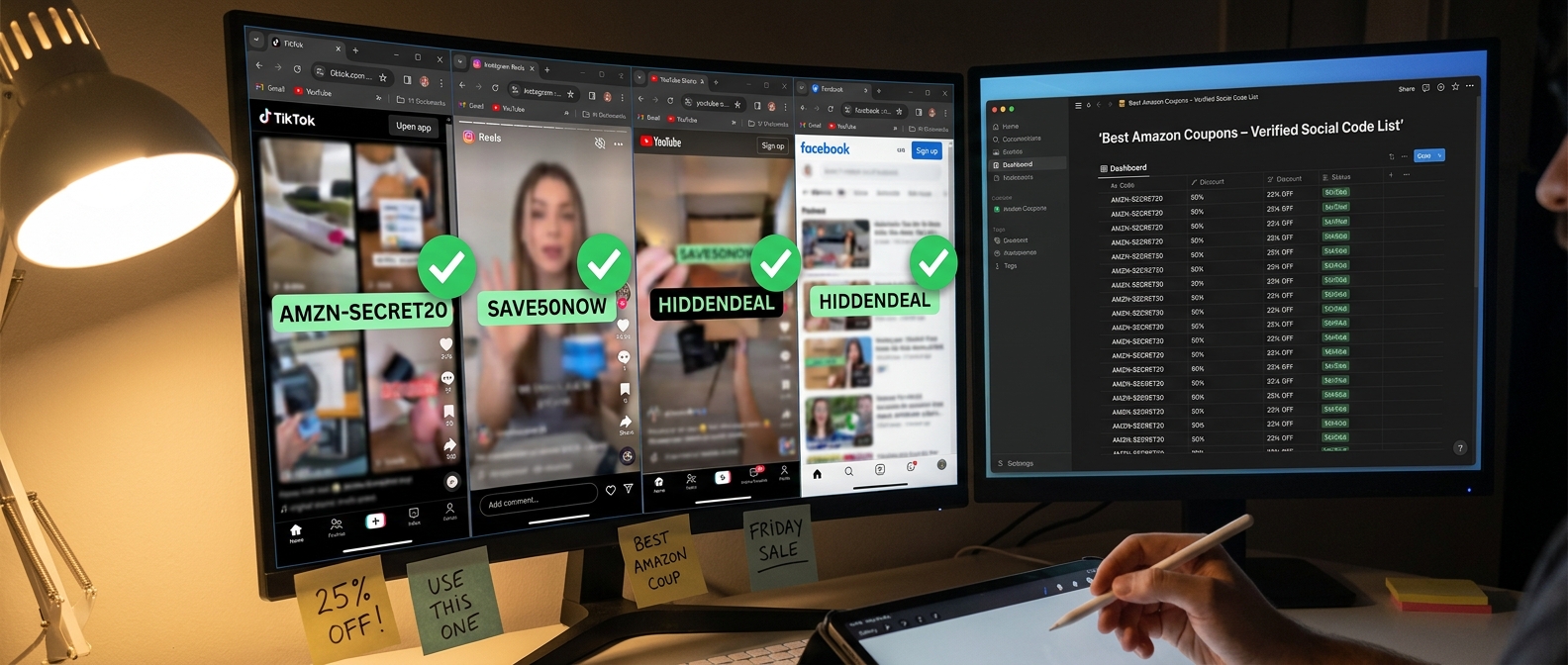
You have probably done this already. You spot a TikTok or Instagram Reel promising a “hidden Amazon code,” pause three times to read the tiny text, tap the link, add the item to your cart, paste the code, and get… nothing. Invalid. Expired. Not available in your region. Or worse, the post was really just fishing for affiliate clicks. It is annoying, and it wastes way more time than the so-called deal is worth. The frustrating part is that some of these clips do share real discounts. They just get buried under junk. The trick is not to trust the video. Trust a process. If you know how to pull the code from the caption or pinned comment, test it quickly, spot category locks, and save only the codes that survive checkout, you can turn all that scrolling into actual savings instead of a full-price Amazon order and a bad mood.
⚡ In a Hurry? Key Takeaways
- Most amazon secret promo codes from tiktok and instagram are either expired, limited, or tied to specific products, so always verify them at checkout before you get excited.
- Pull the code from the caption, pinned comment, or creator bio link, then test it on a few related listings to find the exact item family it works on.
- Skip fake “code generator” sites and save only verified winners in a trusted coupon hub like Best Amazon Coupons for faster repeat use.
Why these viral code videos are so hit-or-miss
Short-form social posts move fast. That is the good news and the bad news.
A creator may post a real code the minute they get it from a brand. For a few hours, it works. Then the coupon hits its redemption cap, the brand edits the landing page, or Amazon limits it to one color, one seller, or first-time buyers only. But the video keeps spreading long after the deal is half-dead.
That is why people searching for amazon secret promo codes from tiktok and instagram often feel like they are always one step late. The code might have been real. It just was not real anymore by the time you saw it.
The “Social Feed Code Drop” method that actually saves time
Instead of treating every Reel or TikTok like a treasure map, use a simple filter system.
Step 1. Ignore the hype and find the actual code source
Do not rely on the text flashing inside the video. It is often blurry, cropped, or missing a character.
Check these in order:
- The video caption
- The pinned comment
- The creator’s bio link or link page
- A follow-up comment where viewers report success or failure
If the creator says “comment DEAL and I’ll DM you,” be careful. Sometimes that is just engagement bait. A good code post usually gives you the code or a direct product link without a lot of games.
Step 2. Copy the code exactly once
Promo codes fail for dumb reasons all the time. A zero looks like the letter O. A one looks like a capital I. Some codes are case-sensitive. Copy and paste if you can. If you must type it manually, double-check every character before assuming the deal is fake.
Step 3. Test the code on the product page first
Before heading to checkout, look for clues on the listing itself:
- An on-page coupon box you can tick
- A banner showing a percentage-off promotion
- A note that says “applied at checkout”
- A specific seller name, since codes often work only with one seller
If none of that appears, the code may still work, but your odds go down.
Step 4. Try nearby product variations
This is the part most shoppers skip.
A social post might show one water bottle, phone stand, or storage bin, but the code may actually apply only to a certain size, color, pack count, or bundled version. If the code fails on the main product, test a few related listings from the same brand or seller.
Think of it like checking the whole shelf, not just the one item at eye level.
What “hidden rules” usually kill the deal
Most failed code attempts come down to restrictions the video never mentioned.
First-time purchase locks
Some Amazon promos only work if you have never bought from that brand before. If you ordered from them six months ago, the code can silently stop working for you.
Category or family locks
A code may work on one branch of a product line, like kitchen organizers, but not on the same brand’s bathroom organizers.
Seller locks
Amazon often has multiple sellers on one listing. If the code was created for Seller A and your cart defaults to Seller B, it will fail even though the product page looks identical.
Regional limits
A lot of viral posts spread across countries. A code made for Amazon US may not work in Canada, the UK, or another local storefront.
Redemption caps
This is the big one. Many social-first promo drops are limited to the first few hundred or first few thousand uses. Once that cap is hit, the code is basically a ghost.
How to verify a viral code in under three minutes
If you want a practical routine, use this:
- Open the video.
- Pull the code from the caption or pinned comment.
- Open the exact product link, not just a search result.
- Clip any on-page coupon first.
- Add one item to cart.
- Paste the promo code at checkout.
- If it fails, try one or two close variations from the same brand or seller.
- Note any rules you discover, like new-customer only or one color only.
If it still does not work after that, move on. The mistake is spending 20 minutes trying to revive a dead coupon.
How to spot affiliate bait before you waste your evening
Not every creator is being shady, but some clear warning signs pop up again and again.
- The code is visible for half a second and never written anywhere else
- The link leads through multiple redirect pages
- The caption is vague, like “works on everything”
- Comments are full of “doesn’t work” and the creator never responds
- The post pushes a mysterious external coupon site instead of Amazon
If a post sends you away from Amazon to a random “generator” or “unlock page,” close it. Real Amazon promotions do not need a secret decoding tool.
Build your own tiny verification system
You do not need a spreadsheet obsession to stay organized, but a small system helps.
Keep four quick notes
- Code
- Product or brand
- Discount amount
- Rules or limits you noticed
That way, when a code works, you do not have to go hunting for it again. You can also tell whether it worked because of a clipped coupon, a promo code, or both stacked together.
Save only the survivors
The smartest move is to park verified deals in one trusted place. If you already use a reliable coupon hub like Best Amazon Coupons, save the code there only after you confirm it works. That gives you a cleaner, reusable shortlist instead of a social feed full of maybe-deals.
Why social video still matters for deal hunters
For all the frustration, TikTok and Instagram are still where some of the freshest deals show up first. Brands seed offers there because creators can move inventory fast. That means shoppers willing to verify quickly can sometimes catch a discount hours before bigger deal sites or tech blogs notice it.
So no, the social feed is not useless. It is just noisy.
The win comes from treating it like a lead, not the final answer.
At a Glance: Comparison
| Feature/Aspect | Details | Verdict |
|---|---|---|
| Video-only code claim | Code appears briefly on-screen, with no caption or pinned comment backup. | Low trust. Usually not worth the effort. |
| Caption or pinned-comment code | Easy to copy, easier to verify, often includes product link or rules. | Best starting point. |
| Verified code saved in trusted hub | Tested at checkout, with notes on seller, category, and limits. | Most reliable and best for repeat savings. |
Conclusion
The best part of this approach is that it gives you a filter, not just hope. Right now, short-form viral clips are where a lot of fresh Amazon promo codes and stacking tricks appear first, often hours before they hit bigger deal roundups, but almost nobody has a system for catching the real ones without burning half an evening doomscrolling. If you pull the code from the description or pinned comment, test it across a few related items, watch for hidden rules like first-time-buyer or category locks, and save only the working deals in a trusted place like Best Amazon Coupons, you give yourself a real edge on today-only and limited-redemption drops. Better yet, you stop feeding fake generator sites and sketchy coupon pages. You turn the social content you are already watching into a steady stream of verified checkout savings. That is a much better deal than replaying the same blurry Reel five times and still paying full price.