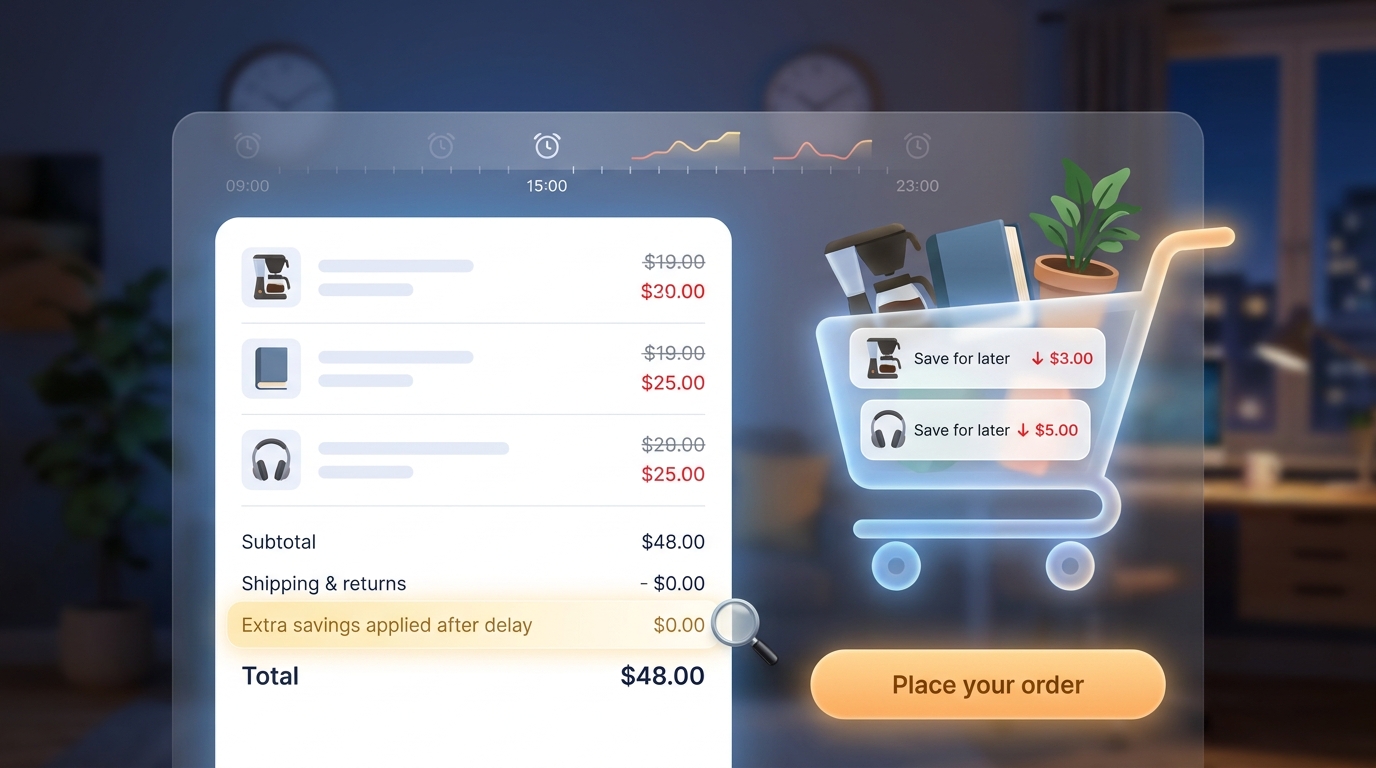
You are not imagining it. You clip a coupon, paste in a promo code, head to checkout, and somehow the final total still looks off. Maybe the discount shrinks. Maybe a “limited-time deal” disappears. Maybe the price is different from what you saw ten minutes ago. It is frustrating, especially when you feel like you did everything right. Lately, a lot of Amazon shoppers have noticed the same thing. The good news is that some of the most reliable savings are showing up when people do the exact opposite of rushing to buy. The amazon cart abandon discount trick is simple. Add the item, wait, move it to “Save for later,” then check back before you pay. That small pause can sometimes surface a lower price, a revived coupon, or a cleaner checkout total. It is not magic. It is just learning how Amazon’s pricing and promo system behaves when you stop playing along at full speed.
⚡ In a Hurry? Key Takeaways
- The amazon cart abandon discount trick can work because Amazon often changes prices, coupons, and offer visibility after items sit in your cart or “Save for later.”
- Best move: add the item, clip any coupon, take screenshots, wait a few hours or a day, then recheck both the cart and the product page before buying.
- This is low-risk and free, but it is not guaranteed. Limited-stock items and lightning deals can disappear while you wait.
Why slowing down can actually save you money
Amazon is not a simple digital shelf where every shopper sees the same thing all day. Prices move. Coupons come and go. Promo eligibility can vary by account, timing, and even whether an item is in your cart or just on your wish list.
That is why so many shoppers get the strange feeling that checkout is where the “real” price finally shows up. Sometimes it is lower. Sometimes it is annoyingly higher. The point is that the number is not always stable.
Frugal shoppers have learned to use that to their advantage. Instead of checking out immediately, they let the item sit. They move it into “Save for later.” They come back later in the day, or the next morning. Very often, that pause reveals one of three things.
- A lower base price
- A coupon that reappears or gets applied more clearly
- A better final total once shipping, quantity rules, or promo stacking settle down
What the amazon cart abandon discount trick really is
Despite the dramatic name, this is not a hack in the shady sense. You are not breaking Amazon. You are just giving its own pricing engine time to change.
The basic routine
Here is the simple version.
- Find the item you want.
- Clip any available coupon on the product page.
- Add the item to your cart.
- If there is a promo code, apply it and note the total.
- Take a screenshot.
- Do not buy yet.
- Either leave it in the cart or move it to “Save for later.”
- Check again in a few hours, then again the next day.
That is it. No browser extension required. No weird plug-in. No new account.
Why “Save for later” matters
“Save for later” is useful because Amazon actively refreshes those prices and shows you when they change. It turns your cart into a little price-watch list. If an item drops, Amazon often flags it right there. If it rises, you see that too.
That means you are no longer buying blind at the first number you saw.
What kinds of discounts people are seeing?
Most reports fall into a few buckets.
1. Quiet price drops
You add an item at one price, come back later, and it is a few dollars cheaper. This happens a lot with household goods, electronics accessories, beauty items, and brand-name basics.
2. Coupons that appear later
Sometimes a coupon was missing the first time you looked, then shows up later on the product page or in the cart. Sometimes it was there, vanished, then came back.
3. Better promo code behavior
Promo codes are fussy. Some only work with specific sellers, quantities, or item variations. Waiting can sometimes make the checkout total cleaner, especially if a listing changes from one seller to another or if Amazon itself becomes the seller again.
If you have been struggling with account-specific offers, it is also worth reading The “Hidden Brand Tailored Trapdoor” Hack: How One Quiet Checkbox Turns Targeted Prime Offers Into Stealth Promo Codes At Checkout. It pairs nicely with this trick because one strategy helps surface better offers, and the other helps you time your purchase better.
How to do it step by step without overthinking it
If you want a repeatable routine, use this.
Step 1: Screenshot everything
Before you wait, take screenshots of:
- The item price on the product page
- Any clipped coupon
- Any promo code entered at checkout
- The estimated final total
This gives you a baseline. Without it, Amazon’s moving numbers can make you feel like you imagined the earlier price.
Step 2: Test both cart and “Save for later”
Leave some items in the cart. Move others to “Save for later.” Different shoppers swear by different methods, and the truth is both can be useful.
If it is an everyday item with plenty of stock, “Save for later” is usually the safer test. If it is a more time-sensitive item, keeping it in the cart may help you monitor it more closely.
Step 3: Recheck at different times
Look again:
- Later the same day
- Early the next morning
- After midnight local time
- During major sale windows or weekends
Prices often move on a schedule that feels random from the outside. A little patience helps.
Step 4: Revisit the product page, not just the cart
This matters. Sometimes the cart does not fully reflect a fresh coupon, a changed seller, or a new listing variation. Open the item page again and compare.
Step 5: Check the seller line carefully
If the seller changed, your coupon or promo code may no longer apply. A lower price is great, but not if it swaps in a less reliable seller or removes Prime shipping.
When this trick works best
The amazon cart abandon discount trick is most useful when:
- You are buying non-urgent items
- The product has lots of stock
- The listing already shows rotating coupons
- You are stacking a coupon with a promo code
- You suspect the price is being tested or adjusted throughout the day
Think vitamins, batteries, phone chargers, cleaning products, skincare, storage items, pet supplies, and small kitchen gadgets. Those categories often bounce around more than people expect.
When you should not wait
This is where common sense matters.
Skip the waiting game if the item is:
- A Lightning Deal close to ending
- Low in stock
- A hard-to-find seasonal item
- Needed urgently
- Part of a time-limited bundle
If the product could sell out, waiting may cost you more than it saves. This trick is best for items where availability is stable.
Why Amazon-only discounts can feel “quiet”
Some of the best savings never arrive as a flashy banner. They show up as a small clipped coupon, a checkout adjustment, a changed seller with better pricing, or a “price dropped” note in saved items.
That is why shoppers miss them. They are looking for one big discount code, when the real savings often come from a mix of tiny changes that only become visible over time.
Amazon also personalizes some offers. Two people can look at the same item and get different coupon boxes or different promo eligibility. That is another reason to avoid rushing. You want to give your account more chances to surface what it qualifies for.
Small habits that make this work better
Use a wishlist too
If you are tracking several versions of the same item, a wishlist helps you compare without clogging your cart.
Watch unit price, not just total price
That giant coupon on a bulk pack is not always the better deal. Check the per-unit cost.
Try a quantity change
Some promo codes only apply when you buy two or more. Others stop working if the quantity changes. Test both.
Sign out and back in if something looks wrong
Not glamorous, but it sometimes refreshes coupons or clears weird cart behavior.
Do not assume the first “deal” is the best one
This is the whole point. Amazon rewards fast clicking with convenience, not always with the lowest total.
What this trick does not do
Let’s keep this grounded. The amazon cart abandon discount trick is useful, but it is not a guaranteed secret coupon machine.
It does not:
- Force Amazon to send you a discount
- Guarantee a price drop
- Work the same way on every account
- Beat every third-party price tracker in every case
What it does do is help you stop overpaying just because you moved too quickly during a volatile pricing window.
Pair this with promo-code hunting the smart way
If you already chase Amazon promo codes, timing matters just as much as the code itself. A code that looks weak at one moment can become worthwhile once the base price shifts or a coupon reappears.
That is why this method works well alongside targeted-offer strategies like The “Hidden Brand Tailored Trapdoor” Hack: How One Quiet Checkbox Turns Targeted Prime Offers Into Stealth Promo Codes At Checkout. One helps you find better account-specific offers. The other helps you wait for the best moment to use them.
At a Glance: Comparison
| Feature/Aspect | Details | Verdict |
|---|---|---|
| Immediate checkout | Fast and convenient, but you may miss later price drops, revived coupons, or a better seller offer. | Best only for urgent or low-stock items. |
| Leave in cart or Save for later | Gives Amazon time to refresh pricing and promotions, and lets you monitor changes more clearly. | Best low-effort method for everyday items. |
| Stacking with coupons and promo codes | Works well when combined with timing, screenshots, and checking the product page again before purchase. | Best value if you are patient and detail-oriented. |
Conclusion
Right now, shoppers are catching Amazon prices and promotions changing at the last second often enough that it is smart to stop treating the first checkout total as the final truth. At the same time, plenty of careful buyers are seeing the opposite result when they slow down. They abandon the cart on purpose, move items into “Save for later,” and come back to better prices, better coupons, or at least a more honest total. That is why this routine matters so much heading into the holiday season. It costs nothing. It works across a huge mix of product categories. And it pairs nicely with almost any secret promo code strategy you already use. Instead of chasing glitch deals that vanish in two hours, you are building a habit that can save you money every day. Slow down, take screenshots, wait a bit, and make Amazon work a little harder for your purchase.