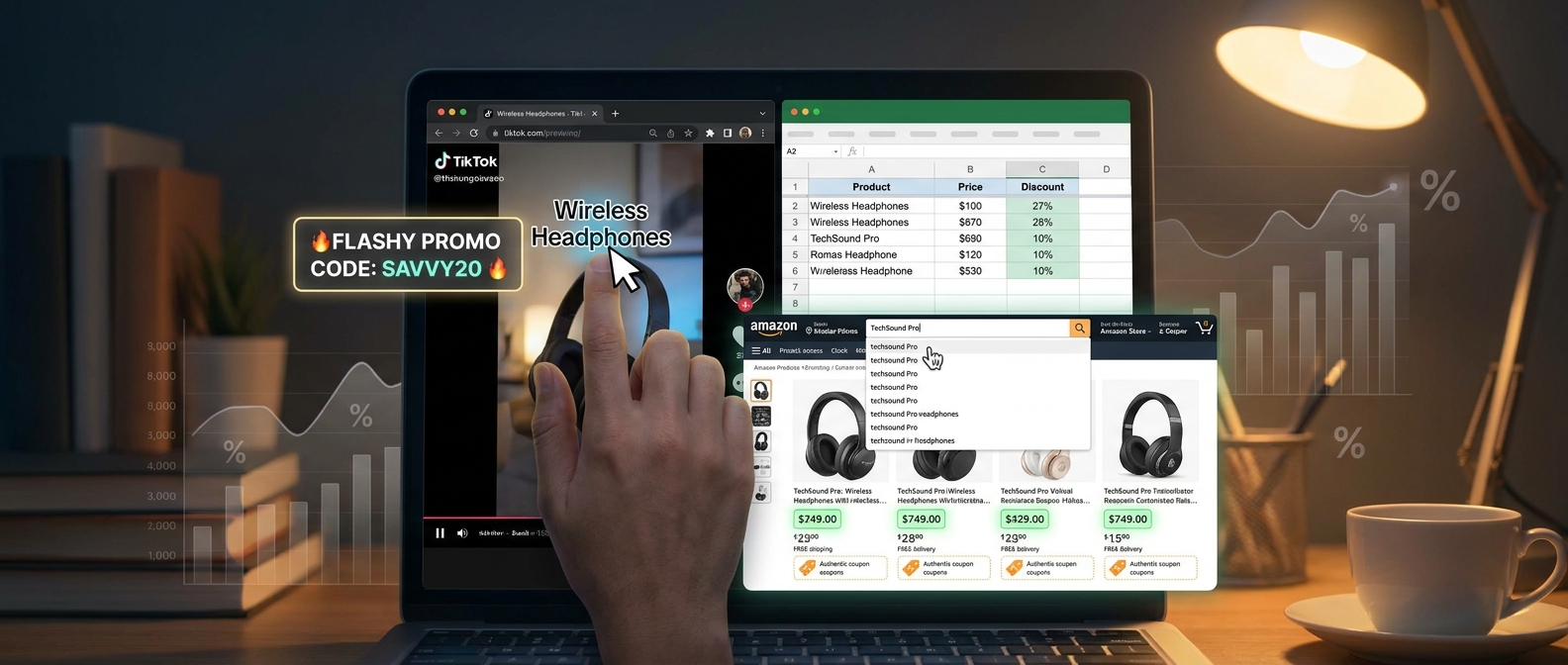
You are not imagining it. Those TikTok and Instagram deal videos really do make it look like everyone else is paying half price while your Amazon cart just sits there rejecting code after code. One says “not eligible.” Another is already expired. A third dumps you onto some random storefront that looks nothing like Amazon. It is annoying, and honestly a little sneaky.
The good news is there is usually a pattern behind those “secret” deals. A lot of creators are showing a code tied to a very specific Amazon listing, a variation of the product, a seller coupon, or a short-lived launch promo that only works on the real item page. The trick is not copying the code blindly. The trick is finding the matching Amazon listing first, then checking whether the discount is being applied on Amazon itself. Think of it like code scouting. You use the social post as a clue, then you verify the real deal in your own Amazon cart before you buy.
⚡ In a Hurry? Key Takeaways
- The safest way to turn TikTok Amazon promo codes into real Amazon discounts is to find the exact Amazon listing first, then test the code and any on-page coupon inside your actual Amazon cart.
- Search by brand name, product wording, pack size, color, and seller details, because one small mismatch can make a code fail.
- If a deal only works on an off-Amazon checkout page, treat it as a different offer, not an Amazon discount.
What “Off-Amazon Code Scout” actually means
It sounds fancy, but it is really simple.
You see a viral deal video. Instead of tapping the creator’s link and hoping for the best, you use the information in that post to hunt down the real Amazon listing yourself. Then you test whether the discount works on Amazon, not on some outside checkout page.
That is the whole hack.
The “off-Amazon” part just means the clue started somewhere else. TikTok. Instagram. A comment section. A deal forum. The “code scout” part means you verify it on Amazon before you spend a dime.
Why promo codes from social media so often fail
1. The code is tied to one exact listing
Amazon is picky. A code might only work on one seller’s listing, one color, one size, or one bundle. If you pick what looks like the same item from a different seller, the code can fail instantly.
2. The creator is sending you to an outside cart
Some videos blur the line on purpose. They talk about an “Amazon deal,” but the link opens a brand site, a landing page, or a storefront tool. That does not mean it is always a scam, but it does mean it is not the same as getting a discount in your real Amazon checkout.
3. The code was a launch promo
Many of these crazy discounts are front-loaded. Brands toss out a coupon for a few hours to get sales moving and boost ranking. By the time the video goes viral, the code is already dead.
4. The savings come from stacking, not just one code
Sometimes the big discount in the video is really a mix of an on-page coupon, a promo code, and a temporary sale price. Miss one piece and your price looks completely different.
How to turn TikTok Amazon promo codes into real Amazon discounts
If you are specifically wondering how to turn TikTok Amazon promo codes into real Amazon discounts, use this repeatable checklist.
Step 1: Screenshot the post before you do anything
Grab the product name, brand, color, size, percentage off, and promo code if shown. Also note any phrases like “clip coupon” or “prime only.” Tiny details matter here.
Step 2: Search Amazon manually
Do not start with the creator’s link. Open Amazon and search using the most specific terms from the video:
- Brand name
- Product type
- Pack count or size
- Color or model name
- Any odd wording shown in the listing
If the item is common, add the seller brand to narrow it down.
Step 3: Match the listing carefully
This is where most people get tripped up. Two listings can look identical at a glance but be sold by different sellers or represent different versions.
Check these details:
- Brand name
- Seller name
- Variant selected, like color or size
- Pack quantity
- Main image and bullet wording
If one of those is off, the code may not apply.
Step 4: Look for the on-page coupon box
On Amazon, many of the best deals need the little coupon checkbox on the product page. If the social post showed 40 percent off, the real math may be something like this:
- 20 percent instant sale
- 10 percent coupon to clip
- 10 percent promo code at checkout
Miss the coupon clip, and the “secret code” seems fake when it is actually incomplete.
Step 5: Add it to your cart before judging the deal
Amazon often does not show the final promo reduction until late in checkout. Add the item to your cart and begin checkout if needed. You do not have to place the order to see whether the discount appears.
This is the moment of truth.
Step 6: Test the code only in Amazon’s checkout field
If there is a promo code box in your Amazon cart or checkout, try the code there. If the creator is asking you to enter it somewhere else, you are no longer testing an Amazon discount.
That is a different purchase path.
Step 7: Compare the final price, not the claimed percentage
Ignore the hype. Just look at the subtotal. If the final Amazon price is good, great. If not, move on. A boring real discount beats an exciting fake one every time.
The tiny search twist that helps most
Here is the part people miss. Do not just search the product name. Search the product name plus the clue that seems too small to matter.
Examples:
- “portable blender 24oz lavender” instead of “portable blender”
- “collagen peptides 2 pack lemon seller brandname” instead of just “collagen”
- “charging station 6 in 1 white coupon” instead of “charging station”
That tiny extra detail often pulls up the exact listing that the promo was built for.
Red flags that tell you it is not a real Amazon discount
“Amazon deal” but no Amazon cart
If the checkout page is not Amazon, it is not an Amazon discount. Simple as that.
The link uses a weird shortener and hides the destination
A clean Amazon product page is one thing. A maze of redirects is another. Be careful.
The creator never shows the actual final checkout price
Lots of videos flash percentages. Fewer show the real subtotal after discounts. That is the number that matters.
The item title is vague on purpose
If a post says “this viral organizer” without showing the brand, model, or seller, it may be harder to verify because the offer is weak or already gone.
What to do when the code is dead
Do not give up too fast. A dead code does not always mean there is no deal left.
Try these:
- Check for a clip coupon on the same listing
- Look at other variations, like a different color or pack size
- Search the same brand storefront on Amazon
- See if the product now uses a straight sale price instead of a code
And if the product has a multi-buy promotion, you may be able to save more by building the cart the right way. That is exactly the idea behind The Hidden ‘BOGO Stack’ Hack: How One Bundle Trick Turns Amazon’s Multi‑Buy Deals Into Secret Promo‑Code Jackpots. It is a smart next step when one-item promo codes stop working.
A safe routine I recommend
If you want this to be easy, use the same routine every time:
- Watch the deal video.
- Screenshot the details.
- Search Amazon yourself.
- Match the exact listing.
- Clip any coupon.
- Add to cart.
- Test the code only on Amazon.
- Buy only if the final checkout price makes sense.
This keeps you from getting pulled into coupon farms, fake urgency, or off-site carts that were never the same deal in the first place.
At a Glance: Comparison
| Feature/Aspect | Details | Verdict |
|---|---|---|
| Creator link vs manual Amazon search | Creator links may route to a different listing or an outside checkout. Manual search helps you verify the exact Amazon product page. | Manual Amazon search is safer |
| Promo code alone vs stacked savings | Many viral deals combine a sale price, a clipped coupon, and a checkout code. | Always check for stacking |
| Off-site cart vs Amazon checkout | An off-site page may still offer a discount, but it is not the same as saving in your actual Amazon cart. | Best to stick with Amazon if that is your goal |
Conclusion
Social feeds are packed with flashy “secret code” videos right now, and too many of them quietly push people toward off-Amazon carts, sketchy coupon pages, or launch codes that vanish before most shoppers even see them. The fix is not magic. It is a method. Use the post as a clue, scout the exact Amazon listing yourself, and verify every part of the discount in your real Amazon cart. That means fewer dead codes, fewer fake deal pages, and a much better shot at getting real savings on the exact product you already wanted. Once you get used to this routine, those viral deal clips stop feeling confusing and start feeling useful.