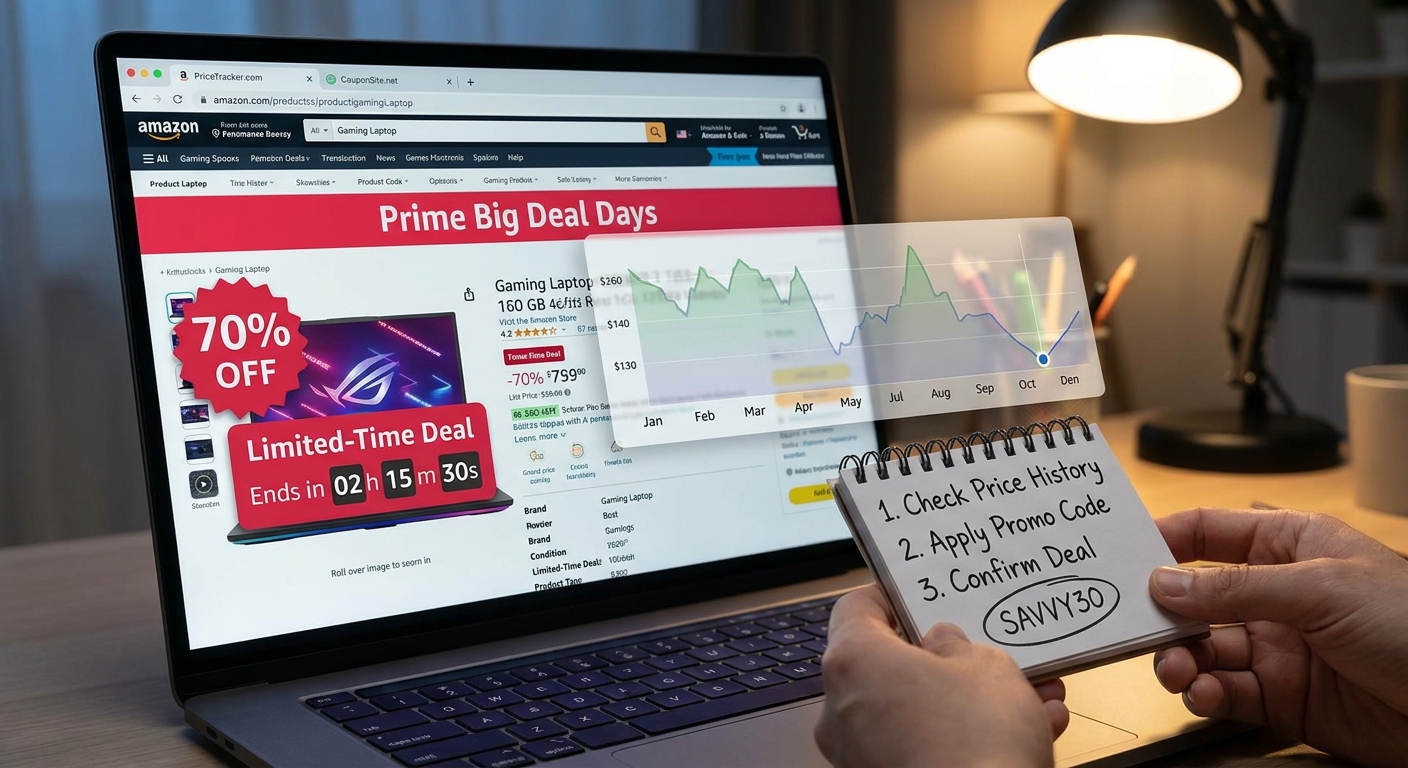
You are not imagining it. Amazon deal pages can feel like a casino with better packaging. Big red percentages, strikethrough prices, ticking clocks, “limited-time deal” banners, and that little voice in your head saying, “Buy it now before it jumps back up.” The annoying part is that a lot of these “discounts” are not fake in the strict legal sense, but they are not always meaningful either. Sometimes the sale price is just the normal price wearing a party hat. If you want to know how to tell if an amazon prime big deal days discount is real, the fix is surprisingly simple. Do one 60-second price history check before checkout, then add any coupon or promo code only after you know the base deal is actually good. That tiny pause can save you from panic-buying junk, and it can also help you spot the rare times when a deal is genuinely excellent and worth stacking with an extra code.
⚡ In a Hurry? Key Takeaways
- The fastest way to tell if an Amazon Prime Big Deal Days discount is real is to check the product’s recent price history, not just the strikethrough price on the listing.
- Use a one-minute drill: compare today’s price to the 30-day and 90-day pattern, then clip coupons and try a verified promo code only if the base price is already solid.
- Countdown timers and “limited deal” labels create pressure, but price history gives context and helps you avoid overpaying for a fake bargain.
The problem with Amazon “deals” is not always the math. It is the framing.
Most people do not sit around tracking blender prices for three months. That is why sale labels work so well. Amazon knows that if a product says “was $89.99, now $59.99,” your brain focuses on the $30 gap.
But that gap only matters if the item actually sold for $89.99 long enough for that higher price to mean something. If it bounced up for a short stretch and then came right back down, the “discount” can look much bigger than it feels in real life.
This is why the real question is not, “Is there a discount?” It is, “Compared to what this item usually costs, is this actually a good buy today?”
The 60-second “Real Discount Radar” check
Here is the simplest repeatable method I know.
Step 1: Open the product page and ignore the percentage off
Do not start with the flashy number. Start with the actual price you would pay today before tax.
If there is a clipped coupon, subtract that too. If there is a promo code box or a checkbox discount, note it, but do not get excited yet.
Step 2: Check price history
Use a price-tracking tool or browser extension that shows the item’s recent price history. You want the quick version, not a deep research project.
Look at three things:
- Its price over the last 30 days
- Its price over the last 90 days
- Whether today’s “sale” is actually lower than the usual pattern
If the item has been sitting at roughly the same price for weeks, the Prime Big Deal Days tag may be more theater than deal.
Step 3: Ask one blunt question
Would I still think this is a good price if Amazon removed the words “deal,” “limited time,” and “save 42%”?
If the answer is no, keep moving.
Step 4: Only then stack the extras
Once the base price checks out, then you go hunting for the cherry on top. Clip the on-page coupon. Apply any checkout code. Then route back through Best Amazon Coupons to see if there is a verified extra discount that turns a good deal into a great one.
That order matters. First confirm the real price. Then stack the extras.
How to spot a fake-feeling discount fast
Sign 1: The current price matches the recent “non-sale” price
This is the biggest giveaway. If the chart shows the item has hovered around today’s price for days or weeks, the event badge is mostly marketing.
Sign 2: The strikethrough price looks wildly higher than the chart
Sometimes an item has a reference price that does not reflect where it normally sells. That can make the discount percentage look dramatic even when the actual savings are ordinary.
Sign 3: The countdown timer is doing all the heavy lifting
If the only reason the offer feels urgent is that a timer is ticking down, slow yourself down on purpose. A real deal usually still looks good when you remove the pressure.
Sign 4: The coupon makes the deal look better than it is
Coupons are great. But they can also distract you from a mediocre starting price. A $20 coupon on an item that was $20 cheaper last month is not a win. It is catch-up.
What a real deal usually looks like
A true score often has at least two of these signs:
- Today’s price is at or near the lowest point in the last 30 to 90 days
- The item rarely drops this low
- The seller is reputable and the listing is the correct model, size, or version
- A coupon or promo code pushes it below its normal sale price
That last point is where hidden savings show up. The best deals are often not the loudest ones. They are the ones where the chart says “good base price” and the extra code quietly pushes it even lower.
A simple example
Let’s say a pair of earbuds is listed at $79.99, down from $129.99, with a 15% coupon.
Sounds fantastic. Until you check price history and see this:
- Most of last month, they sold for $84.99
- Twice in the last 90 days, they dropped to $74.99
- The “$129.99” price barely appeared
Now the picture changes. After the coupon, maybe your total is decent. But it is not the once-a-year blowout the page wants you to believe it is.
On the other hand, if the chart shows they usually sit around $99.99 and today they fall to $67.99 after coupon and code, that is worth your attention.
Do not forget the listing trap
There is another sneaky issue during big sales. Sometimes shoppers compare the wrong version of a product.
Make sure the price history matches the exact listing you want. Storage size, color, bundle, generation, and seller all matter. A 256GB gadget is not the same deal as the 128GB version, even if the product photos look almost identical.
This is also a good moment to glance at who is selling and shipping the item. A real discount is less exciting if it comes from a sketchy seller with spotty reviews.
When a “bad” deal might still be worth buying
Not every purchase has to be a record-low price to make sense.
If you need the item now, if the current price is fair compared to recent history, and if you can stack a code on top, that can still be a sensible buy. The goal is not perfection. The goal is not getting tricked by inflated savings claims.
And if you bought too early and the better stack shows up later, it is worth knowing there are post-purchase strategies too. If that situation sounds painfully familiar, read The “Hidden Prime-Refund Loop” Hack: How One Simple Return Timing Trick Turns Dead Amazon Deals Into Fresh Promo-Code Savings. It is a practical follow-up for shoppers trying to recover value after a deal shifts.
Your one-minute pre-checkout drill
If you want the shortest possible version, use this every time:
- Look at the final item price on Amazon.
- Check the last 30 to 90 days of price history.
- Decide if today is truly low, just normal, or inflated then discounted.
- If it is truly low, clip the coupon.
- Before placing the order, check Best Amazon Coupons for any extra verified code.
- If it is only “fine,” buy only if you actually need it now.
That is it. No spreadsheet. No obsession. Just a calm little speed bump between you and impulse buying.
At a Glance: Comparison
| Feature/Aspect | Details | Verdict |
|---|---|---|
| Strikethrough price | Shows what Amazon says you are saving versus a reference price, but that reference may not reflect the item’s usual selling price. | Useful only as a hint, not proof of a real deal. |
| Price history check | Shows what the product actually cost over recent weeks or months. | Best way to tell if the discount is real. |
| Coupon and promo-code stacking | Can turn a genuinely low base price into a standout buy, but cannot rescue a padded “sale” by itself. | Great finishing move, after the price-history check. |
Conclusion
Prime Big Deal Days can be useful, but it is also noisy on purpose. The whole homepage is built to make you move fast, and social feeds are packed with people shouting about “must-buy” offers. What actually helps is not more hype. It is a calm system. Check the recent price history. See if the discount is real. Then, if the base price is truly good, stack a verified code before checkout. That one-minute drill cuts through padded reference prices, slows down FOMO, and gives you a much better shot at finding the quiet little deals that are actually worth your money. That is the real win here. Not buying more stuff. Just buying smarter.