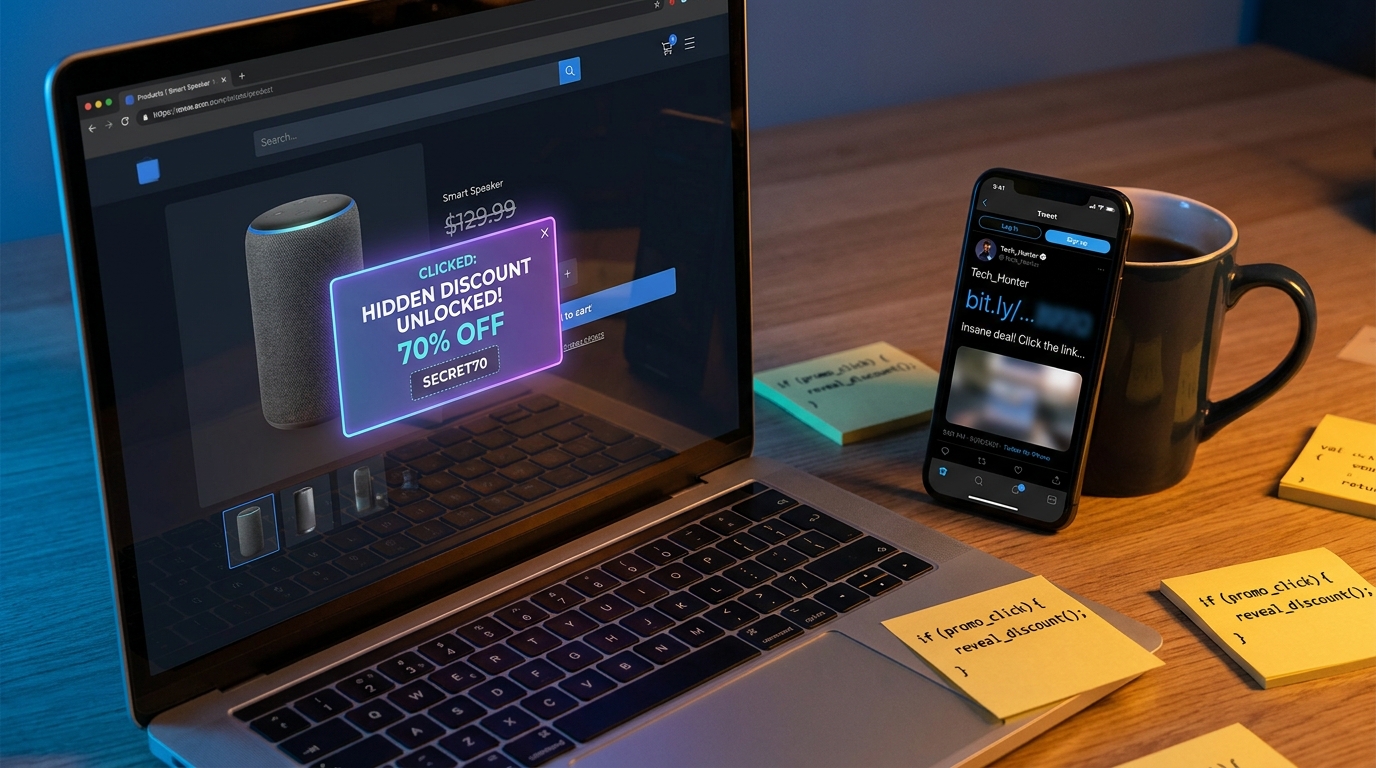
You are not crazy. Amazon promo code hunting really has gotten weirder. One minute TikTok is full of people showing 60 percent off gadgets, kitchen tools, and random household stuff. The next minute you click the link, paste the code, and get nothing. Expired. Wrong country. Fake screenshot. Or the item page looks normal and gives you zero clue that any discount exists at all. That is the part most shoppers are missing. Amazon quietly shut down its public Promo Codes page, and a lot of sellers have shifted to “share-only” promo links sent through influencers, Facebook groups, Telegram channels, and social posts. So the best deals are often not sitting on Amazon’s regular coupon page anymore. They are floating around in semi-private corners of the internet. The good news is that regular people can still find them. You just need a different playbook than the old “Google Amazon coupon code” routine.
⚡ In a Hurry? Key Takeaways
- Amazon hidden social promo code links are real, and many of the best discounts now show up through influencer or social-share links instead of Amazon’s old public promo pages.
- To use them, open the exact shared link, clip any on-page coupon, add the right item variation, and check the final checkout screen for the discount before paying.
- Stick to Amazon checkout only. If a “deal” asks you to pay off-platform, join a sketchy site, or buy gift cards first, walk away.
What changed, and why it feels like promo codes suddenly got harder
For years, shoppers had a simple habit. Check Amazon’s coupon area, browse deal sites, maybe search for a code, and hope something sticks.
That habit works less and less now.
Amazon has pulled back from making promo codes easy to browse in one public place. Sellers still run discounts, sometimes very deep ones, but they are often told to distribute them through social traffic. That means creator links, group posts, stories, livestream comments, and “limited audience” shares.
From a seller’s point of view, this makes sense. It feels more controlled. It also helps brands test deals with smaller groups instead of blasting a discount to every shopper on Amazon.
From your point of view, it is annoying. The code exists. The discount is real. But it is hidden behind the exact link path or audience the seller intended.
What “share-only” promo links actually are
Think of these as Amazon product links with extra logic attached.
Sometimes the link itself carries the promotion. Sometimes it drops you on a product page where a coupon box appears. Sometimes it works only when a matching promo code is entered at checkout. And sometimes the discount applies only if you buy a certain quantity or choose one specific seller listing.
That is why two people can look at what seems like the same item and get different results. One person used the creator’s direct link. The other searched Amazon manually and landed on a slightly different listing, variation, or seller offer.
Common forms these hidden deals take
Here are the big ones:
- Direct influencer links that pre-load the promo context
- Amazon product pages with a hidden or delayed “Apply coupon” checkbox
- Checkout-only promo codes that do not show savings until the final payment page
- Seller promotions tied to one color, size, bundle, or pack count
- Codes limited to one region, usually Amazon US only
Why influencers keep getting the “real” codes
Because they often are getting the real codes first.
Sellers want attention, reviews, and quick bursts of sales. Influencers and niche deal communities can provide that faster than a public coupon page can. So brands hand them custom links, limited-time discounts, or codes with small redemption caps.
This is also why the deal can be legitimate and still disappear in hours. A seller might only allow 100 redemptions. Once those are gone, the code is effectively dead, even if the video is still going viral.
That is the hidden social code drop pattern. It is less like an always-on coupon and more like a flash sale disguised as a social post.
How to find Amazon hidden social promo code links without wasting your afternoon
The old method was searching giant coupon databases. The better method now is watching where fresh links appear first.
1. Check creator posts right after they go live
TikTok, Instagram, YouTube Shorts, Reddit deal threads, and Facebook groups are often the first place these codes surface.
Timing matters. If a creator says “limited code” or “works at checkout,” assume it may burn out quickly.
2. Follow niche deal communities, not just giant coupon sites
Big coupon sites are often slow, cluttered, or packed with old submissions. Smaller communities tend to notice whether a code still works right now.
If you want another angle on this whole mess, The “DealSeek Deep Dive” Hack: How One Free App Turns Random Amazon Browsing Into Hidden 50–90% Off Promo Code Scores does a good job explaining why random old coupon lists are becoming less useful.
3. Use the exact shared Amazon link first
This is the part many people skip.
Do not search Amazon for the product name right away. Open the exact social-share link first. That link may route you to the right listing, variation, or promotional setup.
4. Read the caption and comments carefully
Sometimes the creator leaves out key details in the video itself. The comments may tell you:
- which color works
- whether the code is case-sensitive
- if you need to clip an on-page coupon too
- whether the deal is dead already
- which country the offer works in
How to verify a hidden social code before you get excited
This is where you save yourself from fake deals and bad screenshots.
Start with the product page
Once you open the share link, check these things:
- Is Amazon the actual checkout platform?
- Is the seller the same one mentioned in the post?
- Is there a clip coupon box under the price?
- Did the link open the right size, color, or bundle?
If anything is off, the code may fail even if the listing looks close enough.
Then test the code at checkout
Add the item to your cart. Go far enough into checkout to reach the promo code box and the order summary. Many real discounts do not appear until this step.
Look for a line showing:
- Promotions
- Your Coupon Savings
- Promo Code Applied
If the final total does not change, the deal is not real for your account, region, or item setup.
Do not trust screenshots alone
Screenshots are easy to fake, crop, or post long after a code expires. Treat them as hints, not proof.
The step-by-step method that works best
1. Open the exact social link
If possible, do it on the same regional Amazon site mentioned by the poster. A US code on Amazon.com usually will not work on Amazon.co.uk or Amazon.ca.
2. Sign into your Amazon account first
Some promotions are account-limited or behave strangely when you are not logged in.
3. Clip any visible coupon
This matters more than people think. Some deals stack a clickable coupon with a checkout code.
4. Double-check the item variation
That 50 percent code may only work on the blue two-pack, not the black single item.
5. Add to cart and test at checkout
Do not stop at the cart page. Checkout is where the truth shows up.
6. Buy only if the final math is right
Never assume the discount will appear later. If the total is wrong, back out.
Why some codes fail even when they are real
This is the frustrating part. A real code can still fail for perfectly boring reasons.
- The redemption cap was reached
- The code expired within hours
- The seller changed the listing
- You are on the wrong Amazon region
- You picked the wrong variation
- The code only works for Prime members
- The offer is for first-time buyers of that brand or item
So no, failure does not automatically mean scam. But it also does not mean you should keep trying random code sites for another hour.
How to avoid scams while hunting these deals
Here is the good rule. If the discount happens inside Amazon checkout, fine. If someone tries to move you outside that system, be careful.
Safe signs
- The link goes to an Amazon product page
- The discount appears in Amazon’s own cart or checkout summary
- You pay Amazon directly
Bad signs
- You are told to message someone for the “real” code
- You must pay shipping on a separate website
- You are asked to buy gift cards first
- The post promises reimbursement later through PayPal or Venmo
- The link uses a lookalike Amazon domain
If it leaves Amazon, your risk goes way up.
How this changes your shopping strategy
The biggest shift is simple. Stop treating Amazon discounts like a library of permanent coupon codes.
That old model is fading.
The better model is to treat deals as live drops. You watch fresh sources, open the direct links quickly, verify at checkout, and move on if the math is wrong.
This is less convenient, yes. But it also means there are real discounts floating around that many shoppers never see, because they are still looking in the old places.
What regular shoppers can do right now
If you want to actually benefit from this change, start here:
- Follow a few reliable creators who post Amazon deals in your categories
- Check comments for real-time success or failure reports
- Open direct links instead of searching manually first
- Test at checkout before assuming a deal is fake
- Ignore giant static code lists that are obviously outdated
You do not need insider status. You just need fresher sources and better habits.
At a Glance: Comparison
| Feature/Aspect | Details | Verdict |
|---|---|---|
| Old public promo hunting | Relied on Amazon’s public promo pages and static coupon lists that are now often outdated or incomplete | Less useful than it used to be |
| Hidden social promo links | Often tied to influencers, private shares, exact item variations, and limited redemption caps | Best source for fresh real discounts, if you verify carefully |
| Safety and checkout verification | Real savings should appear inside Amazon checkout, not through off-platform payment tricks | Always the final test before buying |
Conclusion
Amazon did not exactly announce this with a parade, but the shopping pattern has changed. The public Promo Codes page is gone, sellers are pushing more discounts through private social and influencer links, and that means a growing pile of real deals never lands on the usual bargain pages at all. The upside is that once you understand how amazon hidden social promo code links work, you can stop chasing fake code lists and start catching live discounts where they actually appear. Open the exact link, check the item variation, clip any coupon, and verify the final price at checkout. Do that, and this confusing shift can actually work in your favor. You do not need to be an influencer to get the good deals anymore. You just need to shop like the internet changed, because it did.