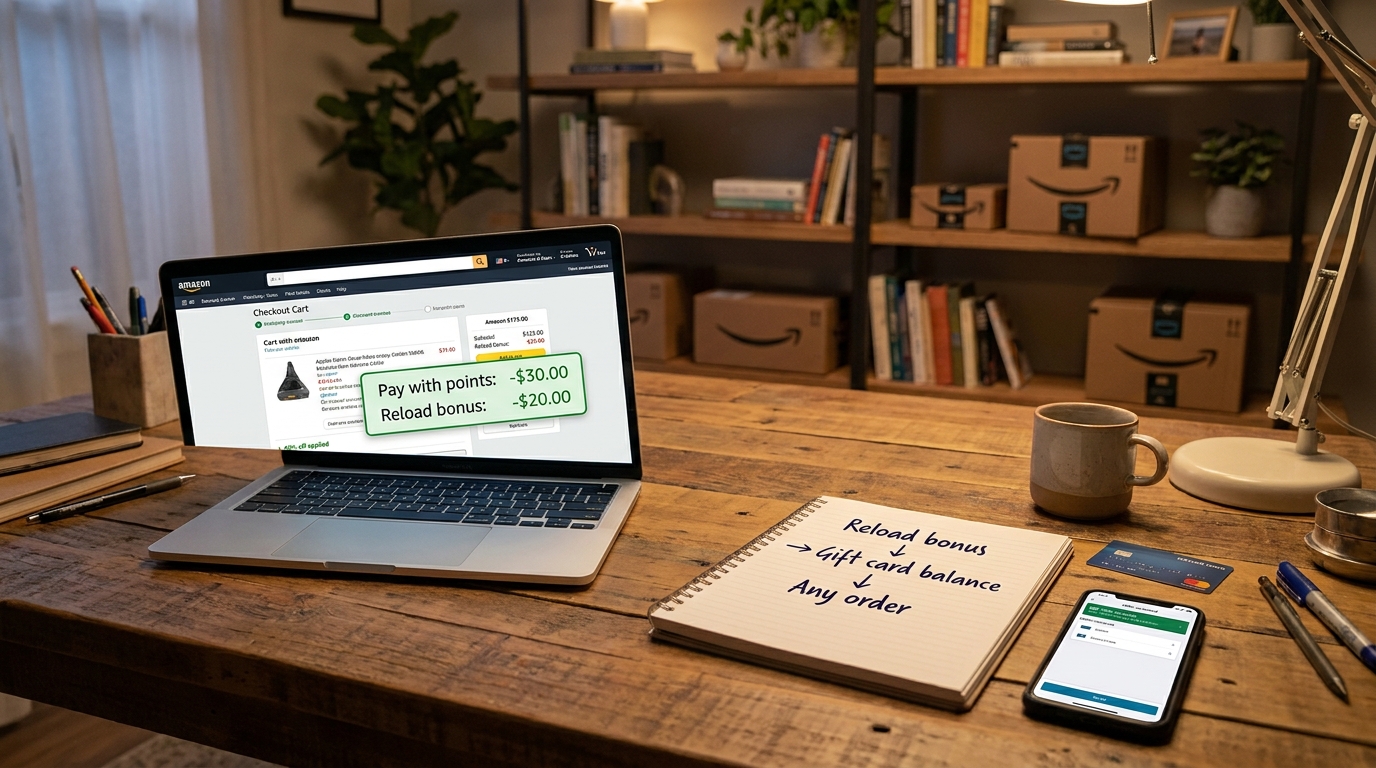
You are not crazy if Amazon discounts feel fake lately. You clip a coupon, open a browser extension, try a promo code from a deal post, and somehow your total barely changes. Meanwhile other people claim they got 30 or 40 percent off on the exact kind of stuff you buy. The annoying truth is that some of the best Amazon savings are not sitting on product pages at all. They are hidden inside gift card reload offers, pay-with-points promos, and tiny account-specific banners that most people never notice. That is where the so-called amazon reload bonus promo code hack comes in. It is less of a hack in the shady sense and more of a smart routine. You check whether Amazon or your card issuer offered you a reload bonus, trigger it, then use that balance or points discount on your real order. Done right, it can quietly turn a full-price cart into a meaningful discount on items you were already going to buy.
⚡ In a Hurry? Key Takeaways
- The “gift card reload loop” works by combining Amazon reload bonuses or pay-with-points offers with your normal purchase, often creating a private 20 to 40 percent discount.
- Before you shop, check your Amazon gift card reload page, your promotional banners, and any eligible card-linked “use 1 point, save” offers.
- Stick to official Amazon and bank offers only. This is best for planned purchases, not excuse-making for impulse buys.
What the “Gift Card Reload Loop” Actually Is
The name makes it sound more dramatic than it is.
Here is the basic idea. Amazon sometimes offers a bonus when you reload your gift card balance. Card issuers also sometimes offer a promo where using as little as 1 reward point can unlock a discount on an Amazon order. If you trigger one of those offers first, then place your order using the boosted balance or the points-linked discount, you have effectively made your own promo code.
That is why this works when public coupon codes do not. These offers are often attached to your account, not to the product listing.
Why Most Shoppers Miss It
Amazon does not exactly put a giant banner on every search result saying, “Hey, you personally qualify for extra money.”
These promos usually show up in quieter places:
- The gift card reload page
- Your Amazon messages or promo emails
- The checkout page after you add an eligible payment method
- A bank or card rewards page tied to Amazon Shop with Points
That is why one person swears Amazon has no deals, while another person quietly knocks 25 percent off a boring household order.
How the Reload Loop Works Step by Step
1. Check for a reload offer before adding items to cart
Go to your Amazon gift card balance or reload page and look for language like:
- Reload $100, get a $10 credit
- Add funds and earn a bonus
- Get a promotional credit after your first reload
Sometimes there is a minimum amount. Sometimes it is only for selected accounts. Sometimes it is only your first reload in a while.
2. Check for a pay-with-points deal
This is the other half of the loop that people miss. Card issuers like American Express, Discover, Chase, or Citi sometimes run Amazon offers such as:
- Use 1 point, get 20 percent off
- Use at least 1 Membership Rewards point, save up to $50
- Use rewards at checkout, get up to 40 percent off eligible items
The best version is the one-point trick. You use the smallest amount of points possible just to trigger the discount.
3. Link the right card and activate the offer
If your card rewards account is eligible, make sure that card is connected to your Amazon account. Then check the offer terms carefully. Some are account-wide. Some only work on sold-by-Amazon items. Some exclude gift cards, digital purchases, or subscriptions.
4. Reload only what you can use soon
This is important. The smart move is to reload an amount you know you will spend on Amazon anyway, not a random giant number because the word “bonus” made your pulse go up.
If you normally spend $50 to $150 a month on household stuff, pet supplies, batteries, or school items, keep the reload in that neighborhood.
5. Pay using the bonus path
Now place your order. Use the gift card balance you just loaded, or apply the minimum reward points needed to unlock the discount. That is the loop. Trigger benefit first, buy second.
A Real-World Example
Let’s say Amazon offers you a reload deal: add $100, get a $10 bonus credit.
Then your card issuer gives you a pay-with-points promo: use 1 point, get 20 percent off up to $20.
You buy $100 of things you already needed.
- You reload $100 and get $10 extra value
- You place a $100 order and get $20 off through the points promo
- Your effective savings can reach $30 on a $100 planned spend
That is where people start talking about 20 to 40 percent off. Not every account gets every offer, and not every category qualifies, but the math can be very real.
Where to Look for These Hidden Offers
If you want to try the amazon reload bonus promo code hack without wasting an hour, start here:
- Amazon Gift Card Reload page
- Your Amazon account messages and promotional emails
- The “Shop with Points” section after linking an eligible rewards card
- Your card issuer’s rewards portal
- The checkout page, especially payment and promo sections
Do not assume no banner means no offer. Sometimes the offer appears only after your eligible card is linked.
How to Build a Reusable Routine
The best part of this trick is that it is repeatable.
Before any medium or big Amazon order, run this quick checklist:
- Check gift card reload offers.
- Check Shop with Points offers.
- Add only items sold or fulfilled in ways that match the promo terms.
- Test the discount in cart before placing the order.
- Screenshot the offer in case the credit posts later.
That turns random luck into a habit.
If you like stacking methods, this pairs nicely with The “Cashback Ladder Stack” Hack: How To Turn One Amazon Order Into 3 Hidden Rebates In 5 Minutes, especially when a public coupon is weak but account-based promos are strong.
Common Gotchas That Kill the Discount
Eligible items matter
Some pay-with-points promos only work on items shipped and sold by Amazon. Marketplace sellers may not qualify.
The discount cap matters
“Save 40 percent” sounds huge until you see the cap is $20 or $30. Still useful, but know the ceiling.
Gift card reload bonuses can post later
Sometimes the bonus is instant. Sometimes it lands as a separate promotional credit after the reload is complete.
Rewards points can be a bad value if overused
If your points are worth more when used for travel or statement credits, only use the minimum amount required to trigger the Amazon offer.
These offers are often targeted
Your friend may get 40 percent off while you get nothing, or vice versa. That is normal, frustrating, and very Amazon.
Is This Safe and Legit?
Yes, if you stick to official offers shown by Amazon or your card issuer.
This is not about weird third-party codes, coupon generators, or sketchy browser pop-ups. It is just using the promos already tied to your account in a smarter order.
The only real risk is behavioral, not technical. If a bonus makes you buy more than you planned, the “deal” stops being a deal.
When This Trick Is Worth It, and When It Is Not
Worth it
- You already have a planned Amazon order
- You regularly buy essentials on Amazon
- You find a one-point promo or a meaningful reload bonus
- You are tired of fake coupon lists and want something real
Not worth it
- You would not normally spend that money on Amazon
- The reload amount is too high for your budget
- The promo only applies to stuff you do not need
- You would burn valuable rewards points beyond the minimum trigger amount
At a Glance: Comparison
| Feature/Aspect | Details | Verdict |
|---|---|---|
| Gift card reload bonuses | Targeted Amazon offers that add bonus credit or value when you reload a set amount. | Great if you already spend on Amazon and keep the reload modest. |
| Pay-with-points promos | Card-linked discounts like “use 1 point, save up to 40 percent,” often capped at a dollar limit. | Usually the best value when you use the minimum points needed. |
| Combined reload loop | Checking both offers before checkout can create a private discount stack on everyday orders. | Best overall move for shoppers who want real savings without chasing flaky promo codes. |
Conclusion
If Amazon has felt stingy lately, this is one of the few tricks that still feels grounded in reality. Right now Amazon and major card issuers are quietly handing out fresh reload and pay-with-points promos like “use 1 point, save up to 40 percent” or “reload and get an extra bonus credit,” but most shoppers never see them because they are buried in small banners and emails instead of on the product pages where people actually look. Once you get in the habit of checking for these first, you are basically making your own private promo code that works on a lot more than the flashy deal posts do. And in a week full of fake code lists and creator promos that disappear before checkout, building a simple reload loop that quietly cuts 20 to 40 percent off a real cart is about as close to an easy win as online shopping gets.