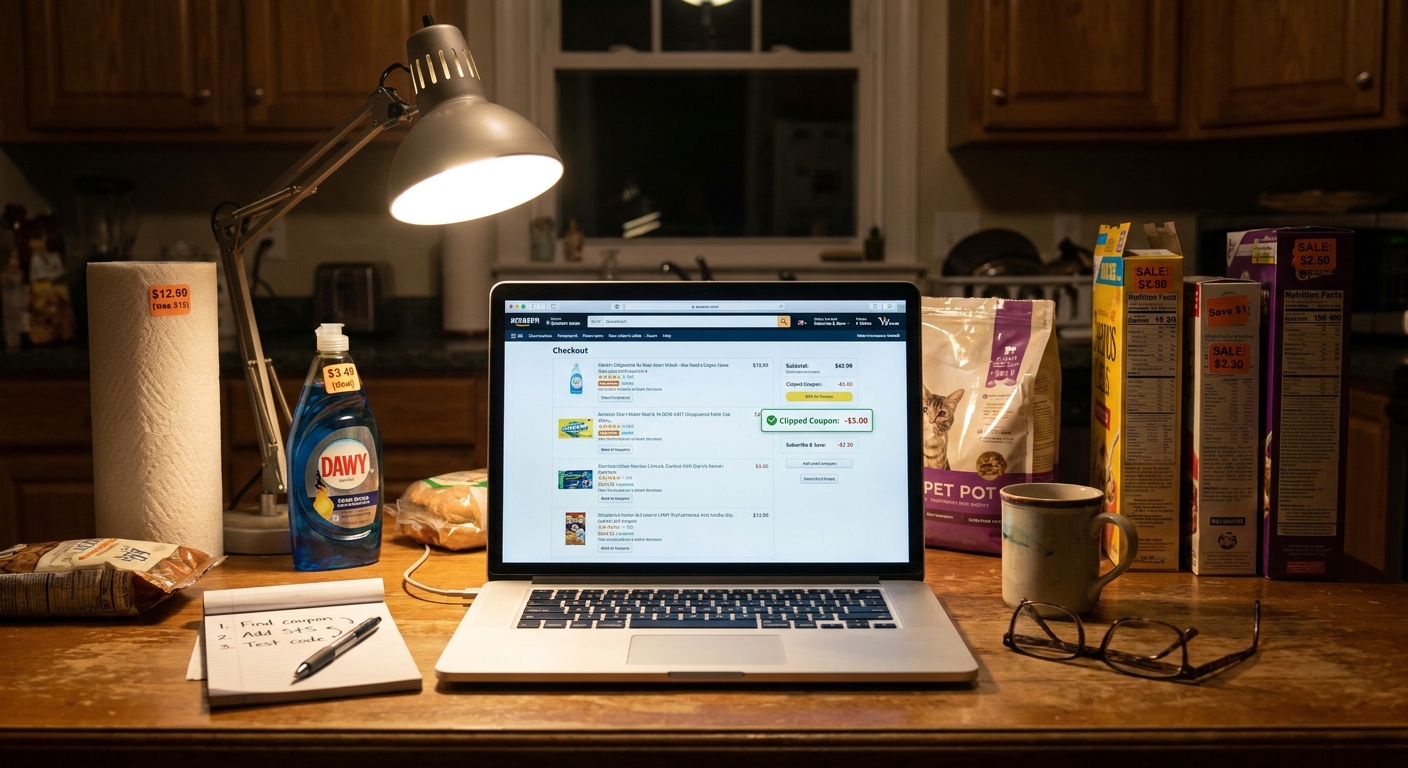
You are not wrong to feel a little tricked by Amazon pricing. You spot a Subscribe & Save discount, feel good about it, then later notice a tiny coupon box, a promo banner, or a code tucked into the product page that could have knocked the price down even more. It is annoying, especially when you are buying boring but necessary stuff like laundry pods, dog treats, coffee, vitamins, or paper towels. The good news is that there really is a repeatable system here. The best deals often come from stacking three separate savings on the same item: the base sale price, a clipped coupon or promo code, and the Subscribe & Save discount. When all three line up, the math can get surprisingly good. Right now, with Prime Day-style promos already showing up early, this amazon subscribe and save stacking coupons hack can cut 30 to 60 percent off things you were going to buy anyway.
⚡ In a Hurry? Key Takeaways
- The best Amazon savings often come from stacking three discounts at once: sale price, coupon or promo, and Subscribe & Save.
- Always check the product page for a coupon checkbox and any extra promo text before you hit Subscribe & Save.
- Do the final math in checkout, because some codes do not stack and some “deals” are weaker than a simple one-time purchase.
How the triple stack actually works
Think of Amazon discounts like three separate doors. If all three are open, you walk through each one and your price keeps dropping.
Stack layer 1: The sale price
This is the easiest one to see. Maybe the item is already marked down for a limited time, or it has a Prime-exclusive price, or it is sitting in a category promo.
Stack layer 2: The coupon or promo
This is the one people miss most often. Sometimes it is a green coupon checkbox under the price. Sometimes it is a promo line on the page that says something like “Save an extra 20% when you apply.” Sometimes there is a code in the listing.
If you want a deeper look at this part, read The ‘Hidden Checkbox’ Hack: How Amazon’s Quiet Coupons Stack With Promo Codes For Double Discounts. It explains why that tiny checkbox matters so much.
Stack layer 3: Subscribe & Save
This is the recurring discount. Usually it is 5 percent. Sometimes it jumps to 10 or 15 percent, especially on household basics, baby items, pantry staples, and pet supplies. On some products, Amazon pushes this harder during major sale periods.
The step-by-step playbook
1. Start with products you already buy regularly
This hack works best on things you know you will use. Dishwasher tablets. Protein shakes. Cat litter. Razors. Trash bags. Not random gadgets you only want because the percentage looks big.
2. Check the one-time price first
Open the product page and look at the regular buy-now price. If it is already on sale, great. That becomes your base.
3. Hunt for the quiet coupon
Look right under the price and delivery info. If there is a coupon checkbox, clip it. Then scan a little lower for promo text or limited-time discount notes.
4. Switch to Subscribe & Save
Now compare the Subscribe & Save option. Amazon will usually show the discount percentage right there. Select the delivery schedule, but do not assume the number on the page tells the whole story.
5. Add it to your cart and check the real total
This is where the truth shows up. In your cart or at checkout, you can see whether the coupon stayed attached and whether any promo came off correctly. If one part disappears, the stack may not be real.
6. Compare against one-time purchase
Sometimes the one-time deal plus coupon is better than Subscribe & Save. It happens. The whole point is to use the option with the lower final price, not the one with the prettier badge.
7. Cancel later if you only want the first shipment
This is the part many shoppers forget. After your order ships, you can go into your Subscribe & Save settings and cancel future deliveries if you do not need a repeat order. Amazon allows this. Just do not forget to do it.
What a real triple stack can look like
Let’s say a household cleaner normally sells for $24.
The current sale price drops it to $19.20. Then there is a clipped 20 percent coupon, which cuts another $3.84. Then Subscribe & Save takes another 10 percent off the remaining price. Suddenly your final cost is much closer to the low teens than the original $24.
That is why this works so well during busy sale periods. Amazon is mixing temporary markdowns with category coupons and recurring-order discounts at the same time. If you catch all three, the savings can get very real.
Where this hack works best
You will usually have the best luck in a few categories:
- Groceries and pantry refills
- Pet food, treats, and litter
- Cleaning supplies
- Paper goods
- Baby products
- Health and personal care items
These are the categories Amazon loves to push with rotating coupons and repeat-delivery incentives.
Common mistakes that ruin the deal
Forgetting to clip the coupon
This is the classic miss. The discount does not apply itself just because you saw it.
Not reading the promo fine print
Some promos only work on the first Subscribe & Save order. Some need a minimum quantity. Some are for select account holders.
Buying the wrong size or variation
The coupon might apply only to the lemon scent, the 32-count box, or the pack of two. Amazon listings are messy like that.
Trusting the percentage instead of the final number
“Save 15%” sounds better than it sometimes is. Always compare the final checkout price.
Leaving unwanted subscriptions running
If you used Subscribe & Save as a one-time savings tool, put a reminder in your phone to cancel after shipment.
How to tell if a deal is actually good
A big percentage does not automatically mean a smart buy. Ask three simple questions:
- Is this something I buy anyway?
- Is the final price lower than recent sale prices?
- Will I remember to manage the subscription if I do not want repeats?
If the answer is yes to all three, you probably have a winner.
At a Glance: Comparison
| Feature/Aspect | Details | Verdict |
|---|---|---|
| Best stack combo | Sale price + clipped coupon or promo + Subscribe & Save discount | Usually the strongest setup |
| Where it works best | Groceries, pet supplies, paper goods, cleaning items, personal care | Great for repeat essentials |
| Biggest risk | Missing a coupon, using the wrong product variation, or forgetting to cancel a future shipment | Easy to avoid with a quick checkout check |
Conclusion
Amazon makes discounts feel more confusing than they need to be. That is the frustrating part. But once you know where the savings hide, the system gets easier. Start with the sale price. Clip every relevant coupon. Then test Subscribe & Save and confirm the final total in checkout. That simple routine is the amazon subscribe and save stacking coupons hack in plain English. With Prime Day-style sales already heating up, Amazon is quietly pushing aggressive category promos and short-lived codes on top of standard Subscribe & Save offers. If you use this playbook on real monthly essentials, you can shave 30 to 60 percent off groceries, pet supplies, and household refills without wasting time on dead codes or flashy one-off deals. Better yet, it is a repeatable habit you can use all year, not just during the big sale weeks.